
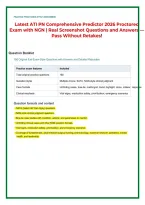
PRACTICE PROCTORED-STYLE ASSESSMENT
Latest ATI PN Comprehensive Predictor 2026 Proctored
Exam with NGN | Real Screenshot Questions and Answers —
Pass Without Retakes!
Question Booklet
180 Original Exit-Exam-Style Questions with Answers and Detailed Rationales
Practice exam features Included
Total original practice questions 180
Question styles Multiple choice, SATA, NGN-style clinical judgment
Case formats Unfolding cases, bow-tie, matrix/grid, trend, highlight, cloze, ordered response
Clinical emphasis Vital signs, medication safety, prioritization, emergency scenarios
Question formats and content
• SATA (Select All That Apply) questions.
• NGN-style clinical judgment questions.
• Bow-tie case studies with condition, actions, and parameters to monitor.
• Unfolding clinical cases and other NGN question formats.
• Vital signs, medication safety, prioritization, and emergency scenarios.
• Coverage of fundamentals, adult medical-surgical nursing, pharmacology, maternal-newborn, pediatrics, mental
health, and leadership.
, Vital Signs & Assessment Reference
Typical adult resting reference ranges: temperature approximately 36.0–38.0°C (96.8–100.4°F), pulse
60–100/min, respirations 12–20/min, blood pressure commonly around 90/60 to below 120/80 mmHg, and oxygen
saturation often 95–100% at sea level in a healthy adult. Interpret values in context; baseline, age, pregnancy,
altitude, chronic disease, medications, and symptoms can change what is expected. A single value is not a
diagnosis.
Escalate promptly: severe respiratory distress, new altered mental status, chest pain, signs of shock, rapidly
falling oxygen saturation, or vital signs outside ordered parameters. Use the facility's escalation protocol.
Practice Exam
Choose the best answer unless the item says SATA. Read the rationale after selecting your response.
Fundamentals, Safety & Infection Prevention
1. A nurse is preparing to transfer a client from bed to chair. Which action best reduces injury risk?
A. Ask the client to hold the nurse’s neck
B. Lock the bed and chair wheels and use a gait belt if indicated
C. Keep the chair several feet away
D. Pull the client up by the arms
Correct answer: B
Rationale: Locking wheels stabilizes the equipment. A gait belt and appropriate body mechanics support a safer transfer;
pulling on the arms or neck can injure the client and nurse.
2. Which action is most effective for preventing transmission of infection in routine care?
A. Wear sterile gloves for every task
B. Perform hand hygiene at the indicated moments
C. Keep the room door closed
D. Use antibiotics prophylactically
Correct answer: B
Rationale: Hand hygiene is a core infection-prevention measure. Gloves do not replace hand hygiene, and sterile technique is
reserved for procedures that require it.
3. A client on contact precautions has a draining wound caused by a multidrug-resistant organism. Which PPE is
generally indicated on room entry?
A. Gloves and gown
B. Surgical mask only
C. N95 respirator only
D. Shoe covers only
Correct answer: A
Rationale: Contact precautions generally require gown and gloves when contact with the client or environment is anticipated.
Follow organism-specific and facility guidance.
Original PN Practice Exam • Educational use Page 2
, 4. A nurse finds a client on the floor beside the bed. What should the nurse do first?
A. Immediately lift the client into bed
B. Assess responsiveness, breathing, and injury before moving
C. Complete an incident report
D. Leave to find the family
Correct answer: B
Rationale: First assess the client for immediate threats and possible injury. Do not move the client until injury is assessed
unless the location presents an immediate danger.
5. Which statement by a client using home oxygen requires correction?
A. “I will keep oxygen away from flames.”
B. “I will not smoke near the equipment.”
C. “I can use petroleum jelly inside my nostrils.”
D. “I will secure cylinders upright.”
Correct answer: C
Rationale: Petroleum-based products can increase fire risk around oxygen. Use a water-based lubricant if approved and keep
oxygen away from heat, flames, and smoking.
6. SATA: Which actions help prevent pressure injuries? Select all that apply.
A. Reposition based on individualized risk and tolerance
B. Keep skin clean and manage moisture
C. Massage reddened bony prominences vigorously
D. Use pressure-redistributing surfaces when indicated
E. Assess nutrition and hydration
Correct answer: A, B, D, E
Rationale: Repositioning, moisture management, appropriate support surfaces, and nutrition/hydration support skin integrity.
Do not massage persistent redness over bony areas because tissue damage may worsen.
7. A client with suspected pulmonary tuberculosis is admitted. Which precautions are appropriate?
A. Contact precautions only
B. Droplet precautions and surgical mask for staff
C. Airborne precautions in an appropriate room and fit-tested respirator
D. Protective isolation
Correct answer: C
Rationale: Suspected infectious pulmonary TB requires airborne precautions, typically an airborne infection isolation room and
a fit-tested N95 or higher-level respirator according to policy.
8. A nurse is about to administer medication but notices the client’s identification band is missing. What is the
best action?
A. Ask the roommate to identify the client
B. Use the room number
C. Pause and verify identity using approved identifiers and replace the band per policy
D. Give the medication if the client states their name
Correct answer: C
Rationale: Medication administration requires approved client identifiers. Room number is not an identifier; follow policy to
establish identity before proceeding.
Original PN Practice Exam • Educational use Page 3
, 9. Which task is appropriate to delegate to assistive personnel for a stable client?
A. Initial assessment of new chest pain
B. Teaching insulin injection
C. Measuring and recording routine vital signs
D. Evaluating response to analgesia
Correct answer: C
Rationale: Routine vital-sign collection for a stable client may be delegated when permitted. Assessment, teaching, and
evaluation require nursing judgment.
10. A client reports dizziness when standing. Which action is safest?
A. Encourage rapid position changes
B. Assist the client to sit or lie down and assess vital signs
C. Leave the client standing while obtaining supplies
D. Restrict fluids without an order
Correct answer: B
Rationale: Prevent a fall first, then assess orthostatic symptoms and vital signs and report findings as indicated.
Vital Signs, Physical Assessment & Clinical Judgment
11. An adult has a respiratory rate of 8/min and is difficult to arouse after receiving an opioid. What is the priority
action?
A. Document expected sedation
B. Support airway and breathing, stimulate, call for urgent help, and follow opioid-reversal protocol
C. Offer oral fluids
D. Reassess in one hour
Correct answer: B
Rationale: Bradypnea with reduced responsiveness may indicate opioid-induced respiratory depression. Immediate
airway/breathing support and urgent escalation are priorities; naloxone may be indicated under protocol/order.
12. A client’s blood pressure is 84/50 mmHg, pulse 124/min, skin cool and clammy. Which interpretation is most
appropriate?
A. Expected response to rest
B. Possible poor perfusion/shock requiring urgent assessment
C. Isolated hypertension
D. Normal aging
Correct answer: B
Rationale: Hypotension, tachycardia, and cool clammy skin are concerning for impaired perfusion. Prompt assessment and
escalation are required.
13. Which technique is correct when measuring an adult’s blood pressure?
A. Use a cuff that is too small
B. Place the cuff over thick clothing
C. Support the arm at heart level with an appropriately sized cuff
D. Allow the arm to hang unsupported
Correct answer: C
Rationale: Correct cuff size, bare skin, and arm support at heart level improve accuracy. A cuff that is too small can falsely
elevate the reading.
Original PN Practice Exam • Educational use Page 4


