
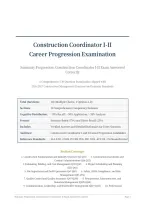
Construction Coordinator I-II
Career Progression Examination
Summary Progression: Construction Coordinator I-II Exam Answered
Correctly
A Comprehensive 130-Question Examination Aligned with
2026/2027 Construction Management Practices and Industry Standards
Total Questions: 130 (Multiple Choice, 4 Options A-D)
Sections: 10 Comprehensive Competency Domains
Cognitive Distribution: ~30% Recall / ~50% Application / ~20% Analysis
Format: Scenario-Based (75%) and Direct Recall (25%)
Includes: Verified Answers and Detailed Rationales for Every Question
Audience: Construction Coordinator I and II Career Progression Candidates
Reference Standards: AIA A201, OSHA 29 CFR 1926, IBC 2024, ACI 318, CSI MasterFormat
Section Coverage:
1. Construction Fundamentals and Industry Overview (Q1-Q15) • 2. Construction Documents and
Contract Administration (Q16-Q32)
3. Estimating, Bidding, and Cost Management (Q33-Q50) • 4. Project Scheduling and Planning
(Q51-Q66)
5. Site Supervision and Field Operations (Q67-Q82) • 6. Safety, OSHA Compliance, and Risk
Management (Q83-Q96)
7. Quality Control and Quality Assurance (Q97-Q108) • 8. Procurement, Subcontractors, and
Materials Management (Q109-Q118)
9. Communication, Leadership, and Stakeholder Management (Q119-Q125) • 10. Professional
Summary Progression: Construction Coordinator I-II Exam Answered Correctly Page 1
,Construction Coordinator I-II Career Progression Examination 2026/2027 Industry Standards
Practice, Ethics, and Career Progression (Q126-Q130)
COMPLETE EXAM - 130 Questions with Verified Answers and Detailed Rationales
Summary Progression: Construction Coordinator I-II Exam Answered Correctly Page 2
,Construction Coordinator I-II Career Progression Examination 2026/2027 Industry Standards
Section 1: Construction Fundamentals and Industry
Overview
Construction Types, Project Delivery Methods, and Industry Roles (Q1-Q15)
Q1: A construction coordinator is reviewing a project portfolio that includes a 32-story
office tower, a 4-lane highway expansion, a single-family residence, and a 200-MW solar
farm. Which classification BEST describes the highway expansion?
A. Residential construction, because it serves public use
B. Commercial construction, because it is publicly funded
C. Heavy civil and infrastructure construction, because it involves transportation systems
and public works [CORRECT]
D. Industrial construction, because it requires engineered materials
Correct Answer: C
Rationale: Highway expansion is classified as heavy civil/infrastructure construction because it
involves transportation systems, public works, earthwork, paving, and bridges. Residential serves
dwelling units, commercial serves business occupancy, and industrial serves manufacturing or
energy production. The 200-MW solar farm would be industrial; the office tower is commercial; the
residence is residential.
Q2: An owner wants to accelerate delivery by overlapping design and construction, with a
single contract for both. Which project delivery method BEST fits this goal?
A. Design-Bid-Build (DBB), because it provides the lowest bid price
B. Design-Build (DB), because one entity holds both design and construction contracts,
enabling overlapping phases [CORRECT]
C. Construction Manager at Risk (CMAR), because the CM converts to a GMP midway
D. Integrated Project Delivery (IPD), because it requires a multi-party agreement
Correct Answer: B
Rationale: Design-Build uses a single contract covering both design and construction, allowing
overlap of phases and a single point of accountability, which is exactly the owner's goal. DBB
requires fully complete design before bidding (no overlap). CMAR uses a CM who later converts to
GMP but design and construction are still separate contracts. IPD uses a multi-party agreement
with shared risk/reward, not a single contract.
Q3: Under Design-Bid-Build (DBB) delivery, who holds the contractual privity with the
general contractor, and what is the architect's role during construction?
A. The architect holds privity with the GC; the owner has only an advisory role
B. The owner holds privity with the GC; the architect serves as the owner's representative
interpreting contract documents [CORRECT]
C. The engineer holds privity with the GC; the architect supervises the trades directly
D. The subcontractors hold privity with the GC; the architect has no construction role
Correct Answer: B
Summary Progression: Construction Coordinator I-II Exam Answered Correctly Page 3
, Construction Coordinator I-II Career Progression Examination 2026/2027 Industry Standards
Rationale: Under DBB, the owner holds the prime contract directly with the GC, while the architect
acts as the owner's representative to interpret the contract documents, respond to RFIs, certify
payment applications, and verify conformance. The architect does not supervise trades or direct
means/methods. Subcontractors hold privity with the GC, not the owner.
Q4: A Construction Manager at Risk (CMAR) project has reached the GMP stage. What
does the CM's conversion to a Guaranteed Maximum Price (GMP) signify?
A. The CM becomes a purely advisory consultant with no construction responsibility
B. The CM takes on financial risk for construction costs exceeding the GMP, similar to a GC,
while retaining preconstruction services input [CORRECT]
C. The owner absorbs all cost overruns above the GMP
D. The architect becomes responsible for trade coordination
Correct Answer: B
Rationale: In CMAR, the CM provides preconstruction services (estimating, value engineering,
constructability) as a consultant, then converts to a builder role at the GMP stage. Once the GMP is
set, the CM bears the risk for costs exceeding the GMP, similar to a GC under a lump-sum contract,
while savings below the GMP are typically shared per the contract.
Q5: Which statement BEST describes the difference between Type I and Type V
construction per the International Building Code (IBC)?
A. Type I is wood-frame; Type V is non-combustible with protected steel
B. Type I is non-combustible, fire-resistive construction (typically high-rise); Type V is
combustible construction allowing wood framing throughout [CORRECT]
C. Type I requires combustible materials; Type V prohibits all combustibles
D. Type I and Type V differ only in height limits, not materials
Correct Answer: B
Rationale: Per IBC, Type I construction is non-combustible, fire-resistive construction used in
high-rises and large buildings, requiring protected steel and concrete with high fire-resistance
ratings. Type V construction permits combustible materials, including wood framing throughout,
and is common in residential and small commercial buildings. Types II, III, and IV fall between
these extremes.
Q6: On an Integrated Project Delivery (IPD) project, the owner, architect, and GC sign a
single multi-party agreement. Which principle is UNIQUE to IPD compared to DBB or
CMAR?
A. The GC bids against other contractors for the work
B. The parties share risk and reward through a jointly developed target cost, with shared
savings and shared overrun up to a cap [CORRECT]
C. The architect has final authority over all change orders without owner input
D. The subcontractors are paid directly by the owner
Correct Answer: B
Rationale: IPD is defined by a multi-party agreement with shared risk/reward tied to a jointly
developed target cost. Savings below the target are shared, and overruns are shared up to a cap,
aligning all parties' interests. DBB and CMAR do not use this shared-risk model. The architect does
Summary Progression: Construction Coordinator I-II Exam Answered Correctly Page 4
Career Progression Examination
Summary Progression: Construction Coordinator I-II Exam Answered
Correctly
A Comprehensive 130-Question Examination Aligned with
2026/2027 Construction Management Practices and Industry Standards
Total Questions: 130 (Multiple Choice, 4 Options A-D)
Sections: 10 Comprehensive Competency Domains
Cognitive Distribution: ~30% Recall / ~50% Application / ~20% Analysis
Format: Scenario-Based (75%) and Direct Recall (25%)
Includes: Verified Answers and Detailed Rationales for Every Question
Audience: Construction Coordinator I and II Career Progression Candidates
Reference Standards: AIA A201, OSHA 29 CFR 1926, IBC 2024, ACI 318, CSI MasterFormat
Section Coverage:
1. Construction Fundamentals and Industry Overview (Q1-Q15) • 2. Construction Documents and
Contract Administration (Q16-Q32)
3. Estimating, Bidding, and Cost Management (Q33-Q50) • 4. Project Scheduling and Planning
(Q51-Q66)
5. Site Supervision and Field Operations (Q67-Q82) • 6. Safety, OSHA Compliance, and Risk
Management (Q83-Q96)
7. Quality Control and Quality Assurance (Q97-Q108) • 8. Procurement, Subcontractors, and
Materials Management (Q109-Q118)
9. Communication, Leadership, and Stakeholder Management (Q119-Q125) • 10. Professional
Summary Progression: Construction Coordinator I-II Exam Answered Correctly Page 1
,Construction Coordinator I-II Career Progression Examination 2026/2027 Industry Standards
Practice, Ethics, and Career Progression (Q126-Q130)
COMPLETE EXAM - 130 Questions with Verified Answers and Detailed Rationales
Summary Progression: Construction Coordinator I-II Exam Answered Correctly Page 2
,Construction Coordinator I-II Career Progression Examination 2026/2027 Industry Standards
Section 1: Construction Fundamentals and Industry
Overview
Construction Types, Project Delivery Methods, and Industry Roles (Q1-Q15)
Q1: A construction coordinator is reviewing a project portfolio that includes a 32-story
office tower, a 4-lane highway expansion, a single-family residence, and a 200-MW solar
farm. Which classification BEST describes the highway expansion?
A. Residential construction, because it serves public use
B. Commercial construction, because it is publicly funded
C. Heavy civil and infrastructure construction, because it involves transportation systems
and public works [CORRECT]
D. Industrial construction, because it requires engineered materials
Correct Answer: C
Rationale: Highway expansion is classified as heavy civil/infrastructure construction because it
involves transportation systems, public works, earthwork, paving, and bridges. Residential serves
dwelling units, commercial serves business occupancy, and industrial serves manufacturing or
energy production. The 200-MW solar farm would be industrial; the office tower is commercial; the
residence is residential.
Q2: An owner wants to accelerate delivery by overlapping design and construction, with a
single contract for both. Which project delivery method BEST fits this goal?
A. Design-Bid-Build (DBB), because it provides the lowest bid price
B. Design-Build (DB), because one entity holds both design and construction contracts,
enabling overlapping phases [CORRECT]
C. Construction Manager at Risk (CMAR), because the CM converts to a GMP midway
D. Integrated Project Delivery (IPD), because it requires a multi-party agreement
Correct Answer: B
Rationale: Design-Build uses a single contract covering both design and construction, allowing
overlap of phases and a single point of accountability, which is exactly the owner's goal. DBB
requires fully complete design before bidding (no overlap). CMAR uses a CM who later converts to
GMP but design and construction are still separate contracts. IPD uses a multi-party agreement
with shared risk/reward, not a single contract.
Q3: Under Design-Bid-Build (DBB) delivery, who holds the contractual privity with the
general contractor, and what is the architect's role during construction?
A. The architect holds privity with the GC; the owner has only an advisory role
B. The owner holds privity with the GC; the architect serves as the owner's representative
interpreting contract documents [CORRECT]
C. The engineer holds privity with the GC; the architect supervises the trades directly
D. The subcontractors hold privity with the GC; the architect has no construction role
Correct Answer: B
Summary Progression: Construction Coordinator I-II Exam Answered Correctly Page 3
, Construction Coordinator I-II Career Progression Examination 2026/2027 Industry Standards
Rationale: Under DBB, the owner holds the prime contract directly with the GC, while the architect
acts as the owner's representative to interpret the contract documents, respond to RFIs, certify
payment applications, and verify conformance. The architect does not supervise trades or direct
means/methods. Subcontractors hold privity with the GC, not the owner.
Q4: A Construction Manager at Risk (CMAR) project has reached the GMP stage. What
does the CM's conversion to a Guaranteed Maximum Price (GMP) signify?
A. The CM becomes a purely advisory consultant with no construction responsibility
B. The CM takes on financial risk for construction costs exceeding the GMP, similar to a GC,
while retaining preconstruction services input [CORRECT]
C. The owner absorbs all cost overruns above the GMP
D. The architect becomes responsible for trade coordination
Correct Answer: B
Rationale: In CMAR, the CM provides preconstruction services (estimating, value engineering,
constructability) as a consultant, then converts to a builder role at the GMP stage. Once the GMP is
set, the CM bears the risk for costs exceeding the GMP, similar to a GC under a lump-sum contract,
while savings below the GMP are typically shared per the contract.
Q5: Which statement BEST describes the difference between Type I and Type V
construction per the International Building Code (IBC)?
A. Type I is wood-frame; Type V is non-combustible with protected steel
B. Type I is non-combustible, fire-resistive construction (typically high-rise); Type V is
combustible construction allowing wood framing throughout [CORRECT]
C. Type I requires combustible materials; Type V prohibits all combustibles
D. Type I and Type V differ only in height limits, not materials
Correct Answer: B
Rationale: Per IBC, Type I construction is non-combustible, fire-resistive construction used in
high-rises and large buildings, requiring protected steel and concrete with high fire-resistance
ratings. Type V construction permits combustible materials, including wood framing throughout,
and is common in residential and small commercial buildings. Types II, III, and IV fall between
these extremes.
Q6: On an Integrated Project Delivery (IPD) project, the owner, architect, and GC sign a
single multi-party agreement. Which principle is UNIQUE to IPD compared to DBB or
CMAR?
A. The GC bids against other contractors for the work
B. The parties share risk and reward through a jointly developed target cost, with shared
savings and shared overrun up to a cap [CORRECT]
C. The architect has final authority over all change orders without owner input
D. The subcontractors are paid directly by the owner
Correct Answer: B
Rationale: IPD is defined by a multi-party agreement with shared risk/reward tied to a jointly
developed target cost. Savings below the target are shared, and overruns are shared up to a cap,
aligning all parties' interests. DBB and CMAR do not use this shared-risk model. The architect does
Summary Progression: Construction Coordinator I-II Exam Answered Correctly Page 4


