
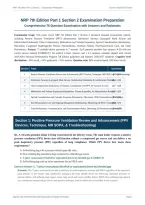
NRP 7th Edition Part 1 Section 2 - Examination Preparation Summer 2026/2027 Edition
NRP 7th Edition Part 1 Section 2 Examination Preparation
Comprehensive 75-Question Examination with Answers and Rationales
Examination Scope: This exam covers NRP 7th Edition Part 1 Section 2 advanced neonatal resuscitation content,
including Positive Pressure Ventilation (PPV) advancement, Alternative Airways (Laryngeal Mask Airway and
Endotracheal Intubation), Chest Compressions, Medications and Volume Expansion, Special Considerations (Prematurity,
Meconium, Congenital Diaphragmatic Hernia, Pneumothorax, Hydrops Fetalis), Post-Resuscitation Care, and Team
Performance. Format: 75 multiple-choice questions in 7 sections. Each question provides four options (A-D) with one
correct answer marked [CORRECT], the explicit Correct Answer, and a 2-3 sentence rationale aligned with current
AAP/AHA Neonatal Resuscitation Program 7th Edition guidelines and Summer 2026/2027 standards. Cognitive level
distribution: ~30% recall, ~55% application, ~15% analysis. Question style: 80% scenario-based, 20% direct recall.
Section Topic Questions
1 Positive Pressure Ventilation Review and Advancement (PPV Devices, Technique, MR SOPA, Q1
& Troubleshooting)
- Q12
2 Alternative Airways (Laryngeal Mask Airway, Endotracheal Intubation, & Confirmation Methods)
Q13 - Q26
3 Chest Compressions (Indications, Technique, Coordination with PPV, & Vascular Access) Q27 - Q38
4 Medications and Volume Expansion (Epinephrine, Volume Expanders, & Administration Routes)
Q39 - Q50
5 Special Considerations and Complex Scenarios (Prematurity, Meconium, CDH, Pneumothorax,Q51
& Hydrops)
- Q62
6 Post-Resuscitation Care and Ongoing Management (Stabilization, Monitoring, & NICU Transition)
Q63 - Q70
7 Team Performance, Communication, and Documentation (Roles, Debriefing, & DocumentationQ71
Standards)
- Q75
Section 1: Positive Pressure Ventilation Review and Advancement (PPV
Devices, Technique, MR SOPA, & Troubleshooting)
Q1. A 34-week gestation infant is being resuscitated in the delivery room. The team leader requests a positive
pressure ventilation (PPV) device that will function without a compressed gas source and can deliver a set
peak inspiratory pressure (PIP) regardless of lung compliance. Which PPV device best meets these
requirements?
A. Self-inflating bag with a pressure-release (pop-off) valve
B. Flow-inflating bag (anesthesia bag) connected to a blended gas source
C. T-piece resuscitator (NeoPuff or equivalent) driven by blended gas [CORRECT]
D. Self-inflating bag with an inline manometer but no PEEP valve
Correct Answer: C. T-piece resuscitator (NeoPuff or equivalent) driven by blended gas
Rationale: The T-piece resuscitator provides a precisely set peak inspiratory pressure and PEEP regardless of the operator's
hand pressure or the infant's lung compliance, making it the most reliable device for delivering consistent pressures in
preterm infants. Self-inflating bags require active lung recoil and cannot reliably deliver PEEP; flow-inflating bags depend
on a continuous compressed gas source and operator technique, both of which are not available in this scenario.
Aligned with AAP/AHA Neonatal Resuscitation Program 7th Edition Page 1
,NRP 7th Edition Part 1 Section 2 - Examination Preparation Summer 2026/2027 Edition
Q2. A labor and delivery unit is restocking its resuscitation equipment. The charge nurse asks which device is
mandatory for the resuscitation area because it is the ONLY PPV device that functions without a compressed
gas source. Which device should be stocked to satisfy this requirement?
A. Flow-inflating bag (anesthesia bag)
B. T-piece resuscitator
C. Self-inflating bag (240 mL or larger, with pop-off valve and PEEP valve) [CORRECT]
D. Mapleson D circuit with a reservoir tube
Correct Answer: C. Self-inflating bag (240 mL or larger, with pop-off valve and PEEP valve)
Rationale: The self-inflating bag is the only PPV device that does not require a compressed gas source to function because
the bag re-expands automatically after compression due to its internal spring mechanism. Flow-inflating bags and T-piece
resuscitators both require a continuous gas flow to function. NRP 7th Edition requires at least one self-inflating bag in every
delivery setting as a backup in case of gas source failure.
Q3. A 28-week preterm infant is receiving PPV via T-piece resuscitator. The initial PIP is set at 20 cm H2O
and PEEP at 5 cm H2O. After 30 seconds, the heart rate is 90 bpm, oxygen saturation is 60% (target
65%-70% at 5 minutes), and there is minimal chest rise. What is the most appropriate next step?
A. Increase the PIP by 5-10 cm H2O and reassess chest rise and heart rate [CORRECT]
B. Switch immediately to a self-inflating bag with a pop-off valve
C. Begin chest compressions at 90/min synchronized 3:1 with PPV
D. Increase the oxygen concentration to 100% and continue at the same PIP
Correct Answer: A. Increase the PIP by 5-10 cm H2O and reassess chest rise and heart rate
Rationale: When PPV produces inadequate chest rise and persistent bradycardia, the priority is to optimize ventilation by
increasing inspiratory pressure in 5-10 cm H2O increments until visible chest rise is achieved. NRP 7th Edition emphasizes
that most neonatal bradycardia is caused by inadequate ventilation rather than cardiac pathology. Switching devices or
starting compressions prematurely without first ensuring effective ventilation is inappropriate.
Q4. During PPV with a face mask, the team notes bilateral air entry but persistent air leak around the mouth
corners. Which component of the MR SOPA corrective steps should the team address FIRST?
A. Reposition the head (R in MR SOPA)
B. Suction the mouth and nose (S in MR SOPA)
C. Adjust the mask placement (M in MR SOPA) [CORRECT]
D. Open the mouth slightly (O in MR SOPA)
Correct Answer: C. Adjust the mask placement (M in MR SOPA)
Rationale: MR SOPA is performed in the strict order M, R, S, O, P, A. The first step (M) is mask adjustment, which
includes repositioning the mask on the face to maximize the seal and eliminate visible air leaks. Repositioning the head (R),
suctioning (S), opening the mouth (O), increasing pressure (P), and considering an alternative airway (A) follow in sequence
only if mask adjustment does not resolve the ventilation problem.
Aligned with AAP/AHA Neonatal Resuscitation Program 7th Edition Page 2
, NRP 7th Edition Part 1 Section 2 - Examination Preparation Summer 2026/2027 Edition
Q5. A term infant born via emergency cesarean section for non-reassuring fetal heart rate is apneic and limp
at birth. The team provides PPV at 40 breaths per minute via a self-inflating bag. The most recent NRP 7th
Edition guideline recommends a ventilation rate of:
A. 20-30 breaths per minute
B. 40-60 breaths per minute [CORRECT]
C. 60-80 breaths per minute
D. 90 breaths per minute synchronized 3:1 with compressions
Correct Answer: B. 40-60 breaths per minute
Rationale: NRP 7th Edition recommends a PPV rate of 40-60 breaths per minute, which translates to one breath every
1.0-1.5 seconds with a 1-second inspiratory time. This rate optimizes alveolar ventilation while allowing adequate exhalation
time to prevent air trapping. A rate of 90/min is reserved for chest compression coordination (3:1 ratio yielding 30 breaths
and 90 compressions per minute).
Q6. You are ventilating a term infant with inadequate chest rise. The MR SOPA sequence has been initiated.
After mask adjustment (M), the air leak persists. What is the next correct step?
A. Reposition the head to a slightly extended 'sniffing' position (R) [CORRECT]
B. Increase the peak inspiratory pressure by 5 cm H2O (P)
C. Insert a laryngeal mask airway (A)
D. Begin chest compressions because HR is now 70 bpm
Correct Answer: A. Reposition the head to a slightly extended 'sniffing' position (R)
Rationale: MR SOPA is sequential: M (mask), R (reposition head), S (suction mouth/nose), O (open mouth), P (pressure
increase), A (alternative airway). After mask adjustment fails, repositioning the head is the next maneuver to relieve upper
airway obstruction. Jumping ahead to pressure increase (P) or alternative airway (A) skips essential troubleshooting steps
that often resolve the obstruction.
Q7. A 36-week infant has copious oral secretions noted at birth. PPV is initiated but chest rise is poor. After
mask adjustment (M) and head repositioning (R), what is the next MR SOPA step?
A. Open the mouth slightly and reapply the mask (O)
B. Suction the mouth and nose with a 10F or 12F suction catheter (S) [CORRECT]
C. Increase inspiratory pressure by 5-10 cm H2O (P)
D. Place a laryngeal mask airway (A)
Correct Answer: B. Suction the mouth and nose with a 10F or 12F suction catheter (S)
Rationale: When secretions are visible and PPV remains ineffective after M and R, the next MR SOPA step is S: suction the
mouth and nose. Copious secretions obstruct the upper airway and prevent effective ventilation. NRP 7th Edition
recommends bulb suctioning or a 10F-12F suction catheter at 80-100 mm Hg wall suction. Suctioning the mouth before the
nose prevents aspiration during the brief apnea that may follow nasal stimulation (diving reflex).
Aligned with AAP/AHA Neonatal Resuscitation Program 7th Edition Page 3
NRP 7th Edition Part 1 Section 2 Examination Preparation
Comprehensive 75-Question Examination with Answers and Rationales
Examination Scope: This exam covers NRP 7th Edition Part 1 Section 2 advanced neonatal resuscitation content,
including Positive Pressure Ventilation (PPV) advancement, Alternative Airways (Laryngeal Mask Airway and
Endotracheal Intubation), Chest Compressions, Medications and Volume Expansion, Special Considerations (Prematurity,
Meconium, Congenital Diaphragmatic Hernia, Pneumothorax, Hydrops Fetalis), Post-Resuscitation Care, and Team
Performance. Format: 75 multiple-choice questions in 7 sections. Each question provides four options (A-D) with one
correct answer marked [CORRECT], the explicit Correct Answer, and a 2-3 sentence rationale aligned with current
AAP/AHA Neonatal Resuscitation Program 7th Edition guidelines and Summer 2026/2027 standards. Cognitive level
distribution: ~30% recall, ~55% application, ~15% analysis. Question style: 80% scenario-based, 20% direct recall.
Section Topic Questions
1 Positive Pressure Ventilation Review and Advancement (PPV Devices, Technique, MR SOPA, Q1
& Troubleshooting)
- Q12
2 Alternative Airways (Laryngeal Mask Airway, Endotracheal Intubation, & Confirmation Methods)
Q13 - Q26
3 Chest Compressions (Indications, Technique, Coordination with PPV, & Vascular Access) Q27 - Q38
4 Medications and Volume Expansion (Epinephrine, Volume Expanders, & Administration Routes)
Q39 - Q50
5 Special Considerations and Complex Scenarios (Prematurity, Meconium, CDH, Pneumothorax,Q51
& Hydrops)
- Q62
6 Post-Resuscitation Care and Ongoing Management (Stabilization, Monitoring, & NICU Transition)
Q63 - Q70
7 Team Performance, Communication, and Documentation (Roles, Debriefing, & DocumentationQ71
Standards)
- Q75
Section 1: Positive Pressure Ventilation Review and Advancement (PPV
Devices, Technique, MR SOPA, & Troubleshooting)
Q1. A 34-week gestation infant is being resuscitated in the delivery room. The team leader requests a positive
pressure ventilation (PPV) device that will function without a compressed gas source and can deliver a set
peak inspiratory pressure (PIP) regardless of lung compliance. Which PPV device best meets these
requirements?
A. Self-inflating bag with a pressure-release (pop-off) valve
B. Flow-inflating bag (anesthesia bag) connected to a blended gas source
C. T-piece resuscitator (NeoPuff or equivalent) driven by blended gas [CORRECT]
D. Self-inflating bag with an inline manometer but no PEEP valve
Correct Answer: C. T-piece resuscitator (NeoPuff or equivalent) driven by blended gas
Rationale: The T-piece resuscitator provides a precisely set peak inspiratory pressure and PEEP regardless of the operator's
hand pressure or the infant's lung compliance, making it the most reliable device for delivering consistent pressures in
preterm infants. Self-inflating bags require active lung recoil and cannot reliably deliver PEEP; flow-inflating bags depend
on a continuous compressed gas source and operator technique, both of which are not available in this scenario.
Aligned with AAP/AHA Neonatal Resuscitation Program 7th Edition Page 1
,NRP 7th Edition Part 1 Section 2 - Examination Preparation Summer 2026/2027 Edition
Q2. A labor and delivery unit is restocking its resuscitation equipment. The charge nurse asks which device is
mandatory for the resuscitation area because it is the ONLY PPV device that functions without a compressed
gas source. Which device should be stocked to satisfy this requirement?
A. Flow-inflating bag (anesthesia bag)
B. T-piece resuscitator
C. Self-inflating bag (240 mL or larger, with pop-off valve and PEEP valve) [CORRECT]
D. Mapleson D circuit with a reservoir tube
Correct Answer: C. Self-inflating bag (240 mL or larger, with pop-off valve and PEEP valve)
Rationale: The self-inflating bag is the only PPV device that does not require a compressed gas source to function because
the bag re-expands automatically after compression due to its internal spring mechanism. Flow-inflating bags and T-piece
resuscitators both require a continuous gas flow to function. NRP 7th Edition requires at least one self-inflating bag in every
delivery setting as a backup in case of gas source failure.
Q3. A 28-week preterm infant is receiving PPV via T-piece resuscitator. The initial PIP is set at 20 cm H2O
and PEEP at 5 cm H2O. After 30 seconds, the heart rate is 90 bpm, oxygen saturation is 60% (target
65%-70% at 5 minutes), and there is minimal chest rise. What is the most appropriate next step?
A. Increase the PIP by 5-10 cm H2O and reassess chest rise and heart rate [CORRECT]
B. Switch immediately to a self-inflating bag with a pop-off valve
C. Begin chest compressions at 90/min synchronized 3:1 with PPV
D. Increase the oxygen concentration to 100% and continue at the same PIP
Correct Answer: A. Increase the PIP by 5-10 cm H2O and reassess chest rise and heart rate
Rationale: When PPV produces inadequate chest rise and persistent bradycardia, the priority is to optimize ventilation by
increasing inspiratory pressure in 5-10 cm H2O increments until visible chest rise is achieved. NRP 7th Edition emphasizes
that most neonatal bradycardia is caused by inadequate ventilation rather than cardiac pathology. Switching devices or
starting compressions prematurely without first ensuring effective ventilation is inappropriate.
Q4. During PPV with a face mask, the team notes bilateral air entry but persistent air leak around the mouth
corners. Which component of the MR SOPA corrective steps should the team address FIRST?
A. Reposition the head (R in MR SOPA)
B. Suction the mouth and nose (S in MR SOPA)
C. Adjust the mask placement (M in MR SOPA) [CORRECT]
D. Open the mouth slightly (O in MR SOPA)
Correct Answer: C. Adjust the mask placement (M in MR SOPA)
Rationale: MR SOPA is performed in the strict order M, R, S, O, P, A. The first step (M) is mask adjustment, which
includes repositioning the mask on the face to maximize the seal and eliminate visible air leaks. Repositioning the head (R),
suctioning (S), opening the mouth (O), increasing pressure (P), and considering an alternative airway (A) follow in sequence
only if mask adjustment does not resolve the ventilation problem.
Aligned with AAP/AHA Neonatal Resuscitation Program 7th Edition Page 2
, NRP 7th Edition Part 1 Section 2 - Examination Preparation Summer 2026/2027 Edition
Q5. A term infant born via emergency cesarean section for non-reassuring fetal heart rate is apneic and limp
at birth. The team provides PPV at 40 breaths per minute via a self-inflating bag. The most recent NRP 7th
Edition guideline recommends a ventilation rate of:
A. 20-30 breaths per minute
B. 40-60 breaths per minute [CORRECT]
C. 60-80 breaths per minute
D. 90 breaths per minute synchronized 3:1 with compressions
Correct Answer: B. 40-60 breaths per minute
Rationale: NRP 7th Edition recommends a PPV rate of 40-60 breaths per minute, which translates to one breath every
1.0-1.5 seconds with a 1-second inspiratory time. This rate optimizes alveolar ventilation while allowing adequate exhalation
time to prevent air trapping. A rate of 90/min is reserved for chest compression coordination (3:1 ratio yielding 30 breaths
and 90 compressions per minute).
Q6. You are ventilating a term infant with inadequate chest rise. The MR SOPA sequence has been initiated.
After mask adjustment (M), the air leak persists. What is the next correct step?
A. Reposition the head to a slightly extended 'sniffing' position (R) [CORRECT]
B. Increase the peak inspiratory pressure by 5 cm H2O (P)
C. Insert a laryngeal mask airway (A)
D. Begin chest compressions because HR is now 70 bpm
Correct Answer: A. Reposition the head to a slightly extended 'sniffing' position (R)
Rationale: MR SOPA is sequential: M (mask), R (reposition head), S (suction mouth/nose), O (open mouth), P (pressure
increase), A (alternative airway). After mask adjustment fails, repositioning the head is the next maneuver to relieve upper
airway obstruction. Jumping ahead to pressure increase (P) or alternative airway (A) skips essential troubleshooting steps
that often resolve the obstruction.
Q7. A 36-week infant has copious oral secretions noted at birth. PPV is initiated but chest rise is poor. After
mask adjustment (M) and head repositioning (R), what is the next MR SOPA step?
A. Open the mouth slightly and reapply the mask (O)
B. Suction the mouth and nose with a 10F or 12F suction catheter (S) [CORRECT]
C. Increase inspiratory pressure by 5-10 cm H2O (P)
D. Place a laryngeal mask airway (A)
Correct Answer: B. Suction the mouth and nose with a 10F or 12F suction catheter (S)
Rationale: When secretions are visible and PPV remains ineffective after M and R, the next MR SOPA step is S: suction the
mouth and nose. Copious secretions obstruct the upper airway and prevent effective ventilation. NRP 7th Edition
recommends bulb suctioning or a 10F-12F suction catheter at 80-100 mm Hg wall suction. Suctioning the mouth before the
nose prevents aspiration during the brief apnea that may follow nasal stimulation (diving reflex).
Aligned with AAP/AHA Neonatal Resuscitation Program 7th Edition Page 3


