
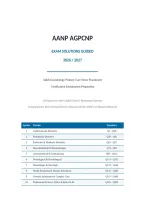
AANP AGPCNP
EXAM SOLUTIONS GUIDED
Adult-Gerontology Primary Care Nurse Practitioner
Certification Examination Preparation
200 Questions with Guided Clinical Reasoning Pathways
Comprehensive Multi-Domain Review Aligned with the AANP Certification Blueprint
Section Domain Questions
1 Cardiovascular Disorders Q1 - Q28
2 Respiratory Disorders Q29 - Q50
3 Endocrine & Metabolic Disorders Q51 - Q72
4 Musculoskeletal & Rheumatologic Q73 - Q92
5 Gastrointestinal & Genitourinary Q93 - Q112
6 Neurological & Psychological Q113 - Q132
7 Hematologic & Oncologic Q133 - Q146
8 Health Promotion & Disease Prevention Q147 - Q160
9 Geriatric Syndromes & Complex Care Q161 - Q180
10 Professional Practice, Ethics & End-of-Life Q181 - Q200
, Cognitive Level Distribution: 25% Recall | 55% Application | 20% Analysis
Question Style: 75% Scenario-Based | 25% Direct Recall of Guidelines & Criteria
, Section 1: Cardiovascular Disorders (HTN, CAD, HF, Arrhythmias, Dyslipidemia, &
Vascular Disease)
Q1: A 58-year-old African American male with a 10-year history of hypertension presents for routine
follow-up. Current BP is 152/96 mmHg on hydrochlorothiazide 25 mg daily. According to the 2017
ACC/AHA hypertension guidelines, what is the most appropriate next step in management?
A. Increase hydrochlorothiazide to 50 mg daily
B. Add amlodipine 5 mg daily [CORRECT]
C. Switch to losartan 50 mg daily
D. Recommend DASH diet and recheck in 6 months
Correct Answer: B
Rationale:
The 2017 ACC/AHA guideline classifies BP ≥130/80 as hypertension and recommends a target <130/80 for most
adults. For an African American patient with stage 2 hypertension not at goal on a thiazide, adding a CCB (amlodipine)
is evidence-based because thiazides and CCBs have superior BP-lowering efficacy in Black patients compared with
ACE inhibitors or ARBs as monotherapy. Option A is incorrect because increasing HCTZ beyond 25 mg yields
minimal additional BP reduction and increases metabolic adverse effects. Option C is incorrect because ACE
inhibitors/ARBs are less effective as monotherapy in Black patients and are typically added second-line. Option D
delays needed pharmacotherapy in a patient already above goal.
Q2: A 72-year-old female with type 2 diabetes, CKD stage 3 (eGFR 45), and hypertension has BP 138/86
on lisinopril 20 mg daily. Her potassium is 5.2 mEq/L. What is the best next step?
A. Add amlodipine 5 mg daily and continue lisinopril [CORRECT]
B. Discontinue lisinopril and switch to losartan
C. Discontinue lisinopril and switch to hydrochlorothiazide
D. Reduce lisinopril to 10 mg and recheck in 3 months
Correct Answer: A
Rationale:
ACE inhibitors are strongly recommended in diabetic patients with CKD for renal protection, and K of 5.2 is a
borderline elevation (continue with monitoring up to 5.5). Adding a CCB like amlodipine addresses the uncontrolled BP
and is safe in CKD. Option B is incorrect because ARBs have similar hyperkalemia risk and offer no advantage over the
ACE inhibitor already prescribed. Option C removes the renal-protective agent. Option D leaves BP uncontrolled at a
level above the <130/80 target recommended for diabetics.
Q3: A 65-year-old male presents with stable angina occurring 2-3 times per week, relieved by sublingual
nitroglycerin. He has no diabetes, normal renal function, and BP 132/82. His LDL is 118 mg/dL. Which
of the following is the most appropriate initial pharmacologic regimen?
A. Aspirin 81 mg, metoprolol, atorvastatin 80 mg, and sublingual nitroglycerin PRN [CORRECT]
B. Aspirin 81 mg, amlodipine, rosuvastatin 20 mg, and isosorbide mononitrate
C. Aspirin 325 mg, carvedilol, atorvastatin 40 mg, and ranolazine
, AANP AGPCNP Exam Solutions Guided 2026/2027
D. Clopidogrel 75 mg, metoprolol, atorvastatin 80 mg, and isosorbide dinitrate
Correct Answer: A
Rationale:
Guideline-directed medical therapy (GDMT) for chronic stable angina includes antiplatelet therapy (aspirin 81 mg
preferred over 325 mg due to bleeding risk), beta-blocker as first-line antianginal, high-intensity statin (atorvastatin
40-80 mg or rosuvastatin 20-40 mg) with LDL goal <70 mg/dL, and short-acting nitrates for acute relief. Option B
omits the beta-blocker, which is first-line for angina. Option C uses aspirin 325 mg, which the 2026 AHA update
recommends against due to increased bleeding without ischemic benefit. Option D substitutes clopidogrel for aspirin,
which is not first-line for stable CAD without recent stenting.
Q4: A 78-year-old female presents with progressive dyspnea on exertion, orthopnea, and bilateral lower
extremity edema. Echocardiogram shows LVEF 35% with dilated left ventricle. She has CKD stage 3
(eGFR 38). Which medication must be initiated with the most careful dose titration and potassium
monitoring?
A. Sacubitril/valsartan
B. Carvedilol
C. Spironolactone [CORRECT]
D. Ivabradine
Correct Answer: C
Rationale:
Aldosterone antagonists (spironolactone) reduce mortality in HFrEF but carry significant hyperkalemia risk, especially
in CKD stage 3 (eGFR <45) where close monitoring of potassium and creatinine at 1 week, 1 month, and every 3
months is mandatory. Option A (ARNI) is contraindicated with eGFR <30 and requires monitoring but is generally
safer than aldosterone antagonists. Option B (beta-blocker) requires gradual titration but is not primarily
potassium-affecting. Option D (ivabradine) is for symptomatic HFrEF with HR >70 on maximally tolerated
beta-blocker, not first-line.
Q5: An 82-year-old male with AFib, hypertension, and a CHA2DS2-VASc score of 4 is on warfarin with
INR 2.4. He has fallen twice in the past year and reports occasional dizziness. What is the most
appropriate management?
A. Switch from warfarin to apixaban [CORRECT]
B. Add aspirin 81 mg for additional stroke prevention
C. Discontinue anticoagulation due to fall risk
D. Continue warfarin and add a statin
Correct Answer: A
Rationale:
For an elderly patient with high stroke risk (CHA2DS2-VASc ≥2), anticoagulation is indicated. DOACs (apixaban) are
preferred over warfarin in older adults due to lower intracranial hemorrhage risk, no INR monitoring, and predictable
pharmacokinetics. Fall risk alone does not justify discontinuing anticoagulation because stroke risk outweighs bleed
risk from falls. Option B is incorrect because combination antiplatelet-anticoagulation dramatically increases bleeding
Page 4 Adult-Gerontology Primary Care NP Certification Review
EXAM SOLUTIONS GUIDED
Adult-Gerontology Primary Care Nurse Practitioner
Certification Examination Preparation
200 Questions with Guided Clinical Reasoning Pathways
Comprehensive Multi-Domain Review Aligned with the AANP Certification Blueprint
Section Domain Questions
1 Cardiovascular Disorders Q1 - Q28
2 Respiratory Disorders Q29 - Q50
3 Endocrine & Metabolic Disorders Q51 - Q72
4 Musculoskeletal & Rheumatologic Q73 - Q92
5 Gastrointestinal & Genitourinary Q93 - Q112
6 Neurological & Psychological Q113 - Q132
7 Hematologic & Oncologic Q133 - Q146
8 Health Promotion & Disease Prevention Q147 - Q160
9 Geriatric Syndromes & Complex Care Q161 - Q180
10 Professional Practice, Ethics & End-of-Life Q181 - Q200
, Cognitive Level Distribution: 25% Recall | 55% Application | 20% Analysis
Question Style: 75% Scenario-Based | 25% Direct Recall of Guidelines & Criteria
, Section 1: Cardiovascular Disorders (HTN, CAD, HF, Arrhythmias, Dyslipidemia, &
Vascular Disease)
Q1: A 58-year-old African American male with a 10-year history of hypertension presents for routine
follow-up. Current BP is 152/96 mmHg on hydrochlorothiazide 25 mg daily. According to the 2017
ACC/AHA hypertension guidelines, what is the most appropriate next step in management?
A. Increase hydrochlorothiazide to 50 mg daily
B. Add amlodipine 5 mg daily [CORRECT]
C. Switch to losartan 50 mg daily
D. Recommend DASH diet and recheck in 6 months
Correct Answer: B
Rationale:
The 2017 ACC/AHA guideline classifies BP ≥130/80 as hypertension and recommends a target <130/80 for most
adults. For an African American patient with stage 2 hypertension not at goal on a thiazide, adding a CCB (amlodipine)
is evidence-based because thiazides and CCBs have superior BP-lowering efficacy in Black patients compared with
ACE inhibitors or ARBs as monotherapy. Option A is incorrect because increasing HCTZ beyond 25 mg yields
minimal additional BP reduction and increases metabolic adverse effects. Option C is incorrect because ACE
inhibitors/ARBs are less effective as monotherapy in Black patients and are typically added second-line. Option D
delays needed pharmacotherapy in a patient already above goal.
Q2: A 72-year-old female with type 2 diabetes, CKD stage 3 (eGFR 45), and hypertension has BP 138/86
on lisinopril 20 mg daily. Her potassium is 5.2 mEq/L. What is the best next step?
A. Add amlodipine 5 mg daily and continue lisinopril [CORRECT]
B. Discontinue lisinopril and switch to losartan
C. Discontinue lisinopril and switch to hydrochlorothiazide
D. Reduce lisinopril to 10 mg and recheck in 3 months
Correct Answer: A
Rationale:
ACE inhibitors are strongly recommended in diabetic patients with CKD for renal protection, and K of 5.2 is a
borderline elevation (continue with monitoring up to 5.5). Adding a CCB like amlodipine addresses the uncontrolled BP
and is safe in CKD. Option B is incorrect because ARBs have similar hyperkalemia risk and offer no advantage over the
ACE inhibitor already prescribed. Option C removes the renal-protective agent. Option D leaves BP uncontrolled at a
level above the <130/80 target recommended for diabetics.
Q3: A 65-year-old male presents with stable angina occurring 2-3 times per week, relieved by sublingual
nitroglycerin. He has no diabetes, normal renal function, and BP 132/82. His LDL is 118 mg/dL. Which
of the following is the most appropriate initial pharmacologic regimen?
A. Aspirin 81 mg, metoprolol, atorvastatin 80 mg, and sublingual nitroglycerin PRN [CORRECT]
B. Aspirin 81 mg, amlodipine, rosuvastatin 20 mg, and isosorbide mononitrate
C. Aspirin 325 mg, carvedilol, atorvastatin 40 mg, and ranolazine
, AANP AGPCNP Exam Solutions Guided 2026/2027
D. Clopidogrel 75 mg, metoprolol, atorvastatin 80 mg, and isosorbide dinitrate
Correct Answer: A
Rationale:
Guideline-directed medical therapy (GDMT) for chronic stable angina includes antiplatelet therapy (aspirin 81 mg
preferred over 325 mg due to bleeding risk), beta-blocker as first-line antianginal, high-intensity statin (atorvastatin
40-80 mg or rosuvastatin 20-40 mg) with LDL goal <70 mg/dL, and short-acting nitrates for acute relief. Option B
omits the beta-blocker, which is first-line for angina. Option C uses aspirin 325 mg, which the 2026 AHA update
recommends against due to increased bleeding without ischemic benefit. Option D substitutes clopidogrel for aspirin,
which is not first-line for stable CAD without recent stenting.
Q4: A 78-year-old female presents with progressive dyspnea on exertion, orthopnea, and bilateral lower
extremity edema. Echocardiogram shows LVEF 35% with dilated left ventricle. She has CKD stage 3
(eGFR 38). Which medication must be initiated with the most careful dose titration and potassium
monitoring?
A. Sacubitril/valsartan
B. Carvedilol
C. Spironolactone [CORRECT]
D. Ivabradine
Correct Answer: C
Rationale:
Aldosterone antagonists (spironolactone) reduce mortality in HFrEF but carry significant hyperkalemia risk, especially
in CKD stage 3 (eGFR <45) where close monitoring of potassium and creatinine at 1 week, 1 month, and every 3
months is mandatory. Option A (ARNI) is contraindicated with eGFR <30 and requires monitoring but is generally
safer than aldosterone antagonists. Option B (beta-blocker) requires gradual titration but is not primarily
potassium-affecting. Option D (ivabradine) is for symptomatic HFrEF with HR >70 on maximally tolerated
beta-blocker, not first-line.
Q5: An 82-year-old male with AFib, hypertension, and a CHA2DS2-VASc score of 4 is on warfarin with
INR 2.4. He has fallen twice in the past year and reports occasional dizziness. What is the most
appropriate management?
A. Switch from warfarin to apixaban [CORRECT]
B. Add aspirin 81 mg for additional stroke prevention
C. Discontinue anticoagulation due to fall risk
D. Continue warfarin and add a statin
Correct Answer: A
Rationale:
For an elderly patient with high stroke risk (CHA2DS2-VASc ≥2), anticoagulation is indicated. DOACs (apixaban) are
preferred over warfarin in older adults due to lower intracranial hemorrhage risk, no INR monitoring, and predictable
pharmacokinetics. Fall risk alone does not justify discontinuing anticoagulation because stroke risk outweighs bleed
risk from falls. Option B is incorrect because combination antiplatelet-anticoagulation dramatically increases bleeding
Page 4 Adult-Gerontology Primary Care NP Certification Review


