
Topic 3: Voice of the Genome | Pearson Edexcel Biology A (Salters-Nuffield) / 9BN0
Cells: the shared starting point
3.1-3.2 / common features and eukaryotic organisation
A cell is the basic unit of living organisms. Cells have a cell surface membrane, cytoplasm, genetic
material and ribosomes. Some organisms are one cell; multicellular organisms contain specialised cells
that work together.
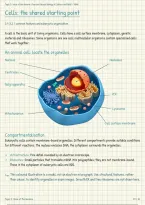
An animal cell: locate the organelles
Nucleus Nucleolus
Centrioles
Golgi apparatus
rER
Lysosome
Mitochondrion
Cell surface membrane
Compartmentalisation
Eukaryotic cells contain membrane-bound organelles. Different compartments provide suitable conditions
for different reactions. The nucleus encloses DNA; the cytoplasm surrounds the organelles.
Ultrastructure: Fine detail revealed by an electron microscope.
Ribosomes: Small particles that translate mRNA into polypeptides; they are not membrane-bound.
Those in the cytoplasm of eukaryotic cells are 80S.
This coloured illustration is a model, not an electron micrograph. Use structural features, rather
than colour, to identify organelles in exam images. Smooth ER and free ribosomes are not drawn here.
Topic 3: Voice of the Genome
,Topic 3: Voice of the Genome | Pearson Edexcel Biology A (Salters-Nuffield) / 9BN0
Organelles: structure explains function
3.2 / link a visible feature to its role
Organelle / structure Function
Nucleus: double envelope with Contains DNA; transcription occurs here. Pores control exchange with
pores the cytoplasm.
Nucleolus: dense region inside Makes rRNA and assembles ribosomal subunits.
nucleus
Ribosomes (80S): rRNA + protein Translate mRNA. Free ribosomes make many cytoplasmic proteins;
bound ribosomes make proteins entering the secretory pathway.
Rough ER: flattened sacs with Synthesises and transports proteins. Polypeptides enter the ER and
ribosomes begin folding and processing.
Smooth ER: membranes without Synthesises lipids; roles include detoxification and calcium storage in
ribosomes particular cells.
Golgi: stack of flattened Modifies proteins, sorts them and packages them into vesicles.
membrane sacs
Mitochondrion: double membrane, Aerobic respiration. The inner membrane has a large surface area for
cristae and matrix ATP production.
Lysosome: membrane enclosing Breaks down materials, including worn organelles. Its membrane
digestive enzymes separates digestive enzymes from the cytoplasm.
Centrioles: cylinders of Part of the centrosome in many animal cells; help organise
microtubules microtubules and the spindle.
High protein secretion predicts extensive rough ER and Golgi. High energy demand predicts many
mitochondria. Always connect the organelle to the cell's activity.
Topic 3: Voice of the Genome
, Topic 3: Voice of the Genome | Pearson Edexcel Biology A (Salters-Nuffield) / 9BN0
From gene to secreted protein
3.3 / rough ER, Golgi and extracellular enzymes
Follow one protein through the cell
1. A gene is transcribed in the nucleus. The mRNA leaves through a nuclear pore.
2. A ribosome associated with rough ER translates the mRNA. The growing polypeptide enters the ER
lumen.
3. In the rough ER lumen the polypeptide folds into its three-dimensional shape. A transport vesicle
containing the protein buds off.
4. The vesicle fuses with the Golgi apparatus. The protein is modified (for example, carbohydrate is
added to form a glycoprotein), then sorted and packaged into vesicles.
5. A secretory vesicle moves to the cell surface membrane and fuses with it.
6. Exocytosis releases the protein outside the cell. An extracellular enzyme acts on a substrate outside
the cell.
A compact pathway
transport vesicle secretory vesicle
rER Golgi Cell surface
Vesicles have a phospholipid bilayer. Budding and fusion move proteins between membrane compartments
without releasing them into the cytosol. ATP supports processes involved in synthesis and transport.
Example: a pancreatic digestive enzyme
A pancreatic secretory cell produces amylase. Its rough ER makes the protein, the Golgi processes and
packages it, and exocytosis releases it for action in the digestive tract.
Ribosomes make polypeptides. The Golgi does not translate mRNA, and the rough ER does not
manufacture ATP.
Topic 3: Voice of the Genome
Cells: the shared starting point
3.1-3.2 / common features and eukaryotic organisation
A cell is the basic unit of living organisms. Cells have a cell surface membrane, cytoplasm, genetic
material and ribosomes. Some organisms are one cell; multicellular organisms contain specialised cells
that work together.
An animal cell: locate the organelles
Nucleus Nucleolus
Centrioles
Golgi apparatus
rER
Lysosome
Mitochondrion
Cell surface membrane
Compartmentalisation
Eukaryotic cells contain membrane-bound organelles. Different compartments provide suitable conditions
for different reactions. The nucleus encloses DNA; the cytoplasm surrounds the organelles.
Ultrastructure: Fine detail revealed by an electron microscope.
Ribosomes: Small particles that translate mRNA into polypeptides; they are not membrane-bound.
Those in the cytoplasm of eukaryotic cells are 80S.
This coloured illustration is a model, not an electron micrograph. Use structural features, rather
than colour, to identify organelles in exam images. Smooth ER and free ribosomes are not drawn here.
Topic 3: Voice of the Genome
,Topic 3: Voice of the Genome | Pearson Edexcel Biology A (Salters-Nuffield) / 9BN0
Organelles: structure explains function
3.2 / link a visible feature to its role
Organelle / structure Function
Nucleus: double envelope with Contains DNA; transcription occurs here. Pores control exchange with
pores the cytoplasm.
Nucleolus: dense region inside Makes rRNA and assembles ribosomal subunits.
nucleus
Ribosomes (80S): rRNA + protein Translate mRNA. Free ribosomes make many cytoplasmic proteins;
bound ribosomes make proteins entering the secretory pathway.
Rough ER: flattened sacs with Synthesises and transports proteins. Polypeptides enter the ER and
ribosomes begin folding and processing.
Smooth ER: membranes without Synthesises lipids; roles include detoxification and calcium storage in
ribosomes particular cells.
Golgi: stack of flattened Modifies proteins, sorts them and packages them into vesicles.
membrane sacs
Mitochondrion: double membrane, Aerobic respiration. The inner membrane has a large surface area for
cristae and matrix ATP production.
Lysosome: membrane enclosing Breaks down materials, including worn organelles. Its membrane
digestive enzymes separates digestive enzymes from the cytoplasm.
Centrioles: cylinders of Part of the centrosome in many animal cells; help organise
microtubules microtubules and the spindle.
High protein secretion predicts extensive rough ER and Golgi. High energy demand predicts many
mitochondria. Always connect the organelle to the cell's activity.
Topic 3: Voice of the Genome
, Topic 3: Voice of the Genome | Pearson Edexcel Biology A (Salters-Nuffield) / 9BN0
From gene to secreted protein
3.3 / rough ER, Golgi and extracellular enzymes
Follow one protein through the cell
1. A gene is transcribed in the nucleus. The mRNA leaves through a nuclear pore.
2. A ribosome associated with rough ER translates the mRNA. The growing polypeptide enters the ER
lumen.
3. In the rough ER lumen the polypeptide folds into its three-dimensional shape. A transport vesicle
containing the protein buds off.
4. The vesicle fuses with the Golgi apparatus. The protein is modified (for example, carbohydrate is
added to form a glycoprotein), then sorted and packaged into vesicles.
5. A secretory vesicle moves to the cell surface membrane and fuses with it.
6. Exocytosis releases the protein outside the cell. An extracellular enzyme acts on a substrate outside
the cell.
A compact pathway
transport vesicle secretory vesicle
rER Golgi Cell surface
Vesicles have a phospholipid bilayer. Budding and fusion move proteins between membrane compartments
without releasing them into the cytosol. ATP supports processes involved in synthesis and transport.
Example: a pancreatic digestive enzyme
A pancreatic secretory cell produces amylase. Its rough ER makes the protein, the Golgi processes and
packages it, and exocytosis releases it for action in the digestive tract.
Ribosomes make polypeptides. The Golgi does not translate mRNA, and the rough ER does not
manufacture ATP.
Topic 3: Voice of the Genome


