
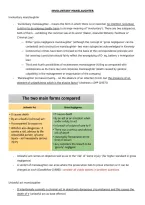
INVOLUNTARY MANSLAUGHTER
Involuntary manslaughter
‘Involuntary manslaughter... means the form in which there is (or need be) no intention (voluntas)
to kill or to do grievous bodily harm (a strange meaning of ‘involuntary’). There are two subspecies,
both of them... exhibiting the common law at its worst’ (Baker, Glanville Williams Textbook of
Criminal Law)
Either ‘gross negligence manslaughter’ (although the concept of ‘gross negligence’ can be
contested) and constructive manslaughter- two main subspecies acknowledged in Kennedy
Constructive crimes have been criticised on the basis of the correspondence principle and
fair warning (conviction should fairly reflect the wrongdoing of D- eg. battery v immigration
law)
Third and fourth possibilities of recklessness manslaughter (killing accompanied with
recklessness as its mens rea) and corporate manslaughter (death caused by general
culpability in the management or organisation of the company)
‘Manslaughter (is) based mainly... on the absence of an intention to kill, but the presence of an
element of unlawfulness which is the elusive factor’ (Andrews v DPP [1937])
Unlawful act carries an objective test so as to the ‘risk’ of ‘some injury’ (far higher standard in gross
negligence)
A verdict of manslaughter can arise where the prosecution fails to prove intention or it can be
charged as such (Goodfellow [1986])- consider all viable options in problem questions
Unlawful act manslaughter
D intentionally commits a criminal act in objectively dangerous circumstances and this causes the
death of V (unlawful act as base offence)
, Rationale follows in A-G's Ref (No 3 of 1994) [1997] that D ‘must accept all the
consequences of his act, so long as the jury are satisfied that he did what he did
intentionally, that what he did was unlawful and that, applying the correct test, it was
dangerous’
‘Unlawful act’’ means a crime rather than a civil wrong’ (not tort- Franklin [1883])
Tony Storey’s Unlawful and Dangerous: a comparative analysis of unlawful act manslaughter
in English, Australian and Canadian law [2017] seeks reform ideas in finding the manner that
different countries- unlawful act excludes strict liability, negligence crimes and omissions in
England and Australia, but not Canada
However, there is a very obvious ‘gap’ between an intentional theft or act of criminal
damage or death
‘...even the most moderate constructivists would argue that the unlawful and dangerous act
should be a crime of violence in which D intentionally wrongs V so as to create a foreseeable
risk of causing serious harm’ (Barry Mitchell, More Thoughts about Unlawful and Dangerous
Act Manslaughter and the One-Punch Killer [2009])- the law at present supports convictions
for unlawful act across a much wider range of offences
Mitchell discusses further the death by ‘one-punch battery’ to find that the only difference in
this scenario between ABH and manslaughter is ‘luck’ (how can this be justified?)
Lord Hope argues that this is simply fair labelling (D should accept the consequences for
‘shifting his normative position’ and putting himself in the wrong by attacking V)
However, Ashworth supports Mitchell’s point, finding that the ‘moral distance’ between what
was intended and what occurred is too great (‘statistically speaking, the risk of death from a
single punch is too small to enter into reasonable contemplation... death would not be an
intrinsic risk when injuring another... it seems wrong to attribute too much weight to
chance’)
A-G's Ref (No 3 of 1994) references the need for D to have acted intentionally (mens rea of unlawful
act must be proved)
It will not be sufficient if the act is deliberate (Lamb [1967]- could not prove mens rea for
assault to establish constructive crime)
‘A degree of mens rea has been recognised as essential’ (Church [1966])
JF and NE [2015]- a deliberate act accompanied by recklessness was sufficient, if the mens
rea of the unlawful act includes recklessness (however, is this fair or should there be a
higher requirement of intention- the argument of a requirement to deliberately commit the
base crime has never been decided in court)
The mens rea requirement does not apply if D fails to see a risk because of self-induced
intoxication (Lipman [1970])
The act is not ‘unlawful’ where D has a defence (in discussion of unlawful act, must work through
original criminal act offence- actus reus, mens rea and any defences, before further discussion)
Scarlett [1993]- self-defence
Slingsby [1995]- consent to permissible harm


