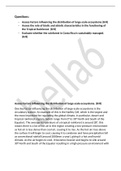
Questions:
- Assess factors influencing the distribution of large-scale ecosystems (8/8)
- Assess the role of biotic and abiotic characteristics in the functioning of
the Tropical Rainforest. (8/8)
- Evaluate whether the rainforest in Costa Rica is sustainably managed.
(8/8)
Assess factors influencing the distribution of large-scale ecosystems. (8/8)
One key factor influencing the distribution of large-scale ecosystems is the
circulatory system. An example of this is the Hadley Cell, which is the largest and
the most important for regulating the global climate, in particular, desert and
tropical rainforest regions (which range from 0° to 30° North and South of the
Equator). The average temperature of a tropical rainforest is around 28°, this
means there is a lot of hot air in this region creating a low-pressure environment
as hot air is less dense than cool air, causing it to rise. As the hot air rises above
the surface it will begin to cool, causing it to condense and have precipitation fall
as convectional rainfall (around 2000mm a year), giving it a hot and humid
climate. As the air begins to cool, it becomes heavier and begins to sink around
30° North and South of the Equator resulting in a high-pressure environment with
- Assess factors influencing the distribution of large-scale ecosystems (8/8)
- Assess the role of biotic and abiotic characteristics in the functioning of
the Tropical Rainforest. (8/8)
- Evaluate whether the rainforest in Costa Rica is sustainably managed.
(8/8)
Assess factors influencing the distribution of large-scale ecosystems. (8/8)
One key factor influencing the distribution of large-scale ecosystems is the
circulatory system. An example of this is the Hadley Cell, which is the largest and
the most important for regulating the global climate, in particular, desert and
tropical rainforest regions (which range from 0° to 30° North and South of the
Equator). The average temperature of a tropical rainforest is around 28°, this
means there is a lot of hot air in this region creating a low-pressure environment
as hot air is less dense than cool air, causing it to rise. As the hot air rises above
the surface it will begin to cool, causing it to condense and have precipitation fall
as convectional rainfall (around 2000mm a year), giving it a hot and humid
climate. As the air begins to cool, it becomes heavier and begins to sink around
30° North and South of the Equator resulting in a high-pressure environment with