
Alternating currents
Alternating current – current which changes in magnitude and direction
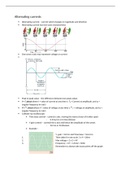
Alternating current has sine wave characteristics
Sine wave y-axis may represent voltage or current
Peak to peak value – the difference between two peak values
I = I 0sinωt where I = value of current at any time t; I 0 = Current at amplitude; and ω =
angular frequency in rad/s
V = V 0 sinωt where V = value of voltage at any time t; V 0 = voltage at amplitude; and ω =
angular frequency in rad/s
Cathode ray oscilloscope:
Time base control – controls x axis, moving the waves closer of further apart
- 0.5ms/cm or 0.5ms/division
Y gain control – controls the y axis and hence the amplitude of the waves
- 5V/cm or 5V/division
Example –
Y- gain = 2V/cm and Time base = 5ms/cm
1. Time taken for one cycle. 5 x 4 = 20ms
2. Max voltage = 2 x 2 = 4V
3. Frequency = 1/T = 1/0.02 = 50Hz
Remember to always take exact points off the graph
, Root mean square value of an alternating current (or voltage) is the equivalent to its direct
current value that produces the same power as the alternating current (or voltage).
r.m.s. value gives the dc value
the d.c voltage (or current) is about 70% of V 0 or I 0 of alternating current
I 2 always has a positive value and is much
greater than I (green dotted lines)
I2 I2
Mean value will be , therefore r.m.s will be the root of the mean square ( ¿ so,
2 2
I = I
2
r.m.s =
√ 2 √2
Mean value of a.c. is zero. Heating occurs in a resistor connected to a.c because heating
depends on I 2 which is always positive.
Power, voltage, and current all vary with the mains supply (a.c.)
V2
Power (P) = IR = I 2 R =
R
P (a.c) = V rms x I rms
V peak I peak
= x
√2 √2
Advantage disadvantage
a.c. can be transformed to high voltages Lines must be suspended high above
so current flowing is reduced and lower ground and high-quality insulators are
power losses are incurred needed
As current flows it loses power because
of resistance and wire becomes warm
p peak
=
2
Alternating current – current which changes in magnitude and direction
Alternating current has sine wave characteristics
Sine wave y-axis may represent voltage or current
Peak to peak value – the difference between two peak values
I = I 0sinωt where I = value of current at any time t; I 0 = Current at amplitude; and ω =
angular frequency in rad/s
V = V 0 sinωt where V = value of voltage at any time t; V 0 = voltage at amplitude; and ω =
angular frequency in rad/s
Cathode ray oscilloscope:
Time base control – controls x axis, moving the waves closer of further apart
- 0.5ms/cm or 0.5ms/division
Y gain control – controls the y axis and hence the amplitude of the waves
- 5V/cm or 5V/division
Example –
Y- gain = 2V/cm and Time base = 5ms/cm
1. Time taken for one cycle. 5 x 4 = 20ms
2. Max voltage = 2 x 2 = 4V
3. Frequency = 1/T = 1/0.02 = 50Hz
Remember to always take exact points off the graph
, Root mean square value of an alternating current (or voltage) is the equivalent to its direct
current value that produces the same power as the alternating current (or voltage).
r.m.s. value gives the dc value
the d.c voltage (or current) is about 70% of V 0 or I 0 of alternating current
I 2 always has a positive value and is much
greater than I (green dotted lines)
I2 I2
Mean value will be , therefore r.m.s will be the root of the mean square ( ¿ so,
2 2
I = I
2
r.m.s =
√ 2 √2
Mean value of a.c. is zero. Heating occurs in a resistor connected to a.c because heating
depends on I 2 which is always positive.
Power, voltage, and current all vary with the mains supply (a.c.)
V2
Power (P) = IR = I 2 R =
R
P (a.c) = V rms x I rms
V peak I peak
= x
√2 √2
Advantage disadvantage
a.c. can be transformed to high voltages Lines must be suspended high above
so current flowing is reduced and lower ground and high-quality insulators are
power losses are incurred needed
As current flows it loses power because
of resistance and wire becomes warm
p peak
=
2


