
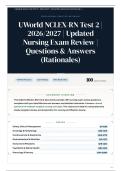
UWORLD NCLEX-RN TEST 2 | 2026/2027 | UPDATED NURSING EXAM REVIEW | …
P R O F E S S I O N A L P R A C T I C E M AT E R I A L S
UWorld NCLEX-RN Test 2 |
2026/2027 | Updated
Nursing Exam Review |
Questions & Answers
(Rationales)
Verified Answers Exam Ready With Rationales 100 QUESTIONS
DOCUMENT OVERVIEW
This UWorld NCLEX-RN Test 2 document provides 100 nursing exam review questions,
complete with pre-identified correct answers and detailed rationales. It covers a broad
spectrum of medical-surgical nursing concepts. This resource is ideal for comprehensive
study, targeted review, and preparation for nursing certification exams.
TOPICS
Safety, Ethics & Management Q1–Q55
Oncology & Hematology Q56–Q59
Cardiovascular & Respiratory Q60–Q70
Gastrointestinal & Nutrition Q71–Q77
Endocrine & Metabolic Q78–Q84
Psychiatric & Mental Health Q85–Q93
Neurology & Sensory Q94–Q100
Page 1
, E XA M Q U EST I O N S
Q1 QUESTION 1 OF 100
A nurse coworker is called into work from home to help care for an influx of clients being
admitted after a bus accident. While assisting the coworker prepare for incoming clients,
the nurse becomes concerned that the coworker may be under the influence of an impairing
substance. Which action by the nurse is best?
1.
Ask another coworker to observe the individual to confirm the suspicion
2.
Confront the coworker about the concern and offer emotional support
3.
Speak with the nursing supervisor about the concern
4.
Telephone the appropriate regulatory agency and make a report
RESPONSE
3.
RATIONALE
The nurse's primary responsibility is to ensure client safety and uphold professional standards.
Reporting concerns about a coworker's potential impairment to the nursing supervisor allows for
appropriate investigation and intervention while maintaining confidentiality. This process ensures
client well-being and adherence to workplace policies.
Q2 QUESTION 2 OF 100
The nurse is preparing to change the dressing of a client's subclavian central venous
catheter using a chlorhexidine gluconate (CHG)-impregnated patch and transparent
adhesive dressing. Place the procedural steps in the correct order. All options must be used.
Apply CHG patch over catheter insertion site and cover with a sterile transparent dressing
Cleanse the site with CHG for at least 30 seconds using friction; allow to air dry completely
Discard the clean gloves, perform hand hygiene, and apply sterile gloves
Perform hand hygiene, don face mask, place a mask on the client, and apply clean gloves
Remove old dressing and CHG-impregnated patch; assess insertion site
Page 2
, RESPONSE
Perform hand hygiene, don face mask, place a mask on the client, and apply clean gloves
Remove old dressing and CHG-impregnated patch; assess insertion site
Discard the clean gloves, perform hand hygiene, and apply sterile gloves
Cleanse the site with CHG for at least 30 seconds using friction; allow to air dry completely
Apply CHG patch over catheter insertion site and cover with a sterile transparent dressing
Q3 QUESTION 3 OF 100
Four clients enter the pediatric emergency department at the same time. Which client
should the nurse see first?
1.
2-week-old with tricuspid atresia who has dusky lips and nailbeds
2.
5-week-old with forceful vomiting after every feeding who is crying
3.
12-month-old who was wheezing at home and is now lethargic with no wheezing
4.
3-year-old with fever who had a brief seizure at home and is asleep
RESPONSE
3.
RATIONALE
A child with a history of wheezing who is now lethargic and silent may have progressed to complete
airway obstruction or respiratory failure, indicating a critical, life-threatening condition. This
situation demands immediate assessment and intervention over other clients presenting with less
acute symptoms.
Page 3
, Q4 QUESTION 4 OF 100
The unlicensed assistive personnel (UAP) reports being splashed in the eye while emptying
urine from the catheter bag of a client with AIDS. The UAP is afraid of becoming infected
with HIV and requests immediate testing. What is the nurse's priority action?
1.
Direct the UAP to immediately flush the eye with water at the unit's eyewash station
2.
Reassure the UAP that the risk for HIV is low as urine does not transmit the virus
3.
Refer the UAP to the occupational health department for postexposure prophylaxis
4.
Send the UAP to the facility's emergency department for medical evaluation
RESPONSE
1.
RATIONALE
Immediate irrigation is critical to minimize exposure and potential transmission of pathogens to
mucous membranes. Flushing the affected eye with water removes residual contaminants, reducing
the risk of infection. This is the first priority in managing potential splashes.
Q5 QUESTION 5 OF 100
The nurse reinforces teaching to the parents of a 12-month-old who has begun weaning
from breastfeeding. Which statement by the parents indicates that teaching has been
effective?
1.
"I can allow my child to sleep with a bottle for comfort while weaning."
2.
"I can start substituting breastfeeding sessions with whole cow's milk."
3.
"I should discourage my child from drinking milk to increase solid food intake."
4.
"I will stop breastfeeding completely to expedite the weaning process."
RESPONSE
2.
Page 4
P R O F E S S I O N A L P R A C T I C E M AT E R I A L S
UWorld NCLEX-RN Test 2 |
2026/2027 | Updated
Nursing Exam Review |
Questions & Answers
(Rationales)
Verified Answers Exam Ready With Rationales 100 QUESTIONS
DOCUMENT OVERVIEW
This UWorld NCLEX-RN Test 2 document provides 100 nursing exam review questions,
complete with pre-identified correct answers and detailed rationales. It covers a broad
spectrum of medical-surgical nursing concepts. This resource is ideal for comprehensive
study, targeted review, and preparation for nursing certification exams.
TOPICS
Safety, Ethics & Management Q1–Q55
Oncology & Hematology Q56–Q59
Cardiovascular & Respiratory Q60–Q70
Gastrointestinal & Nutrition Q71–Q77
Endocrine & Metabolic Q78–Q84
Psychiatric & Mental Health Q85–Q93
Neurology & Sensory Q94–Q100
Page 1
, E XA M Q U EST I O N S
Q1 QUESTION 1 OF 100
A nurse coworker is called into work from home to help care for an influx of clients being
admitted after a bus accident. While assisting the coworker prepare for incoming clients,
the nurse becomes concerned that the coworker may be under the influence of an impairing
substance. Which action by the nurse is best?
1.
Ask another coworker to observe the individual to confirm the suspicion
2.
Confront the coworker about the concern and offer emotional support
3.
Speak with the nursing supervisor about the concern
4.
Telephone the appropriate regulatory agency and make a report
RESPONSE
3.
RATIONALE
The nurse's primary responsibility is to ensure client safety and uphold professional standards.
Reporting concerns about a coworker's potential impairment to the nursing supervisor allows for
appropriate investigation and intervention while maintaining confidentiality. This process ensures
client well-being and adherence to workplace policies.
Q2 QUESTION 2 OF 100
The nurse is preparing to change the dressing of a client's subclavian central venous
catheter using a chlorhexidine gluconate (CHG)-impregnated patch and transparent
adhesive dressing. Place the procedural steps in the correct order. All options must be used.
Apply CHG patch over catheter insertion site and cover with a sterile transparent dressing
Cleanse the site with CHG for at least 30 seconds using friction; allow to air dry completely
Discard the clean gloves, perform hand hygiene, and apply sterile gloves
Perform hand hygiene, don face mask, place a mask on the client, and apply clean gloves
Remove old dressing and CHG-impregnated patch; assess insertion site
Page 2
, RESPONSE
Perform hand hygiene, don face mask, place a mask on the client, and apply clean gloves
Remove old dressing and CHG-impregnated patch; assess insertion site
Discard the clean gloves, perform hand hygiene, and apply sterile gloves
Cleanse the site with CHG for at least 30 seconds using friction; allow to air dry completely
Apply CHG patch over catheter insertion site and cover with a sterile transparent dressing
Q3 QUESTION 3 OF 100
Four clients enter the pediatric emergency department at the same time. Which client
should the nurse see first?
1.
2-week-old with tricuspid atresia who has dusky lips and nailbeds
2.
5-week-old with forceful vomiting after every feeding who is crying
3.
12-month-old who was wheezing at home and is now lethargic with no wheezing
4.
3-year-old with fever who had a brief seizure at home and is asleep
RESPONSE
3.
RATIONALE
A child with a history of wheezing who is now lethargic and silent may have progressed to complete
airway obstruction or respiratory failure, indicating a critical, life-threatening condition. This
situation demands immediate assessment and intervention over other clients presenting with less
acute symptoms.
Page 3
, Q4 QUESTION 4 OF 100
The unlicensed assistive personnel (UAP) reports being splashed in the eye while emptying
urine from the catheter bag of a client with AIDS. The UAP is afraid of becoming infected
with HIV and requests immediate testing. What is the nurse's priority action?
1.
Direct the UAP to immediately flush the eye with water at the unit's eyewash station
2.
Reassure the UAP that the risk for HIV is low as urine does not transmit the virus
3.
Refer the UAP to the occupational health department for postexposure prophylaxis
4.
Send the UAP to the facility's emergency department for medical evaluation
RESPONSE
1.
RATIONALE
Immediate irrigation is critical to minimize exposure and potential transmission of pathogens to
mucous membranes. Flushing the affected eye with water removes residual contaminants, reducing
the risk of infection. This is the first priority in managing potential splashes.
Q5 QUESTION 5 OF 100
The nurse reinforces teaching to the parents of a 12-month-old who has begun weaning
from breastfeeding. Which statement by the parents indicates that teaching has been
effective?
1.
"I can allow my child to sleep with a bottle for comfort while weaning."
2.
"I can start substituting breastfeeding sessions with whole cow's milk."
3.
"I should discourage my child from drinking milk to increase solid food intake."
4.
"I will stop breastfeeding completely to expedite the weaning process."
RESPONSE
2.
Page 4


