Analytical chemistry
Chromatography
1. Partition chromatography
(a) Paper chromatography
Mobile phase – solvent
Stationary phase – water trapped between cellulose fibres of the paper
The mobile phase flows through the stationary phase and carries the components of
the mixture with it
The substances in the mixture will have different affinities for the solvent and for the
water, and so they move at different rates over the paper.
It is important that the solvent level is below the line with the spots on it
The reason for covering the container is to make sure that the atmosphere in the
beaker is saturated with solvent vapour. Saturating the atmosphere in the beaker
with vapour stops the solvent from evaporating as it rises up the paper
Amino acids are colourless on chromatogram and can be revealed as bluish spots by
ninhydrin spray (locating agent)
distance travelled by compound
Rf (retention factor) value =
distance travelled by solvent
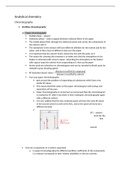
Two-way paper chromatography:
gets around the problem of separating out substances which have very
similar Rf values
This means that their spots on the paper chromatogram will overlap and
separation will be poor.
Paper chromatography is carried out as normal and then the chromatogram
is rotated by 90 after it has dried. It then undergoes chromatography again
with a different solvent
It is very unlikely that the two confusing spots will have the same Rf values
in the second solvent as well as the first, and so the spots will move by a
different amount.
SF1 – solvent
front for the
first
solvent
How are components in a mixture separated
In paper chromatography the different partition coefficients of the components
in a mixture correspond to their relative solubilities in the two solvents
Chromatography
1. Partition chromatography
(a) Paper chromatography
Mobile phase – solvent
Stationary phase – water trapped between cellulose fibres of the paper
The mobile phase flows through the stationary phase and carries the components of
the mixture with it
The substances in the mixture will have different affinities for the solvent and for the
water, and so they move at different rates over the paper.
It is important that the solvent level is below the line with the spots on it
The reason for covering the container is to make sure that the atmosphere in the
beaker is saturated with solvent vapour. Saturating the atmosphere in the beaker
with vapour stops the solvent from evaporating as it rises up the paper
Amino acids are colourless on chromatogram and can be revealed as bluish spots by
ninhydrin spray (locating agent)
distance travelled by compound
Rf (retention factor) value =
distance travelled by solvent
Two-way paper chromatography:
gets around the problem of separating out substances which have very
similar Rf values
This means that their spots on the paper chromatogram will overlap and
separation will be poor.
Paper chromatography is carried out as normal and then the chromatogram
is rotated by 90 after it has dried. It then undergoes chromatography again
with a different solvent
It is very unlikely that the two confusing spots will have the same Rf values
in the second solvent as well as the first, and so the spots will move by a
different amount.
SF1 – solvent
front for the
first
solvent
How are components in a mixture separated
In paper chromatography the different partition coefficients of the components
in a mixture correspond to their relative solubilities in the two solvents