
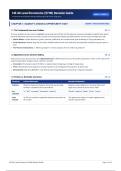
CIE AS Level Economics (9708) Revision Guide PAPER 1 & PAPER 2
Comprehensive Syllabus Notes, Mathematics & Vector Diagrams
CHAPTER 1: SCARCITY, CHOICE & OPPORTUNITY COST Section 1: Basic Economic Ideas
1.1 The Fundamental Economic Problem Ch 1.1
The core problem of economics is scarcity: human wants are infinite, but the physical resources available to satisfy those wants
are finite. Because resources are scarce, society cannot produce everything citizens desire; choices must inevitably be made.
Infinite Wants: Human desires for goods, services, healthcare, and infrastructure grow endlessly as living standards rise.
Finite Resources: Natural reserves, land area, available labour force, and machinery are physically limited at any given point in
time.
The Three Core Questions: 1. What to produce? 2. How to produce it? 3. For whom to produce?
1.2 Opportunity Cost & Decision Making Ch 1.2
Every choice incurs an economic cost. Opportunity Cost is defined as the cost of an activity measured in terms of the value of the
next best alternative foregone when a decision is made.
Consumers: Choosing to spend $1,000 on a laptop means foregoing a holiday of equal value.
Firms: Allocating factory capacity to producing electric cars foregoes the production of petrol cars.
Governments: Spending $500M on new defense technology foregoes constructing 10 regional hospitals.
1.3 Positive vs. Normative Economics Ch 1.3
Dimension Positive Statements Normative Statements
Definition Objective statements based on facts that can be tested, Subjective value judgments or opinions about what
verified, or rejected by empirical evidence. ought to be; cannot be proven true or false.
Key "Is", "Will", "Increases", "Decreases", "Leads to". "Should", "Ought to", "Better", "Fairer", "Unjust".
Language
Exam "A 10% tax increase on cigarettes reduced consumption by "The government ought to increase cigarette tax to
Example 4% in 2024." improve national health."
CIE AS Level Economics (9708) Revision Guide Page 1 of 15
, CHAPTERS 2 & 3: FACTORS OF PRODUCTION & ECONOMIC SYSTEMS Section 1: Basic Economic Ideas
2.1 Factors of Production & Rewards Ch 2
Factors of Production are the economic inputs required to produce goods and services:
Factor Detailed Definition Factor Reward
Land All natural resources provided by nature (e.g. arable land, oil reserves, mineral deposits, forests). Rent
Labour The human physical and mental effort expended in production processes. Wages / Salaries
Capital Man-made physical aids to production (e.g. machinery, factories, computers, tools). Interest
Enterprise The risk-taking skill of organizing the other three factors to produce goods profitably. Profit
2.2 Division of Labour & Specialisation Ch 2.2
Specialisation occurs when individuals, firms, or nations concentrate on producing specific goods/services in which they hold an
advantage. Division of Labour breaks production down into specialized sub-tasks.
Advantages: Higher labour productivity, greater output, worker skill mastery, time saved moving between tasks.
Disadvantages: Extreme monotony/boredom leading to lower quality, risk of structural unemployment, total interdependence.
3.1 Resource Allocation in Economic Systems Ch 3
System
Ownership & Allocation Key Advantages Key Weaknesses
Type
Free Market Private ownership. Price mechanism High efficiency, strong innovation, Market failure, wide income
allocates resources via consumer consumer choice. inequality, under-provision of merit
sovereignty. goods.
Planned State ownership. Central planning Focus on social welfare, full
Economy committee allocates all resources. employment target, equal income
distribution.
Mixed Coexistence of private sector and state Balancing market efficiency with Potential government failure,
Economy intervention. social welfare protections. taxation inefficiencies.
CIE AS Level Economics (9708) Revision Guide Page 2 of 15
Comprehensive Syllabus Notes, Mathematics & Vector Diagrams
CHAPTER 1: SCARCITY, CHOICE & OPPORTUNITY COST Section 1: Basic Economic Ideas
1.1 The Fundamental Economic Problem Ch 1.1
The core problem of economics is scarcity: human wants are infinite, but the physical resources available to satisfy those wants
are finite. Because resources are scarce, society cannot produce everything citizens desire; choices must inevitably be made.
Infinite Wants: Human desires for goods, services, healthcare, and infrastructure grow endlessly as living standards rise.
Finite Resources: Natural reserves, land area, available labour force, and machinery are physically limited at any given point in
time.
The Three Core Questions: 1. What to produce? 2. How to produce it? 3. For whom to produce?
1.2 Opportunity Cost & Decision Making Ch 1.2
Every choice incurs an economic cost. Opportunity Cost is defined as the cost of an activity measured in terms of the value of the
next best alternative foregone when a decision is made.
Consumers: Choosing to spend $1,000 on a laptop means foregoing a holiday of equal value.
Firms: Allocating factory capacity to producing electric cars foregoes the production of petrol cars.
Governments: Spending $500M on new defense technology foregoes constructing 10 regional hospitals.
1.3 Positive vs. Normative Economics Ch 1.3
Dimension Positive Statements Normative Statements
Definition Objective statements based on facts that can be tested, Subjective value judgments or opinions about what
verified, or rejected by empirical evidence. ought to be; cannot be proven true or false.
Key "Is", "Will", "Increases", "Decreases", "Leads to". "Should", "Ought to", "Better", "Fairer", "Unjust".
Language
Exam "A 10% tax increase on cigarettes reduced consumption by "The government ought to increase cigarette tax to
Example 4% in 2024." improve national health."
CIE AS Level Economics (9708) Revision Guide Page 1 of 15
, CHAPTERS 2 & 3: FACTORS OF PRODUCTION & ECONOMIC SYSTEMS Section 1: Basic Economic Ideas
2.1 Factors of Production & Rewards Ch 2
Factors of Production are the economic inputs required to produce goods and services:
Factor Detailed Definition Factor Reward
Land All natural resources provided by nature (e.g. arable land, oil reserves, mineral deposits, forests). Rent
Labour The human physical and mental effort expended in production processes. Wages / Salaries
Capital Man-made physical aids to production (e.g. machinery, factories, computers, tools). Interest
Enterprise The risk-taking skill of organizing the other three factors to produce goods profitably. Profit
2.2 Division of Labour & Specialisation Ch 2.2
Specialisation occurs when individuals, firms, or nations concentrate on producing specific goods/services in which they hold an
advantage. Division of Labour breaks production down into specialized sub-tasks.
Advantages: Higher labour productivity, greater output, worker skill mastery, time saved moving between tasks.
Disadvantages: Extreme monotony/boredom leading to lower quality, risk of structural unemployment, total interdependence.
3.1 Resource Allocation in Economic Systems Ch 3
System
Ownership & Allocation Key Advantages Key Weaknesses
Type
Free Market Private ownership. Price mechanism High efficiency, strong innovation, Market failure, wide income
allocates resources via consumer consumer choice. inequality, under-provision of merit
sovereignty. goods.
Planned State ownership. Central planning Focus on social welfare, full
Economy committee allocates all resources. employment target, equal income
distribution.
Mixed Coexistence of private sector and state Balancing market efficiency with Potential government failure,
Economy intervention. social welfare protections. taxation inefficiencies.
CIE AS Level Economics (9708) Revision Guide Page 2 of 15


