
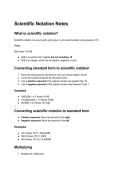
Scientific Notation Notes
What is scientific notation?
Scientific notation is a way to write very large or very small numbers using powers of 10.
Form:
$$a \times 10^n$$
● $a$ is a number from 1 up to, but not including, 10.
● $n$ is an integer, which can be positive, negative, or zero.
Converting standard form to scientific notation
1. Move the decimal point until there is only one nonzero digit to its left.
2. Count the number of places the decimal moved.
3. Use a positive exponent if the original number was greater than 10.
4. Use a negative exponent if the original number was between 0 and 1.
Examples
● $45{,}000 = 4.5 \times 10^4$
● $7{,}200{,}000 = 7.2 \times 10^6$
● $0.0063 = 6.3 \times 10^{-3}$
Converting scientific notation to standard form
● Positive exponent: Move the decimal to the right.
● Negative exponent: Move the decimal to the left.
Examples
● $3.4 \times 10^5 = 340{,}000$
● $9.02 \times 10^2 = 902$
● $5.6 \times 10^{-4} = 0.00056$
Multiplying
1. Multiply the coefficients.
What is scientific notation?
Scientific notation is a way to write very large or very small numbers using powers of 10.
Form:
$$a \times 10^n$$
● $a$ is a number from 1 up to, but not including, 10.
● $n$ is an integer, which can be positive, negative, or zero.
Converting standard form to scientific notation
1. Move the decimal point until there is only one nonzero digit to its left.
2. Count the number of places the decimal moved.
3. Use a positive exponent if the original number was greater than 10.
4. Use a negative exponent if the original number was between 0 and 1.
Examples
● $45{,}000 = 4.5 \times 10^4$
● $7{,}200{,}000 = 7.2 \times 10^6$
● $0.0063 = 6.3 \times 10^{-3}$
Converting scientific notation to standard form
● Positive exponent: Move the decimal to the right.
● Negative exponent: Move the decimal to the left.
Examples
● $3.4 \times 10^5 = 340{,}000$
● $9.02 \times 10^2 = 902$
● $5.6 \times 10^{-4} = 0.00056$
Multiplying
1. Multiply the coefficients.


