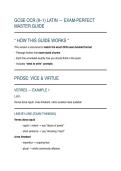
The GCSE OCR Latin (9–1) Exam Perfect Master Guide is a comprehensive revision resource designed to help students prepare for the OCR GCSE Latin examinations, with particular emphasis on Latin translation, comprehension, grammar, prose literature, verse literature, literary analysis and 10- and 12-mark exam questions.
The guide is structured around the way students are expected to approach the examination itself. Rather than simply providing notes, it models how to think about Latin passages in an exam, showing students how to identify significant vocabulary, grammatical features, literary techniques and structural choices, and then turn those observations into developed examination answers.
What is included in the OCR GCSE Latin revision guide?
The guide covers both language and literature skills, making it useful for students revising different components of the OCR GCSE Latin course.
1. Prose Literature: Vice and Virtue
The prose section uses examples involving Verres, Mucius and Cloelia to demonstrate how Latin literature can be analysed for characterisation, themes, language and Roman values.
The Verres example focuses on corruption, oppression, fear and abuse of power. Students are shown how individual Latin words can support an argument about character. For example, rapuit is interpreted as forceful and violent language, while the imperfect timebant demonstrates continuing fear. The phrase nemo auxilium dare audebat is used to demonstrate the complete helplessness of the citizens.
The Mucius example shifts to the opposite side of the vice versus virtue theme. His decisive actions, willingness to confront danger and self-sacrifice are used to demonstrate Roman virtus, courage and heroism.
The Cloelia example similarly examines courage, determination, leadership and selflessness, demonstrating how verbs such as fugit, transivit and servavit can be used as evidence for an interpretation of a character.
Together, these examples teach students to move beyond simply translating Latin and instead explain what particular words reveal about characters, themes and Roman values.
2. Verse Literature: Baucis and Philemon
The verse section focuses on Baucis and Philemon, examining themes including poverty, simplicity, virtue, hospitality and the relationship between wealth and moral goodness.
The guide demonstrates how apparently simple descriptive words can become evidence for a developed literary argument. The adjective parva, for example, emphasises the smallness of the couple's home, while stipulis and canna draw attention to the basic materials used to construct it. These details establish their poverty and humble lifestyle.
However, the guide stresses that the poem does not simply present poverty negatively. Instead, the characters' lack of material wealth is contrasted with their moral virtue, creating the broader idea that goodness and virtue can be more important than wealth or status.
This section therefore demonstrates an important GCSE Latin literature skill: identifying a technique and then explaining why the author or poet has used it and what it contributes to the wider meaning of the passage.
3. Catullus and the theme of otium
The guide also examines Catullus and the presentation of otium, or leisure.
Repetition of otium is identified as an important literary feature, while the use of Catulle contributes to the poem's personal and reflective tone. The word nimium is used to demonstrate the idea of excess, allowing students to explore how leisure can become harmful when taken too far.
This section reinforces the same analytical approach used throughout the literature component: students should identify specific Latin evidence, explain its meaning, analyse its effect and connect it to the central theme of the question.
4. Model 10-Mark and 12-Mark Literature Answers
One of the main features of the guide is its use of model examination paragraphs and full-mark answers.
The model Verres essay demonstrates how a high-level response can combine:
Precise Latin quotations
Analysis of individual vocabulary
Tense analysis
Sentence length
Structural emphasis
Characterisation
Reactions of other characters
Thematic interpretation
Links to the question
For example, the model answer does not simply state that Verres is oppressive. It explains how rapuit suggests forceful theft, how the short sentence creates a blunt and shocking effect, how timebant communicates continuing fear, and how nemo emphasises the absence of resistance.
The guide therefore teaches a repeatable analytical process:
Latin quotation → meaning → technique → effect → interpretation → link to question.
The same approach is applied to the 12-mark prose and verse questions.
5. OCR GCSE Latin Language Practice
The guide includes a mini mock examination for Paper 1: Language, covering three important areas:
Translation
Students practise translating a Latin passage accurately into English, with attention to:
Vocabulary
Verb tenses
Context
Accurate English
Grammatical meaning
Comprehension
The comprehension section tests whether students can extract information from a Latin passage and identify details such as actions, emotions, reasons and movement.
Grammar
The grammar questions require students to identify features including:
Verb tense
Grammatical case
Infinitives
Vocabulary
Clause types
The guide then provides a mark scheme and answers, allowing students to check their understanding and identify mistakes.
An important principle highlighted by the guide is that context matters in translation: students should choose the meaning that makes sense within the passage rather than automatically selecting an obscure dictionary definition.
6. Exam Technique and Mark-Scheme Guidance
The guide places significant emphasis on understanding what separates high-mark answers from weaker responses.
For the literature questions, the guide identifies the characteristics of top-level responses as:
Precise Latin references
Explanation of effects
Developed arguments
Clear structure
Multiple techniques
Sustained analysis
Consistent links to the question
It contrasts this with answers that merely describe what happens, fail to explain the effect of language or use vague analytical statements.
The central message is that identifying a technique is not enough. Students need to explain why the author has used it and what effect or meaning it creates.
7. Practice Questions
The resource provides additional questions covering the major themes and characters studied in the guide.
For Vice and Virtue, questions include Verres' corruption and abuse, fear among the citizens, Mucius as a Roman hero, Cloelia's bravery, and the broader contrast between virtus and vice.
For Baucis and Philemon, questions explore poverty, hospitality, moral superiority and the use of contrast.
For Catullus, questions focus on otium, personal tone and criticism of excess.
This makes the resource suitable not only for reading but also for active exam practice.
8. A Universal 12-Mark Answer Structure
The guide provides a straightforward structure students can apply to essentially any 12-mark literature question:
Language — analyse significant word choices.
Structure — examine word order, repetition or other structural features.
Overall meaning and evaluation — explain what the passage ultimately communicates.
Students are specifically encouraged to include four elements in their analysis:
Latin quotation → what it means → why it matters → effect on the reader.
This gives students a flexible framework rather than requiring them to memorise one response to one question.
9. Two-Week GCSE Latin Revision Plan
The final part of the guide turns the content into a structured 14-day intensive revision programme.
Days 1–3: Language Core
Students focus on vocabulary, translation and grammar.
Days 4–6: Prose
Students revise Verres, Mucius and Cloelia and practise writing literature essays.
Days 7–9: Verse
Students revise Baucis and Philemon and practise Catullus essays.
Days 10–12: Practice Papers
Students complete a full paper each day and use the mark scheme to assess their performance.
Days 13–14: Final Review
The final days focus on memorising key essay material and addressing weaker areas.
The guide also recommends a daily routine consisting of vocabulary active recall, translation practice, a literature paragraph and review of mistakes.
10. Final Exam Strategy
The guide concludes with practical examination advice.
Before the exam, students are encouraged to revise key essays and flashcards. During the examination, the emphasis is on slow, accurate translation, using Latin quotations in literature answers and maintaining clear paragraph structure.
If a student becomes stuck, the guide recommends translating what they can, identifying verbs first and using contextual clues to work out meaning.
Overall Description
The GCSE OCR Latin (9–1) Exam Perfect Master Guide is essentially an exam-focused revision and practice system for OCR GCSE Latin, combining language revision with literature analysis and examination technique.
Its central purpose is to teach students not merely what to revise, but how to use their knowledge in an OCR examination. It models the process of turning individual Latin words, grammatical features and literary techniques into developed analytical arguments, while also providing mock questions, mark schemes, model answers, practice questions and a structured two-week revision timetable.
The resource is particularly focused on helping students improve the skills that matter for higher-mark literature questions: precise Latin quotation, detailed language analysis, explanation of effects, structural analysis, developed argument and consistent links to the question.
Content preview
GCSE OCR (9–1) LATIN — EXAM-PERFECT
MASTER GUIDE
* HOW THIS GUIDE WORKS *
This version is structured to match the exact OCR exam booklet format:
- Passage broken into exam-sized chunks
- Each line annotated exactly how you should think in the exam
- Includes “what to write” prompts
PROSE: VICE & VIRTUE
VERRES — EXAMPLE 1
Latin
Verres dona rapuit. cives timebant. nemo auxilium dare audebat.
LINE-BY-LINE (EXAM THINKING)
Verres dona rapuit
- rapuit = violent → say “abuse of power”
- short sentence → say “shocking / blunt”
cives timebant
- imperfect → ongoing fear
- plural → whole community affected
, nemo auxilium dare audebat
- nemo = total fear
- audebat = lack of courage → oppression
WHAT TO WRITE (MODEL PARAGRAPH)
The author presents Verres as oppressive through violent and impactful language. The
verb “rapuit” suggests forceful theft, emphasising his abuse of power. This is reinforced
by the short sentence, which creates a blunt and shocking effect. Furthermore, the
imperfect tense in “timebant” shows that fear is continuous, suggesting his tyranny
affects the entire community. The phrase “nemo auxilium dare audebat” highlights total
helplessness, as no one dares to act, reinforcing Verres’ control.
MUCIUS — EXAMPLE 2
Latin
Mucius in castra intravit. hostem petivit. manum in ignem posuit.
LINE-BY-LINE
intravit → bold, decisive
petivit → aggressive courage
manum in ignem posuit → extreme bravery → say “self-sacri ce”
WHAT TO WRITE (MODEL PARAGRAPH)
Mucius is presented as heroic through decisive and powerful actions. The verb “intravit”
suggests con dence and boldness, while “petivit” shows that he actively seeks danger.
The most striking moment is “manum in ignem posuit”, which demonstrates extreme
bravery and self-discipline. This shocking image reinforces his willingness to suffer for
Rome, highlighting Roman values of virtus.
fi fi