
Ch2. Anatomy & Physiology 2E Chemical Level of Organization and Biological Molecules
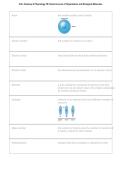
Atom the smallest stable unit of matter
Atomic number the number of protons in an atom
Electron cloud area around the nucleus that contains electrons
Electron shell two-dimensional representation of an electron cloud
Element a pure substance composed of atoms of one kind,
which can not be broken down into simpler substances
by ordinary physical means
Isotopes versions of an element that have different numbers of
neutrons
Mass number the number of protons plus the number of neutrons of
an atom; unique for each isotope
Radioisotopes isotopes that have unstable or radioactive nuclei
, Ch2. Anatomy & Physiology 2E Chemical Level of Organization and Biological Molecules
Radioactive decay the breakdown of the nucleus
Half-life the time required for half of a given amount of isotope
to decay
Atomic weight an average of the different atomic masses and
proportions of different isotopes
Atomic mass the actual mass of an atom, taking into account the
masses of its protons, neutrons and electrons
Mole (mol) a specific quantity that has a weight in grams equal to
the atomic weight of the element
Avogadro's number the number of atoms in one mole of a given element
Valence shell the outermost shell, and the number of electrons in this
shell determines the chemical properties of an element
States of matter Solid - has constant volume and shape; Liquid - has
constant volume but no fixed shape; Gas - no constant
volume and no fixed shape
Physiological roles of acids, bases, and Regulate fluid balance
salts Nerve function
Nutrient absorption
Monomers the building blocks of polymers
, Ch2. Anatomy & Physiology 2E Chemical Level of Organization and Biological Molecules
Polymers large molecules made up of repeating subunits called
monomers
Functional groups specific groups of atoms that confer specific properties
to organic compounds
Chemical reactions processes that involve the rearrangement of atoms to
form new substances
Enzymes proteins that act as catalysts in metabolic processes
Inert elements have a full valence shell and are not reactive
Chemical bonds hold participating atoms together once the reaction has
ended
Molecule two or more atoms joined by shared electrons
Compound two or more atoms of different elements
Molecular weight of a molecule or compound is the sum of the atomic
weights of its atoms
Atom the smallest stable unit of matter
Atomic number the number of protons in an atom
Electron cloud area around the nucleus that contains electrons
Electron shell two-dimensional representation of an electron cloud
Element a pure substance composed of atoms of one kind,
which can not be broken down into simpler substances
by ordinary physical means
Isotopes versions of an element that have different numbers of
neutrons
Mass number the number of protons plus the number of neutrons of
an atom; unique for each isotope
Radioisotopes isotopes that have unstable or radioactive nuclei
, Ch2. Anatomy & Physiology 2E Chemical Level of Organization and Biological Molecules
Radioactive decay the breakdown of the nucleus
Half-life the time required for half of a given amount of isotope
to decay
Atomic weight an average of the different atomic masses and
proportions of different isotopes
Atomic mass the actual mass of an atom, taking into account the
masses of its protons, neutrons and electrons
Mole (mol) a specific quantity that has a weight in grams equal to
the atomic weight of the element
Avogadro's number the number of atoms in one mole of a given element
Valence shell the outermost shell, and the number of electrons in this
shell determines the chemical properties of an element
States of matter Solid - has constant volume and shape; Liquid - has
constant volume but no fixed shape; Gas - no constant
volume and no fixed shape
Physiological roles of acids, bases, and Regulate fluid balance
salts Nerve function
Nutrient absorption
Monomers the building blocks of polymers
, Ch2. Anatomy & Physiology 2E Chemical Level of Organization and Biological Molecules
Polymers large molecules made up of repeating subunits called
monomers
Functional groups specific groups of atoms that confer specific properties
to organic compounds
Chemical reactions processes that involve the rearrangement of atoms to
form new substances
Enzymes proteins that act as catalysts in metabolic processes
Inert elements have a full valence shell and are not reactive
Chemical bonds hold participating atoms together once the reaction has
ended
Molecule two or more atoms joined by shared electrons
Compound two or more atoms of different elements
Molecular weight of a molecule or compound is the sum of the atomic
weights of its atoms


