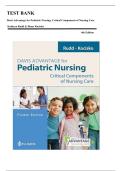
TEST BANK
Davis Advantage for Pediatric Nursing: Critical Components of Nursing Care
Kathryn Rudd & Diane Kocisko
4th Edition
, Table of Contents
Unit I: Pediatric Nursing: An Overview
1. Issues and Trends in Pediatric Nursing
2. Standards of Practice and Ethical Considerations
Unit II: Psycho-Social-Cultural Assessment of the Child and the Family
3. Family Dynamics and Communicating With Children and Families
4. Cultural, Spiritual, and Environmental Influences on the Child
5. End-of-Life Care
6. Communicable Diseases
Unit III: Growth and Development of the Child
7. Growth and Development
8. Newborns and Infants
9. Toddlers and Preschoolers
10. School-Age Children
11. Adolescents
Unit IV: Common Illnesses or Disorders in Childhood and Home Care
12. Respiratory Disorders
13. Cardiovascular Disorders
14. Neurological and Sensory Disorders
15. Mental Health Disorders
16. Gastrointestinal Disorders
17. Renal Disorders
18. Endocrine Disorders
19. Reproductive and Genetic Disorders
20. Hematological, Immunological, and Neoplastic Disorders
21. Musculoskeletal Disorders
22. Dermatological Diseases
,Chapter 1: Issues and Trends in Pediatric Nursing
Multiple Choice
Identify the choice that best completes the statement or answers the question.
(ANSWERS AT THE END OF EVERY CHAPTER)
1. The RN has provided a presentation to middle school children about nursing as a career. One of
the children stated that he wanted to be a pediatric RN, because he wants to take care of babies
and little “kids.” What would be an appropriate response to this middle school–aged child?
1. “Nursing is a general practice; all RNs must know how to take care of all ages of
clients.”
2. “As a pediatric RN, you would get to care for babies and little kids as well as
children through their teenage years.”
3. “What you are describing is actually a neonatal RN. Neonatal RNs work with
newborn babies, toddlers, and preschool-age children.”
4. “Being a pediatric RN requires a master’s degree, so be sure to work hard in
school!”
2. The medical-surgical float RN is assigned to the pediatric unit for the first time and states thatthe
skills are “the same as general nursing since children are little adults with smaller bodies.” What
component of pediatric nursing contraindicates this statement?
1. Pediatric nursing involves care based on the developmental level of the client.
2. Pediatric nursing involves the client’s family in the plan of care.
3. Pediatric nursing in based on prevention of infectious diseases.
4. Pediatric nursing involves cultural sensitivity in client care.
3. The culturally sensitive pediatric RN is aware of the racial makeup of the U.S. population. Which
of the following reflects the demographics of the U.S. pediatric population in 2018, basedon U.S.
Census Bureau data?
1. The American Indian and Alaska Native population represent one-fifth of the
pediatric population.
2. About half of the children fall in the category of something other than White non-
Hispanic.
3. The population of Asian children decreased from 2015 to 2018.
4. There was no change in the population of Non-Hispanic children who represent
two or more races between 2015 and 2018.
4. The RN at a family clinic is providing care to an adolescent client diagnosed with diabetes. The
client has verbalized discomfort with the feelings of isolation when unable to drink alcohol with
their friends. Which of the following would be the most appropriate response to this statement?
1. “Drinking alcohol is not only illegal but dangerous for your blood sugar control
and overall well-being.”
2. “You can still drink alcohol, in moderation, if you control the sugar spike with
more insulin.”
3. “Prepare for alcohol intake with more water and less carbohydrates before drinking
to slow sugar spikes.”
4. “It is understandable that you want to be included, but perhaps we can work out a
plan on how to work through those situations.”
, 5. Which statement best describes the common core concepts of the different models of pediatric
nursing?
1. All models focus on the open communication between the child and RN.
2. All models focus on importance of family relationship to the child.
3. All models focus on safeguarding the child’s dignity during care.
4. All models focus on coordination of care needs that arise during illness.
6. Which of the following tasks is associated with the pediatric medical home care model of pediatric
nursing?
1. The RN refers the family to a childhood cancer support group prior to discharge
from the hospital.
2. The RN includes a simple explanation of the procedure to the child based on the
child’s developmental level.
3. The RN includes the family’s cultural celebrations and observations while
providing care to the child.
4. The RN develops the plan of care with the child and family as the focal point of
the interventions.
7. The pediatric RN begins a research project on 8-year-old clients with the medical diagnosis of
pediatric acute-onset neuropsychiatric syndrome (PANS). The family has consented to the
research, but as the RN begins to administer the intervention, the client refuses to cooperate.
What is the appropriate response to this refusal?
1. The RN should discuss with the family the options of performing the
intervention without the child’s knowledge.
2. The RN should explain to the child that this is necessary and promise a reward at
the end of the research project.
3. The RN should refuse to perform the intervention until the child consents to the
intervention and project.
4. The RN should discuss the pros and cons of the research project with the child
and focus on the outcomes.
8. A RN is providing relationship-based care to a pediatric client. Which of the following is a
challenge the RN is likely to encounter while using this model of care?
1. Maintaining a sterile field for a procedure with a restless toddler
2. Communicating with the blended family on regular basis
3. Treating children with antibiotic-resistant illnesses
4. Caring for a larger number of children with autism spectrum disorders and
childhood depression
9. The pediatric RN desires to expand his or her career options to become the hospital’s RN
educator of pediatrics. Which of the following is necessary for this RN to achieve this careergoal?
1. The RN is recommended to earn a minimum of a master’s degree in nursing.
2. The RN must earn a minimum of a doctorate degree in nursing.
3. The RN must implement and develop research in nursing practice.
4. The RN must implement a plan to obtain certification in pediatrics.
Davis Advantage for Pediatric Nursing: Critical Components of Nursing Care
Kathryn Rudd & Diane Kocisko
4th Edition
, Table of Contents
Unit I: Pediatric Nursing: An Overview
1. Issues and Trends in Pediatric Nursing
2. Standards of Practice and Ethical Considerations
Unit II: Psycho-Social-Cultural Assessment of the Child and the Family
3. Family Dynamics and Communicating With Children and Families
4. Cultural, Spiritual, and Environmental Influences on the Child
5. End-of-Life Care
6. Communicable Diseases
Unit III: Growth and Development of the Child
7. Growth and Development
8. Newborns and Infants
9. Toddlers and Preschoolers
10. School-Age Children
11. Adolescents
Unit IV: Common Illnesses or Disorders in Childhood and Home Care
12. Respiratory Disorders
13. Cardiovascular Disorders
14. Neurological and Sensory Disorders
15. Mental Health Disorders
16. Gastrointestinal Disorders
17. Renal Disorders
18. Endocrine Disorders
19. Reproductive and Genetic Disorders
20. Hematological, Immunological, and Neoplastic Disorders
21. Musculoskeletal Disorders
22. Dermatological Diseases
,Chapter 1: Issues and Trends in Pediatric Nursing
Multiple Choice
Identify the choice that best completes the statement or answers the question.
(ANSWERS AT THE END OF EVERY CHAPTER)
1. The RN has provided a presentation to middle school children about nursing as a career. One of
the children stated that he wanted to be a pediatric RN, because he wants to take care of babies
and little “kids.” What would be an appropriate response to this middle school–aged child?
1. “Nursing is a general practice; all RNs must know how to take care of all ages of
clients.”
2. “As a pediatric RN, you would get to care for babies and little kids as well as
children through their teenage years.”
3. “What you are describing is actually a neonatal RN. Neonatal RNs work with
newborn babies, toddlers, and preschool-age children.”
4. “Being a pediatric RN requires a master’s degree, so be sure to work hard in
school!”
2. The medical-surgical float RN is assigned to the pediatric unit for the first time and states thatthe
skills are “the same as general nursing since children are little adults with smaller bodies.” What
component of pediatric nursing contraindicates this statement?
1. Pediatric nursing involves care based on the developmental level of the client.
2. Pediatric nursing involves the client’s family in the plan of care.
3. Pediatric nursing in based on prevention of infectious diseases.
4. Pediatric nursing involves cultural sensitivity in client care.
3. The culturally sensitive pediatric RN is aware of the racial makeup of the U.S. population. Which
of the following reflects the demographics of the U.S. pediatric population in 2018, basedon U.S.
Census Bureau data?
1. The American Indian and Alaska Native population represent one-fifth of the
pediatric population.
2. About half of the children fall in the category of something other than White non-
Hispanic.
3. The population of Asian children decreased from 2015 to 2018.
4. There was no change in the population of Non-Hispanic children who represent
two or more races between 2015 and 2018.
4. The RN at a family clinic is providing care to an adolescent client diagnosed with diabetes. The
client has verbalized discomfort with the feelings of isolation when unable to drink alcohol with
their friends. Which of the following would be the most appropriate response to this statement?
1. “Drinking alcohol is not only illegal but dangerous for your blood sugar control
and overall well-being.”
2. “You can still drink alcohol, in moderation, if you control the sugar spike with
more insulin.”
3. “Prepare for alcohol intake with more water and less carbohydrates before drinking
to slow sugar spikes.”
4. “It is understandable that you want to be included, but perhaps we can work out a
plan on how to work through those situations.”
, 5. Which statement best describes the common core concepts of the different models of pediatric
nursing?
1. All models focus on the open communication between the child and RN.
2. All models focus on importance of family relationship to the child.
3. All models focus on safeguarding the child’s dignity during care.
4. All models focus on coordination of care needs that arise during illness.
6. Which of the following tasks is associated with the pediatric medical home care model of pediatric
nursing?
1. The RN refers the family to a childhood cancer support group prior to discharge
from the hospital.
2. The RN includes a simple explanation of the procedure to the child based on the
child’s developmental level.
3. The RN includes the family’s cultural celebrations and observations while
providing care to the child.
4. The RN develops the plan of care with the child and family as the focal point of
the interventions.
7. The pediatric RN begins a research project on 8-year-old clients with the medical diagnosis of
pediatric acute-onset neuropsychiatric syndrome (PANS). The family has consented to the
research, but as the RN begins to administer the intervention, the client refuses to cooperate.
What is the appropriate response to this refusal?
1. The RN should discuss with the family the options of performing the
intervention without the child’s knowledge.
2. The RN should explain to the child that this is necessary and promise a reward at
the end of the research project.
3. The RN should refuse to perform the intervention until the child consents to the
intervention and project.
4. The RN should discuss the pros and cons of the research project with the child
and focus on the outcomes.
8. A RN is providing relationship-based care to a pediatric client. Which of the following is a
challenge the RN is likely to encounter while using this model of care?
1. Maintaining a sterile field for a procedure with a restless toddler
2. Communicating with the blended family on regular basis
3. Treating children with antibiotic-resistant illnesses
4. Caring for a larger number of children with autism spectrum disorders and
childhood depression
9. The pediatric RN desires to expand his or her career options to become the hospital’s RN
educator of pediatrics. Which of the following is necessary for this RN to achieve this careergoal?
1. The RN is recommended to earn a minimum of a master’s degree in nursing.
2. The RN must earn a minimum of a doctorate degree in nursing.
3. The RN must implement and develop research in nursing practice.
4. The RN must implement a plan to obtain certification in pediatrics.