5s2 4d10 5p4
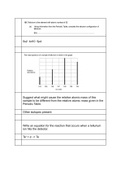
Suggest what might cause the relative atomic mass of this
sample to be different from the relative atomic mass given in the
Periodic Table.
Other isotopes present
Write an equation for the reaction that occurs when a tellurium
ion hits the detector.
Te+ + e- -> Te
, 1. 128
2. Most abundant ion
1. 2 electrons removed from 128Te
2. Due to 128Te2+
1. Same
2. Each isotope has the same number of protons and
electrons
Describe how ions are formed in a time of flight (TOF) mass
spectrometer.
Electrospray ionisation
1. A high voltage is applied to a sample, in a polar solvent
, 2. The sample molecule, M, gains a proton forming MH+
Electron impact ionisation
1. The sample is bombarded by high energy electrons
2. The sample molecule loses an electron forming M+
A TOF mass spectrometer can be used to determine the relative
molecular mass of molecular substances.
Explain why it is necessary to ionise molecules when measuring
their mass in a TOF mass spectrometer
1. Ions, not molecules, will interact with and be accelerated by
an electric field
2. Only ions will create a current when hitting the detector
State the meaning of the term mass number of an isotope.
Total number of protons and neutrons in nucleus of atom
, 1. Ionise sample
2. Accelerate sample
1. m/z
2. Relative abundance
All the isotopes of R react in the same way with concentrated
nitric acid. State why isotopes of an element have the same
chemical properties.
Same electronic configuration
Define the term relative atomic mass.
1. Average mass of 1 atom of an element
Suggest what might cause the relative atomic mass of this
sample to be different from the relative atomic mass given in the
Periodic Table.
Other isotopes present
Write an equation for the reaction that occurs when a tellurium
ion hits the detector.
Te+ + e- -> Te
, 1. 128
2. Most abundant ion
1. 2 electrons removed from 128Te
2. Due to 128Te2+
1. Same
2. Each isotope has the same number of protons and
electrons
Describe how ions are formed in a time of flight (TOF) mass
spectrometer.
Electrospray ionisation
1. A high voltage is applied to a sample, in a polar solvent
, 2. The sample molecule, M, gains a proton forming MH+
Electron impact ionisation
1. The sample is bombarded by high energy electrons
2. The sample molecule loses an electron forming M+
A TOF mass spectrometer can be used to determine the relative
molecular mass of molecular substances.
Explain why it is necessary to ionise molecules when measuring
their mass in a TOF mass spectrometer
1. Ions, not molecules, will interact with and be accelerated by
an electric field
2. Only ions will create a current when hitting the detector
State the meaning of the term mass number of an isotope.
Total number of protons and neutrons in nucleus of atom
, 1. Ionise sample
2. Accelerate sample
1. m/z
2. Relative abundance
All the isotopes of R react in the same way with concentrated
nitric acid. State why isotopes of an element have the same
chemical properties.
Same electronic configuration
Define the term relative atomic mass.
1. Average mass of 1 atom of an element