PDF DOWNLOAD ■
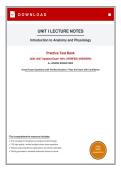
UNIT I LECTURE NOTES
Introduction to Anatomy and Physiology
Practice Test Bank
2026–2027 Updated Exam 100% (VERIFIED ANSWERS)
A+ GRADE BRAND NEW
Actual Exam Questions with Verified Answers / Pass the Exam with Confidence
This comprehensive resource includes:
✓ Full coverage of introductory concepts and terminology
✓ 100 high-quality, verified multiple-choice exam questions
PASS
✓ Step-by-step educational explanations and clinical rationales
100%
✓ Strictly grounded in standard anatomical lecture curricula GUARANTEED
,UNIT I LECTURE NOTES: INTRODUCTION TO ANATOMY & PHYSIOLOGY STUDY RESOURCE — 2026–2027 UPDATED EXAM
TABLE OF CONTENTS & STUDY BLUEPRINT
This master study guide and clinical review book is structured into 8 comprehensive core clinical chapters. Each chapter
corresponds to key physiological domains featured in standard Anatomy & Physiology II Lecture curricula. Every
question is strictly aligned to high-yield clinical learning objectives, detailed verified answers, and extensive rationales.
Each question occupies exactly one full page to optimize clarity and readability.
Chapter / Topic Area Question Range Page Range
Chapter 1: Introductory Definitions & Scientific Pathways Questions 1–12 Pages 3–14
Chapter 2: Overview of Organ Systems Questions 13–35 Pages 15–37
Chapter 3: Homeostasis & Feedback Loops Questions 36–42 Pages 38–44
Chapter 4: Anatomical Position, Planes, Cavities, & Membranes Questions 43–55 Pages 45–57
Chapter 5: Basic Chemistry, pH, & Inorganic Compounds Questions 56–70 Pages 58–72
Chapter 6: Organic Compounds & Biochemistry Questions 71–80 Pages 73–82
Chapter 7: Cell Structure, Organelles, & Membrane Transport Questions 81–90 Pages 83–92
Chapter 8: Tissues, Histology, & Integumentary System Questions 91–100 Pages 93–102
A+ GRADE ONLY — 100% VERIFIED QUESTIONS AND ANSWERS Page 2 of 102
,UNIT I LECTURE NOTES: INTRODUCTION TO ANATOMY & PHYSIOLOGY STUDY RESOURCE — 2026–2027 UPDATED EXAM
CHAPTER 1: INTRODUCTORY DEFINITIONS & SCIENTIFIC PATHWAYS
Question 1 of 100
Learning Objective: Contrast the structural focus of anatomy with the functional focus of physiology.
Which of the following statements represents the correct clinical and academic distinction between
anatomy and physiology?
A. Anatomy is the study of body functions, whereas physiology is the study of body structures.
B. Anatomy is the study of body structures and parts of the body, whereas physiology is the study of body functions
and how these parts work.
C. Anatomy focuses exclusively on microscopic structures, while physiology focuses exclusively on gross organs.
D. Anatomy and physiology are independent fields with no structural relationship to each other.
ANSWER ■: B — Anatomy is the study of body structures and parts of the body, whereas physiology is the study of body
functions and how these parts work.
Explanation: As defined in the Unit I Lecture Notes, anatomy is the study of body structures (parts of the body) [1].
Physiology is the study of body functions (how parts of the body work) [2]. The structural characteristics of a body
component largely determine the function of that component, demonstrating that they are closely related and not
independent [2].
A+ GRADE ONLY — 100% VERIFIED QUESTIONS AND ANSWERS Page 3 of 102
, UNIT I LECTURE NOTES: INTRODUCTION TO ANATOMY & PHYSIOLOGY STUDY RESOURCE — 2026–2027 UPDATED EXAM
CHAPTER 1: INTRODUCTORY DEFINITIONS & SCIENTIFIC PATHWAYS
Question 2 of 100
Learning Objective: Differentiate between gross anatomy and microscopic anatomy.
A medical student is studying structures that are visible to the naked eye without the need for
magnification. Which branch of anatomy does this study represent?
A. Microscopic anatomy.
B. Cytology.
C. Gross anatomy.
D. Histology.
ANSWER ■: C — Gross anatomy.
Explanation: Gross anatomy is defined as the study of relatively large body parts that are visible with the naked eye; that
is, the study of structures that are visible without the need for magnification [1]. Microscopic anatomy covers structures that
cannot be seen without magnification [1].
A+ GRADE ONLY — 100% VERIFIED QUESTIONS AND ANSWERS Page 4 of 102
UNIT I LECTURE NOTES
Introduction to Anatomy and Physiology
Practice Test Bank
2026–2027 Updated Exam 100% (VERIFIED ANSWERS)
A+ GRADE BRAND NEW
Actual Exam Questions with Verified Answers / Pass the Exam with Confidence
This comprehensive resource includes:
✓ Full coverage of introductory concepts and terminology
✓ 100 high-quality, verified multiple-choice exam questions
PASS
✓ Step-by-step educational explanations and clinical rationales
100%
✓ Strictly grounded in standard anatomical lecture curricula GUARANTEED
,UNIT I LECTURE NOTES: INTRODUCTION TO ANATOMY & PHYSIOLOGY STUDY RESOURCE — 2026–2027 UPDATED EXAM
TABLE OF CONTENTS & STUDY BLUEPRINT
This master study guide and clinical review book is structured into 8 comprehensive core clinical chapters. Each chapter
corresponds to key physiological domains featured in standard Anatomy & Physiology II Lecture curricula. Every
question is strictly aligned to high-yield clinical learning objectives, detailed verified answers, and extensive rationales.
Each question occupies exactly one full page to optimize clarity and readability.
Chapter / Topic Area Question Range Page Range
Chapter 1: Introductory Definitions & Scientific Pathways Questions 1–12 Pages 3–14
Chapter 2: Overview of Organ Systems Questions 13–35 Pages 15–37
Chapter 3: Homeostasis & Feedback Loops Questions 36–42 Pages 38–44
Chapter 4: Anatomical Position, Planes, Cavities, & Membranes Questions 43–55 Pages 45–57
Chapter 5: Basic Chemistry, pH, & Inorganic Compounds Questions 56–70 Pages 58–72
Chapter 6: Organic Compounds & Biochemistry Questions 71–80 Pages 73–82
Chapter 7: Cell Structure, Organelles, & Membrane Transport Questions 81–90 Pages 83–92
Chapter 8: Tissues, Histology, & Integumentary System Questions 91–100 Pages 93–102
A+ GRADE ONLY — 100% VERIFIED QUESTIONS AND ANSWERS Page 2 of 102
,UNIT I LECTURE NOTES: INTRODUCTION TO ANATOMY & PHYSIOLOGY STUDY RESOURCE — 2026–2027 UPDATED EXAM
CHAPTER 1: INTRODUCTORY DEFINITIONS & SCIENTIFIC PATHWAYS
Question 1 of 100
Learning Objective: Contrast the structural focus of anatomy with the functional focus of physiology.
Which of the following statements represents the correct clinical and academic distinction between
anatomy and physiology?
A. Anatomy is the study of body functions, whereas physiology is the study of body structures.
B. Anatomy is the study of body structures and parts of the body, whereas physiology is the study of body functions
and how these parts work.
C. Anatomy focuses exclusively on microscopic structures, while physiology focuses exclusively on gross organs.
D. Anatomy and physiology are independent fields with no structural relationship to each other.
ANSWER ■: B — Anatomy is the study of body structures and parts of the body, whereas physiology is the study of body
functions and how these parts work.
Explanation: As defined in the Unit I Lecture Notes, anatomy is the study of body structures (parts of the body) [1].
Physiology is the study of body functions (how parts of the body work) [2]. The structural characteristics of a body
component largely determine the function of that component, demonstrating that they are closely related and not
independent [2].
A+ GRADE ONLY — 100% VERIFIED QUESTIONS AND ANSWERS Page 3 of 102
, UNIT I LECTURE NOTES: INTRODUCTION TO ANATOMY & PHYSIOLOGY STUDY RESOURCE — 2026–2027 UPDATED EXAM
CHAPTER 1: INTRODUCTORY DEFINITIONS & SCIENTIFIC PATHWAYS
Question 2 of 100
Learning Objective: Differentiate between gross anatomy and microscopic anatomy.
A medical student is studying structures that are visible to the naked eye without the need for
magnification. Which branch of anatomy does this study represent?
A. Microscopic anatomy.
B. Cytology.
C. Gross anatomy.
D. Histology.
ANSWER ■: C — Gross anatomy.
Explanation: Gross anatomy is defined as the study of relatively large body parts that are visible with the naked eye; that
is, the study of structures that are visible without the need for magnification [1]. Microscopic anatomy covers structures that
cannot be seen without magnification [1].
A+ GRADE ONLY — 100% VERIFIED QUESTIONS AND ANSWERS Page 4 of 102