
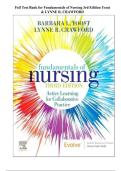
Test Bank For Fundamentals of Nursing 3rd Edition study resource by Barbara L. Yoost and Lynne R. Crawford chapters 1-42
The Fundamentals of Nursing 3rd Edition study resource by Barbara L. Yoost and Lynne R. Crawford is designed to help nursing students strengthen their understanding of essential nursing concepts, clinical skills, patient safety, health assessment, communication, and evidence-based nursing practice. The 3rd edition emphasizes the connection between foundational nursing knowledge and real-world patient care. This independent study resource supports students preparing for fundamentals of nursing courses, classroom examinations, skills checkoffs, clinical experiences, and NCLEX-style assessments. The practice question bank provides an organized way to review core nursing concepts, apply knowledge to patient-care situations, develop clinical judgment, and identify areas requiring additional study. What's Included Comprehensive Practice Questions Chapter-based fundamentals of nursing questions Multiple-choice practice questions Clinical application questions Patient-care scenarios Nursing assessment questions Prioritization and delegation exercises Safety and quality-care questions Nursing process questions Communication and documentation questions Basic skills and clinical-procedure questions Clinical judgment practice NCLEX-style review questions Detailed Educational Explanations Answer explanations Clinical reasoning support Nursing intervention rationales Assessment and prioritization guidance Patient-safety considerations Nursing-process reinforcement Communication principles Patient education concepts Evidence-based nursing applications Ethical and legal considerations Cultural and developmental considerations Core Content Areas Foundations of Nursing Practice History and evolution of nursing Roles and responsibilities of the professional nurse Nursing competencies Nursing process Clinical judgment Evidence-based practice Patient-centered care Quality improvement Patient safety Interprofessional collaboration Care coordination Ethical and legal principles Professional accountability Scope of practice Patient advocacy Cultural responsiveness Health literacy Confidentiality and privacy Health Assessment and Nursing Care Health history Physical assessment Comprehensive and focused assessments Vital-sign measurement Pain assessment Neurological assessment Respiratory assessment Cardiovascular assessment Skin assessment Nutritional assessment Functional assessment Psychosocial assessment Developmental considerations Recognition of patient deterioration Documentation of assessment findings Communication of significant changes Nursing Process and Clinical Judgment Assessment Nursing diagnosis Planning Implementation Evaluation Identifying patient cues Analyzing relevant information Establishing priorities Selecting appropriate interventions Evaluating patient outcomes Revising the plan of care Clinical decision-making Critical thinking Problem-solving Safe assignment and delegation Communication and Therapeutic Relationships Therapeutic communication Active listening Verbal and nonverbal communication Communication barriers Cultural communication Patient interviewing Establishing trust Professional boundaries Conflict resolution Interprofessional communication Handoff communication SBAR communication Documentation and reporting Patient advocacy Difficult conversations Communication with families and caregivers Safety and Infection Prevention Standard precautions Transmission-based precautions Hand hygiene Personal protective equipment Aseptic technique Medical and surgical asepsis Infection prevention Healthcare-associated infections Isolation procedures Patient identification Fall prevention Seizure precautions Aspiration precautions Fire safety Emergency preparedness Safe patient handling Restraint alternatives Restraint use and monitoring Medication safety Error prevention Incident reporting Vital Signs and Basic Measurements Temperature Pulse Respirations Blood pressure Oxygen saturation Pain rating Orthostatic vital signs Factors affecting vital signs Abnormal findings Accurate measurement techniques Documentation Reporting changes in patient condition Pediatric and geriatric considerations Hygiene, Comfort, and Personal Care Bathing and skin care Oral hygiene Hair and nail care Perineal care Bed making Grooming Comfort measures Sleep and rest Environmental control Privacy and dignity Hygiene for dependent patients Infection-control considerations Patient independence Cultural preferences Special care for older adults and patients with disabilities Mobility, Positioning, and Activity Body mechanics Safe patient transfers Ambulation Positioning Range-of-motion exercises Mobility aids Canes, walkers, and crutches Bed mobility Immobility complications Pressure-injury prevention Fall prevention Exercise and activity tolerance Rehabilitation Patient independence Safe use of mechanical lifts Postoperative mobility Nutrition and Hydration Nutritional assessment Dietary requirements Therapeutic diets Feeding assistance Dysphagia precautions Aspiration prevention Enteral nutrition Tube feeding Parenteral nutrition Fluid intake and output Dehydration Fluid overload Electrolyte balance Cultural and religious dietary considerations Patient education Nutrition for healing and recovery Elimination Urinary assessment Bowel assessment Intake and output Urinary catheter care Catheter-associated infection prevention Urinary retention Urinary incontinence Constipation Diarrhea Enemas Ostomy care Specimen collection Toileting assistance Privacy and dignity Elimination changes across the lifespan Skin Integrity and Wound Care Skin assessment Pressure-injury risk assessment Pressure-injury prevention Wound assessment Wound classification Wound drainage Dressing changes Sterile and clean techniques Surgical wounds Skin tears Burns Moisture-associated skin damage Nutrition for wound healing Infection prevention Documentation Patient and caregiver education Oxygenation and Respiratory Care Respiratory assessment Oxygen saturation Oxygen therapy Nasal cannula Simple masks Nonrebreather masks Airway positioning Coughing and deep breathing Incentive spirometry Suctioning Tracheostomy care Aspiration prevention Respiratory distress Emergency airway management Oxygen safety Patient education Fluid, Electrolyte, and Acid-Base Balance Fluid balance Intake and output Dehydration Fluid volume excess Electrolyte assessment Sodium imbalance Potassium imbalance Calcium imbalance Magnesium imbalance Acid-base concepts Basic laboratory interpretation Intravenous fluid therapy Infusion monitoring Complications of fluid therapy Patient safety Medication Administration Medication rights Medication reconciliation Medication orders Dosage calculations Oral medications Sublingual and buccal medications Topical medications Transdermal medications Ophthalmic and otic medications Nasal medications Inhaled medications Enteral medications Parenteral medications Intradermal, subcutaneous, and intramuscular injections Intravenous medication administration Medication storage High-alert medications Adverse effects Allergic reactions Medication education Error prevention Documentation Pain Management Acute pain Chronic pain Pain assessment Pain scales Nonpharmacological interventions Pharmacological interventions Opioid safety Nonopioid analgesics Patient-controlled analgesia Pain reassessment Cultural considerations Pain in older adults Pain in children Barriers to pain management Patient education Evaluation of treatment effectiveness Psychosocial and Mental Health Concepts Emotional support Anxiety Stress Coping Grief and loss Crisis intervention Depression Suicide risk Therapeutic boundaries Spiritual care Family support Social determinants of health Trauma-informed care Patient autonomy Cultural beliefs Referral to appropriate resources Developmental and Lifespan Considerations Infants and children Adolescents Adults Older adults Developmental assessment Age-appropriate communication Growth and development Family-centered care Geriatric syndromes Functional changes Cognitive changes Sensory changes Health promotion across the lifespan Safety considerations by age group Patient Education and Health Promotion Assessing readiness to learn Learning styles Health literacy Teaching methods Patient motivation Medication education Discharge teaching Self-care Disease prevention Wellness promotion Screening and early detection Lifestyle modification Community resources Teach-back method Evaluation of learning Perioperative and Procedural Nursing Care Preoperative assessment Informed consent Surgical safety Patient identification Preoperative teaching Intraoperative safety Postoperative assessment Pain management Wound care Prevention of postoperative complications Deep-vein thrombosis prevention Respiratory exercises Early ambulation Discharge planning Patient and family education Documentation, Informatics, and Care Coordination Legal documentation Electronic health records Accurate charting Timely documentation Objective and subjective data Incident reports Handoff reports Interprofessional communication Care plans Discharge summaries Confidentiality Privacy Information security Use of clinical technology Continuity of care Clinical Judgment and NCLEX Preparation Fundamentals of nursing requires students to integrate assessment findings, patient history, safety concerns, communication, nursing interventions, and responses to care. Practice questions can help students develop skills such as: Recognizing relevant patient cues Identifying changes in patient condition Interpreting vital signs and assessment findings Connecting patient needs with appropriate nursing interventions Establishing priorities Applying the nursing process Selecting safe and effective interventions Determining when to notify the health-care provider Applying delegation and assignment principles Evaluating patient responses Recognizing potential complications Providing patient education Applying infection-control measures Using therapeutic communication Promoting patient independence Applying clinical judgment in basic and complex situations Scenario-based questions may also help students prepare for NCLEX-style clinical judgment tasks involving prioritization, safety, delegation, communication, medication administration, patient education, infection prevention, and evaluation of outcomes. Why Choose This Study Resource? Connects Fundamentals to Clinical Practice Fundamentals of nursing requires more than memorizing procedures. Students must understand why interventions are performed, how to protect patient safety, and how to adapt care to individual patient needs. Builds Clinical Reasoning Patient-care scenarios encourage students to analyze assessment findings, recognize meaningful cues, establish priorities, and select appropriate nursing actions. Supports Fundamentals Exam Preparation Chapter-focused questions provide an organized way to review course material before nursing school examinations, skills checkoffs, clinical evaluations, and cumulative assessments. Reinforces Patient Safety Practice activities help students identify risks, prevent complications, use appropriate precautions, and provide safe, patient-centered care. Strengthens Prioritization and Delegation Foundational nursing practice requires decisions about which patient needs immediate attention, which intervention is most appropriate, and which tasks may be delegated safely. Encourages Active Learning Answering questions and reviewing explanations allows students to identify knowledge gaps, reinforce difficult concepts, and focus study time on areas requiring additional review. Who This Resource Is For ADN nursing students BSN nursing students Fundamentals of nursing students Beginning nursing students Entry-level graduate nursing students Students preparing for NCLEX-style assessments Students preparing for nursing skills checkoffs Students preparing for clinical rotations Nursing tutors and educators Students reviewing basic nursing concepts Students studying health assessment and nursing procedures Students preparing for pharmacology-integrated fundamentals examinations How to Use This Resource Effectively Read the relevant textbook chapter or lecture material. Review the applicable nursing concepts, assessment findings, and clinical skills. Complete practice questions without immediately checking the answers. Analyze why each answer is appropriate. Review related concepts when an answer is incorrect. Connect patient findings with the nursing process. Create notes for recurring safety, communication, and prioritization principles. Practice identifying the most urgent patient need. Review delegation and assignment concepts. Practice documenting and communicating patient information. Revisit difficult topics before examinations and skills checkoffs. Combine the question bank with instructor materials, lecture notes, laboratory practice, clinical resources, and your official textbook. Key Study Topics Students can use this resource to reinforce important areas such as: Fundamentals of nursing Nursing assessment Nursing process Clinical judgment Critical thinking Patient safety Infection prevention Standard precautions Therapeutic communication Documentation Health assessment Vital signs Pain assessment Medication administration Dosage calculations Patient education Health promotion Patient advocacy Ethical and legal nursing practice Cultural responsiveness Health literacy Mobility and positioning Fall prevention Hygiene and comfort Nutrition and hydration Elimination Skin integrity Wound care Oxygenation Fluid and electrolyte balance Acid-base concepts Perioperative nursing Psychosocial care Developmental considerations Geriatric nursing Delegation and assignment Care coordination Interprofessional collaboration Clinical documentation NCLEX-style clinical judgment Academic Integrity & Educational Disclaimer This is an independent educational study resource intended to supplement fundamentals of nursing coursework and examination preparation. It is not affiliated with, endorsed by, or officially distributed by Barbara L. Yoost, Lynne R. Crawford, or the publisher of Fundamentals of Nursing. It does not claim to contain confidential, secure, unreleased, or proprietary examination questions. Students should use this material alongside their official textbook, course resources, instructor guidance, current nursing recommendations, and applicable professional standards. The resource is intended for learning and practice rather than as a substitute for formal instruction. Key Benefits at a Glance Comprehensive fundamentals of nursing review Nursing assessment practice Nursing process questions Clinical judgment exercises Patient-safety review Infection-control practice Therapeutic communication concepts Vital-sign and health-assessment questions Medication administration review Dosage-calculation practice Patient education concepts Mobility and fall-prevention review Nutrition and elimination practice Skin integrity and wound-care concepts Oxygenation and respiratory care Fluid and electrolyte review Pain-management questions Perioperative nursing concepts Developmental and geriatric considerations Delegation and prioritization practice NCLEX-style questions Chapter-focused study Clinical scenario practice Answer explanations and rationales Convenient examination preparation
Document information
- Uploaded on
- September 9, 2026
- Number of pages
- 426
- Written in
- 2026/2027
- Type
- Exam (elaborations)
- Contains
- Questions & answers


