
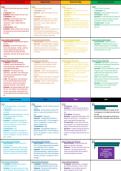
Tropical Forests (Tropical Rainforests) Temperate Forests Boreal Forests (Taiga) Tropical Grasslands (Savannah)
Climate Climate Climate Climate
• Climate is the same all year round, with no individual • 4 distinct seasons of different climates • 1) Temperature = Cold • 2 distinct ‘wet’ and ‘dry’ seasons
seasons • 1) Temperature = Mild • Explanation – Little concentration of the sun’s rays • 1) Temperature = Hot
• 1) Temperature = Hot • Explanation – Moderate concentration of the sun’s • 2) Precipitation = Low • Explanation – High concentration of the sun’s rays
• Explanation – High concentration of the sun’s rays rays • Explanation – Air sinks where these are located (high • 2) Precipitation = Fairly low
• 2) Precipitation = High • 2) Precipitation = High pressure zone) • Explanation – Air sinks where these are located (high
• Explanation – High concentration of sun’s rays → • Explanation – Mid-latitudes so warm + cold air mix • 3) Sunshine Hours = Fairly low pressure zone), which means, despite a wet season
warm air rises (between 2 Hadley Cells) → (between Ferrel Cell + Polar Cell) → warm air rises • Explanation – Due to Earth’s tilt, daylight hours are lasting around 3 months, it is dry overall
condensation → clouds + frequent rainfall (low above cold air → clouds + frequent rainfall (low longer in the summer months but there are little/no • 3) Sunshine Hours = Very high
pressure zone) pressure zone) daylight hours in the winter. Skies are generally clear, • Explanation – Near the equator so lots of sunshine all
• 3) Sunshine Hours = High • 3) Sunshine Hours = Moderate so when there is daylight, there is plenty of sunshine year round
• Explanation – Daylight is around 12 hours per day all • Explanation – Sunshine hours are variable due to the
year round as the sun’s rays are most concentrated at Earth’s tilt, with hours of daylight being shorter in
the equator winter but longer in summer. Sunshine hours are often
relatively low as these areas are often cloudy
Impact of Climate on Global Distribution Impact of Climate on Global Distribution Impact of Climate on Global Distribution Impact of Climate on Global Distribution
• Global Distribution – Located around the equator in • Global Distribution – Located in the mid-latitudes • Global Distribution – Located in northern areas of • Global Distribution – Located in the tropics
the tropics • Explanation – The climate that leads to a temperate the mid-latitudes, close to the Arctic Circle (only form • Explanation – The climate that leads to a topical
• Explanation – The climate that leads to tropical forest is mild + wet conditions, which are met in the in northern hemisphere) grassland is high temperatures + low precipitation,
forests is high temperatures + rainfall + sunshine as mid-latitudes (as warm air rises, forming clouds + • Explanation – The climate that leads to a boreal and this criteria is met in the tropics (but generally not
the dense vegetation that tropical forests are rainfall, but temperatures are not as hot compared to forest is cold temperatures + low precipitation, and at the equator where it is very wet)
characterised by can only be met with intense in the tropics) this criteria is met in northern parts of the mid-
photosynthesis. Only areas near the equator meet this latitudes
criteria
Impact of Climate on Characteristics Impact of Climate on Characteristics Impact of Climate on Characteristics Impact of Climate on Characteristics
• 1) Vegetation – Most trees are evergreen • 1) Vegetation – Fewer plant species than tropical • 1) Vegetation – Trees are evergreen, and they have • 1) Vegetation – Mainly grass + shrubs with a few
(coniferous) in order to take advantage of the rainforests, but still lots of vegetation, which are adapted to the cold + snowy conditions (for example, scattered trees that have adapted to store water from
continual growing season. Forests are dense, with lots usually deciduous trees that drop their leaves in branches on the trees point downwards so that snow the wet season (e.g. baobab trees)
of trees spanning multiple layers autumn as well as shrubs drops off the tree). There are lots of pine trees • Explanation – The dry climate generally only allows
• Explanation – This is because of the high • Explanation – The mild + wet climate supports the • Explanation – The cold + snowy climate supports the the growth of grass + shrubs, and trees that have
temperatures + high rainfall + many sunshine hours, growth of some plant species (but fewer than tropical growth of trees, but only specific trees that are adapted to the climate conditions (only a 3-month
which promotes lots of photosynthesis + therefore rainforests) adapted to this climate season where there is rainfall)
extensive plant growth • 2) Soil – Plants lose leaves in autumn + the leaf litter • 2) Soil – Trees decompose slowly, meaning that the • 2) Soil – Grass decomposes during the dry season,
• 2) Soil – Plants grow quickly + also shed leaves all decomposes quickly, making the soil nutrient-rich soil has few nutrients adding nutrients to the soil, but nutrients are washed
year round, which decompose quickly, providing • Explanation – The moist + mild climate means that • Explanation – Trees decompose slowly due to the away during the wet season
nutrients to the soil. However, the nutrients are leaf litter decomposes very quickly + easily cool + dry climate • Explanation – The 9-month dry season means that
rapidly taken up by plants + there is leaching grass decomposes, but the 3-month wet season
• Explanation – Decomposition happens quickly due to causes the nutrients to wash away
the warm + wet conditions, but lots of plants (due to
the warm + wet conditions) + leaching (due to the
very wet conditions) means that nutrients are quickly
lost
Temperate Grasslands Deserts Tundra Skills
Climate Climate Climate Skill 1
• 2 very pronounced seasons – very hot summers + • 1) Temperature = Very hot in the day (but fairly cold • 1) Temperature = Very low • You need to be able to compare climate graphs for
very cold winters at night) • Explanation – Located at extremely high latitudes + different biomes (skill 1)
• 1) Temperature = Variable (very hot summers but • Explanation – Generally located at the edges of the so they receive a very low concentration of the sun’s • Remember that climate graphs are graphs that show
cold winters) tropics + so receive a high concentration of the sun’s rays the temperature (as a line graph) and rainfall (as bars)
• Explanation – Generally located inland + so far away rays • 2) Precipitation = Extremely low of an area
from the moderating effect of the oceans • 2) Precipitation = Extremely low • Explanation – Located near the poles where air sinks • When describing a climate graph, you should refer to
• 2) Precipitation = Low • Explanation – Located between the Hadley Cell + (between the two Polar Cells) → no evaporation → no the overall trends in the graph as well as specific data
• Explanation – Located between the Hadley Cell + Ferrel Cell (at around 30°N + 30°S of the equator), so clouds → limited rainfall (high pressure zone)
Ferrel Cell (at around 30°N + 30°S of the equator), so air sinks → no evaporation → no clouds → limited • 3) Sunshine Hours = Low in winter (as little or no
air sinks → no evaporation → no clouds → limited rainfall (high pressure zone) hours of daylight) + low in summer (near-continuous
rainfall (high pressure zone) • 3) Sunshine Hours = High daylight in summer but usually lots of cloud cover)
• 3) Sunshine Hours = High • Explanation – Located between the Hadley Cell + • Explanation – Located at extremely high latitudes so
• Explanation – Located between the Hadley Cell + Ferrel Cell (at around 30°N + 30°S of the equator), so either lots of sunlight if tiled towards the sun (in
Ferrel Cell (at around 30°N + 30°S of the equator), so air sinks → no evaporation → no clouds → lots of clear summer) or not sunlight if tilted away from the sun (in
air sinks → no evaporation → no clouds → lots of clear skies + sunshine winter)
skies + sunshine
Impact of Climate on Global Distribution Impact of Climate on Global Distribution Impact of Climate on Global Distribution Skill 2
• Global Distribution – Located at around 30°N + • Global Distribution – Generally located at around • Global Distribution – Located at extremely high • You need to be able to use a world map to show where
30°S of the equator 30°N + 30°S of the equator, but there are exceptions latitudes, near the North + South poles global biomes (major world biomes) are located (skill
• Explanation – The climate that leads to temperate (e.g. the Gobi Desert in China + Mongolia) • Explanation – The climate that leads to tundra is low 2)
grasslands is generally low rainfall + high sunshine • Explanation – The climate that leads to deserts is temperatures + extremely low rainfall, and this 7.1.a – How the Global
hours, and this criteria is met between the Hadley + high daytime temperatures + extremely low rainfall + criteria is met where the Polar Cells are located, at Distribution +
Ferrel Cells – at around 30°N + 30°S of the equator high sunshine hours, and this criteria is met between extremely high latitudes near the poles Characteristics of Major
the Hadley + Ferrel Cells – at around 30°N + 30°S of Biomes are Influenced by
Climate
the equator
Impact of Climate on Characteristics Impact of Climate on Characteristics Impact of Climate on Characteristics
• 1) Vegetation – Few trees, really only grasses + • 1) Vegetation – Plant growth is extremely sparse, • 1) Vegetation – Barely any plants + practically no
small plants are able to grow with just a few plants being able to grow (e.g. cacti) trees, with only some grasses + mosses + shrubs
• Explanation – Few trees as most trees can’t survive • Explanation – Extreme lack of rainfall means that • Explanation – Very cold conditions means that
the very cold winters, with only some grasses + small
almost no plants are able to grow almost no plants/trees are able to grow


