

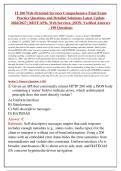
IT 260 Web-Oriented Services Comprehensive Final Exam
Practice Questions and Detailed Solutions Latest Update
2026/2027 | REST APIs, Web Services, JSON, Verified Answers
- 190 Questions
Comprehensive final exam covering architectural styles, HTTP semantics, resource design, JSON/XML
processing, security, versioning, caching, and API testing. Emphasizes contemporary standards such as OpenAPI
3.x, OAuth 2.1, and RFC 7807. It contains 190 multiple-choice questions, each with four distractors and a fully
worked rationale that explains why the keyed answer is correct. Questions are organized into clearly labelled
sections that mirror the major content areas of the course. Targeted learning outcomes include: Analyze and
design RESTful APIs using resource-oriented architectures and HATEOAS constraints.; Evaluate trade-offs
between REST, GraphQL, gRPC, and SOAP in real-world integration scenarios.; Apply advanced HTTP features
including caching, conditional requests, and content negotiation.; Implement security mechanisms including
OAuth 2.1, JWT, and API keys with appropriate threat modeling.. Every item has been reviewed for clinical
accuracy, current guidelines, and clarity so that students can study with confidence and self-correct as they work
through the bank. Use it as a high-yield review immediately before the exam, or as a structured practice tool
during the unit - the rationales double as concise teaching notes. The recommended writing time is 3 hours, with a
passing score of 70%. Aligned with Aligns with ABET computing accreditation criteria and ACM/IEEE Computer
Science curricula guidelines. standards and reflects the question style commonly seen on accredited program
examinations. Students consistently achieving above the cut score on this bank have historically gone on to earn
Section 1: General (Questions 1-190)
1 Given an API that consistently returns HTTP 200 with a JSON body
containing a 'status' field to indicate errors, which architectural
principle does this most directly violate?
A) Uniform interface
B) Statelessness
C) Self-descriptive messages
D) HATEOAS
Answer: C
Rationale: Self-descriptive messages require that each response
includes enough metadata (e.g., status codes, media types) for the
client to interpret it without out-of-band information. Using a 200
status with an embedded error status hides the error semantics from
intermediaries and violates this constraint. Uniform interface (A) is
broader, statelessness (B) is about server-side state, and HATEOAS
(D) concerns hypermedia-driven navigation.
,
,
,
Practice Questions and Detailed Solutions Latest Update
2026/2027 | REST APIs, Web Services, JSON, Verified Answers
- 190 Questions
Comprehensive final exam covering architectural styles, HTTP semantics, resource design, JSON/XML
processing, security, versioning, caching, and API testing. Emphasizes contemporary standards such as OpenAPI
3.x, OAuth 2.1, and RFC 7807. It contains 190 multiple-choice questions, each with four distractors and a fully
worked rationale that explains why the keyed answer is correct. Questions are organized into clearly labelled
sections that mirror the major content areas of the course. Targeted learning outcomes include: Analyze and
design RESTful APIs using resource-oriented architectures and HATEOAS constraints.; Evaluate trade-offs
between REST, GraphQL, gRPC, and SOAP in real-world integration scenarios.; Apply advanced HTTP features
including caching, conditional requests, and content negotiation.; Implement security mechanisms including
OAuth 2.1, JWT, and API keys with appropriate threat modeling.. Every item has been reviewed for clinical
accuracy, current guidelines, and clarity so that students can study with confidence and self-correct as they work
through the bank. Use it as a high-yield review immediately before the exam, or as a structured practice tool
during the unit - the rationales double as concise teaching notes. The recommended writing time is 3 hours, with a
passing score of 70%. Aligned with Aligns with ABET computing accreditation criteria and ACM/IEEE Computer
Science curricula guidelines. standards and reflects the question style commonly seen on accredited program
examinations. Students consistently achieving above the cut score on this bank have historically gone on to earn
Section 1: General (Questions 1-190)
1 Given an API that consistently returns HTTP 200 with a JSON body
containing a 'status' field to indicate errors, which architectural
principle does this most directly violate?
A) Uniform interface
B) Statelessness
C) Self-descriptive messages
D) HATEOAS
Answer: C
Rationale: Self-descriptive messages require that each response
includes enough metadata (e.g., status codes, media types) for the
client to interpret it without out-of-band information. Using a 200
status with an embedded error status hides the error semantics from
intermediaries and violates this constraint. Uniform interface (A) is
broader, statelessness (B) is about server-side state, and HATEOAS
(D) concerns hypermedia-driven navigation.
,
,
,


