

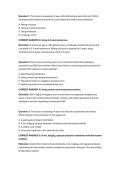
Question 1: The nurse is assessing a 2-year-old child during a well-child visit. Which
developmental milestone should the nurse expect the child to have achieved?
A. Riding a tricycle
B. Using 2-3 word sentences
C. Tying shoelaces
D. Copying a circle
CORRECT ANSWER: B. Using 2-3 word sentences.
Rationale: At 2 years of age, a child typically has a vocabulary of about 50 words and
can speak in 2-3 word sentences. Riding a tricycle is expected at 3 years, tying
shoelaces at 5-6 years, and copying a circle at 3 years.
Question 2: The nurse is providing care to a 6-month-old infant with respiratory
syncytial virus (RSV) bronchiolitis. Which intervention is most important to prevent the
spread of the infection to other patients?
A. Administering antibiotics
B. Using contact and droplet precautions
C. Placing the infant in a negative-pressure room
D. Restricting visitors to immediate family only
CORRECT ANSWER: B. Using contact and droplet precautions.
Rationale: RSV is highly contagious and is transmitted via respiratory droplets and
direct contact with contaminated surfaces. Contact and droplet precautions are the
standard of care for hospitalized infants with RSV.
Question 3: The nurse is assessing a 4-year-old child with suspected otitis media.
Which finding is most indicative of this diagnosis?
A. A pearly gray tympanic membrane
B. A red, bulging, opaque tympanic membrane with decreased mobility
C. A visible cone of light
D. Cerumen impaction in the external ear canal
CORRECT ANSWER: B. A red, bulging, opaque tympanic membrane with decreased
mobility.
Rationale: Acute otitis media is characterized by a red, bulging, and opaque tympanic
membrane with decreased or absent mobility on pneumatic otoscopy. The cone of light
is distorted or absent.
,Question 4: The nurse is caring for a 10-year-old child with newly diagnosed type 1
diabetes mellitus. The child is experiencing polyuria, polydipsia, and polyphagia. The
nurse should anticipate which immediate intervention?
A. Starting an oral hypoglycemic agent
B. Administering a subcutaneous injection of regular insulin
C. Initiating a 24-hour urine collection for glucose
D. Instructing the child on a carbohydrate-controlled diet
CORRECT ANSWER: B. Administering a subcutaneous injection of regular insulin.
Rationale: Type 1 diabetes results from absolute insulin deficiency. The immediate
treatment for hyperglycemia in a newly diagnosed child is insulin therapy. Oral
hypoglycemic agents are used for type 2 diabetes.
Question 5: The nurse is preparing a 5-year-old child for a tonsillectomy. Which
statement is the most therapeutic to explain the procedure to the child?
A. "You are going to have your tonsils taken out so you won't get sick anymore."
B. "The doctor is going to fix your throat so it doesn't hurt anymore."
C. "You will be given a special medicine to make you sleepy, and when you wake up,
your throat will be sore, but we will give you medicine for the pain."
D. "If you are a good boy, you will not feel a thing."
CORRECT ANSWER: C. "You will be given a special medicine to make you sleepy,
and when you wake up, your throat will be sore, but we will give you medicine for
the pain."
Rationale: This statement is honest, developmentally appropriate, and provides a
realistic expectation of the procedure and recovery. It uses concrete language and
avoids euphemisms or false reassurance.
Question 6: The nurse is performing a developmental screening on a 9-month-old
infant using the Denver II Developmental Screening Test. Which fine motor skill should
the nurse expect the infant to have mastered?
A. Pincer grasp
B. Palmar grasp
C. Transferring objects from hand to hand
D. Building a tower of two blocks
CORRECT ANSWER: A. Pincer grasp.
,Rationale: The pincer grasp (using the thumb and forefinger to pick up small objects)
typically develops around 9-10 months. The palmar grasp is present at birth.
Transferring objects hand-to-hand occurs around 7 months, and building a tower of two
blocks occurs at 12-15 months.
Question 7: The nurse is assessing a 2-week-old infant during a well-baby visit. The
mother reports that the infant is crying excessively and seems to be in pain. The nurse
notes that the infant's stool is mucousy and blood-tinged. Which condition should the
nurse suspect?
A. Pyloric stenosis
B. Intussusception
C. Celiac disease
D. Imperforate anus
CORRECT ANSWER: B. Intussusception.
Rationale: Intussusception is the telescoping of a proximal segment of the intestine
into a distal segment. It is most common in infants 3 months to 3 years and presents
with acute, colicky abdominal pain, vomiting, and "currant jelly" (mucousy, bloody)
stools.
Question 8: The nurse is caring for a 5-year-old child with a fever of 104°F (40°C) and a
petechial rash. The child is lethargic and has a sti neck. What is the nurse's priority
action?
A. Administer acetaminophen and a tepid sponge bath
B. Apply cool compresses to the forehead
C. Initiate isolation precautions and notify the healthcare provider immediately
D. Administer a dose of ibuprofen
CORRECT ANSWER: C. Initiate isolation precautions and notify the healthcare
provider immediately.
Rationale: The combination of high fever, petechial rash, lethargy, and nuchal rigidity is
highly suspicious for meningococcal meningitis. This is a medical emergency. The nurse
must initiate isolation precautions immediately and notify the provider to facilitate rapid
administration of antibiotics.
Question 9: The nurse is teaching the parents of a 3-year-old child who has been
diagnosed with iron deficiency anemia. Which dietary instruction is most appropriate?
, A. "Your child should drink whole milk with every meal."
B. "Your child should avoid foods high in vitamin C."
C. "Your child should increase their intake of red meats, beans, and fortified cereals."
D. "Your child should take an iron supplement with a glass of milk."
CORRECT ANSWER: C. "Your child should increase their intake of red meats,
beans, and fortified cereals."
Rationale: Iron-rich foods include red meats, poultry, fish, beans, and iron-fortified
cereals. Vitamin C enhances iron absorption, while calcium (milk) inhibits it. The
supplement should be taken with juice (vitamin C), not milk.
Question 10: The nurse is assessing a 7-year-old child who has been diagnosed with
attention-deficit/hyperactivity disorder (ADHD) and is prescribed methylphenidate. The
nurse should monitor the child for which adverse e ect?
A. Weight gain
B. Bradycardia
C. Decreased appetite and weight loss
D. Hypotension
CORRECT ANSWER: C. Decreased appetite and weight loss.
Rationale: Methylphenidate is a stimulant. Common side e ects include decreased
appetite, weight loss, insomnia, and tachycardia. The child's growth parameters should
be monitored closely.
Question 11: The nurse is assessing a 15-year-old adolescent who is suspected of
having an eating disorder. Which assessment finding is most consistent with anorexia
nervosa?
A. Amenorrhea and lanugo
B. Hypertension and tachycardia
C. Obesity and hyperglycemia
D. Bradycardia and hypothermia
CORRECT ANSWER: D. Bradycardia and hypothermia.
Rationale: Anorexia nervosa is characterized by extreme weight loss, fear of gaining
weight, and a distorted body image. Physiological findings include bradycardia,
hypothermia, hypotension, and amenorrhea. Lanugo (fine hair) is also a common
finding.
developmental milestone should the nurse expect the child to have achieved?
A. Riding a tricycle
B. Using 2-3 word sentences
C. Tying shoelaces
D. Copying a circle
CORRECT ANSWER: B. Using 2-3 word sentences.
Rationale: At 2 years of age, a child typically has a vocabulary of about 50 words and
can speak in 2-3 word sentences. Riding a tricycle is expected at 3 years, tying
shoelaces at 5-6 years, and copying a circle at 3 years.
Question 2: The nurse is providing care to a 6-month-old infant with respiratory
syncytial virus (RSV) bronchiolitis. Which intervention is most important to prevent the
spread of the infection to other patients?
A. Administering antibiotics
B. Using contact and droplet precautions
C. Placing the infant in a negative-pressure room
D. Restricting visitors to immediate family only
CORRECT ANSWER: B. Using contact and droplet precautions.
Rationale: RSV is highly contagious and is transmitted via respiratory droplets and
direct contact with contaminated surfaces. Contact and droplet precautions are the
standard of care for hospitalized infants with RSV.
Question 3: The nurse is assessing a 4-year-old child with suspected otitis media.
Which finding is most indicative of this diagnosis?
A. A pearly gray tympanic membrane
B. A red, bulging, opaque tympanic membrane with decreased mobility
C. A visible cone of light
D. Cerumen impaction in the external ear canal
CORRECT ANSWER: B. A red, bulging, opaque tympanic membrane with decreased
mobility.
Rationale: Acute otitis media is characterized by a red, bulging, and opaque tympanic
membrane with decreased or absent mobility on pneumatic otoscopy. The cone of light
is distorted or absent.
,Question 4: The nurse is caring for a 10-year-old child with newly diagnosed type 1
diabetes mellitus. The child is experiencing polyuria, polydipsia, and polyphagia. The
nurse should anticipate which immediate intervention?
A. Starting an oral hypoglycemic agent
B. Administering a subcutaneous injection of regular insulin
C. Initiating a 24-hour urine collection for glucose
D. Instructing the child on a carbohydrate-controlled diet
CORRECT ANSWER: B. Administering a subcutaneous injection of regular insulin.
Rationale: Type 1 diabetes results from absolute insulin deficiency. The immediate
treatment for hyperglycemia in a newly diagnosed child is insulin therapy. Oral
hypoglycemic agents are used for type 2 diabetes.
Question 5: The nurse is preparing a 5-year-old child for a tonsillectomy. Which
statement is the most therapeutic to explain the procedure to the child?
A. "You are going to have your tonsils taken out so you won't get sick anymore."
B. "The doctor is going to fix your throat so it doesn't hurt anymore."
C. "You will be given a special medicine to make you sleepy, and when you wake up,
your throat will be sore, but we will give you medicine for the pain."
D. "If you are a good boy, you will not feel a thing."
CORRECT ANSWER: C. "You will be given a special medicine to make you sleepy,
and when you wake up, your throat will be sore, but we will give you medicine for
the pain."
Rationale: This statement is honest, developmentally appropriate, and provides a
realistic expectation of the procedure and recovery. It uses concrete language and
avoids euphemisms or false reassurance.
Question 6: The nurse is performing a developmental screening on a 9-month-old
infant using the Denver II Developmental Screening Test. Which fine motor skill should
the nurse expect the infant to have mastered?
A. Pincer grasp
B. Palmar grasp
C. Transferring objects from hand to hand
D. Building a tower of two blocks
CORRECT ANSWER: A. Pincer grasp.
,Rationale: The pincer grasp (using the thumb and forefinger to pick up small objects)
typically develops around 9-10 months. The palmar grasp is present at birth.
Transferring objects hand-to-hand occurs around 7 months, and building a tower of two
blocks occurs at 12-15 months.
Question 7: The nurse is assessing a 2-week-old infant during a well-baby visit. The
mother reports that the infant is crying excessively and seems to be in pain. The nurse
notes that the infant's stool is mucousy and blood-tinged. Which condition should the
nurse suspect?
A. Pyloric stenosis
B. Intussusception
C. Celiac disease
D. Imperforate anus
CORRECT ANSWER: B. Intussusception.
Rationale: Intussusception is the telescoping of a proximal segment of the intestine
into a distal segment. It is most common in infants 3 months to 3 years and presents
with acute, colicky abdominal pain, vomiting, and "currant jelly" (mucousy, bloody)
stools.
Question 8: The nurse is caring for a 5-year-old child with a fever of 104°F (40°C) and a
petechial rash. The child is lethargic and has a sti neck. What is the nurse's priority
action?
A. Administer acetaminophen and a tepid sponge bath
B. Apply cool compresses to the forehead
C. Initiate isolation precautions and notify the healthcare provider immediately
D. Administer a dose of ibuprofen
CORRECT ANSWER: C. Initiate isolation precautions and notify the healthcare
provider immediately.
Rationale: The combination of high fever, petechial rash, lethargy, and nuchal rigidity is
highly suspicious for meningococcal meningitis. This is a medical emergency. The nurse
must initiate isolation precautions immediately and notify the provider to facilitate rapid
administration of antibiotics.
Question 9: The nurse is teaching the parents of a 3-year-old child who has been
diagnosed with iron deficiency anemia. Which dietary instruction is most appropriate?
, A. "Your child should drink whole milk with every meal."
B. "Your child should avoid foods high in vitamin C."
C. "Your child should increase their intake of red meats, beans, and fortified cereals."
D. "Your child should take an iron supplement with a glass of milk."
CORRECT ANSWER: C. "Your child should increase their intake of red meats,
beans, and fortified cereals."
Rationale: Iron-rich foods include red meats, poultry, fish, beans, and iron-fortified
cereals. Vitamin C enhances iron absorption, while calcium (milk) inhibits it. The
supplement should be taken with juice (vitamin C), not milk.
Question 10: The nurse is assessing a 7-year-old child who has been diagnosed with
attention-deficit/hyperactivity disorder (ADHD) and is prescribed methylphenidate. The
nurse should monitor the child for which adverse e ect?
A. Weight gain
B. Bradycardia
C. Decreased appetite and weight loss
D. Hypotension
CORRECT ANSWER: C. Decreased appetite and weight loss.
Rationale: Methylphenidate is a stimulant. Common side e ects include decreased
appetite, weight loss, insomnia, and tachycardia. The child's growth parameters should
be monitored closely.
Question 11: The nurse is assessing a 15-year-old adolescent who is suspected of
having an eating disorder. Which assessment finding is most consistent with anorexia
nervosa?
A. Amenorrhea and lanugo
B. Hypertension and tachycardia
C. Obesity and hyperglycemia
D. Bradycardia and hypothermia
CORRECT ANSWER: D. Bradycardia and hypothermia.
Rationale: Anorexia nervosa is characterized by extreme weight loss, fear of gaining
weight, and a distorted body image. Physiological findings include bradycardia,
hypothermia, hypotension, and amenorrhea. Lanugo (fine hair) is also a common
finding.


