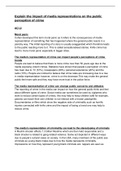
Explain the impact of media representations on the public
perception of crime
AC1.5
Moral panic
Cohen developed this term moral panic as it refers to the consequences of media
representation of something that has happened where the general public reacts in a
panicky way. The initial reporting of a story is usually exaggerated which therefore leads
to the public reacting more to it. This is called sensationalised stories. Knife crime has
lead to more moral panic especially in bigger cities.
The media's representation of crime can impact people’s perceptions of crime
trends
People are lead to believe that there is more crime now than 50 years ago due to the
media exposing violent crimes. Statistics have shown that people’s perception of crime
has risen due to TV (57%), newspapers (48%), personal experience (20%) and the
radio (15%). People are inclined to believe that crime rates are increasing due to a rise
in media representation however, crime is on the decrease.This may make the general
public feel more safe and they may have more trust in the police force.
The media representation of crime can change public concerns and attitudes
The reporting of crime in the media can impact on how the general public think and feel
about different types of crime. Social media can sometimes be used by vigilantes who
want to reduce certain types of crimes, this may help to keep children safe for example,
parents can teach their own children to not interact with a known paedophile.
Documentaries or films which show the negative side of criminality such as horrific
injuries connected with knife crime and the impact of losing a loved one may help to
reduce crime.
The media’s representation of criminality can lead to the stereotyping of criminals
A Muslim shooter effects 1.3 billion Muslims which are then held responsible and a
black shooter is related to gang related violence. Same act depicted in different ways
due to people’s cultural views on society. In the USA, many members of the public see
criminals as young black males due to how the media represents criminality.
Impressions on how they represent young black criminals are: rappers are seen as
perception of crime
AC1.5
Moral panic
Cohen developed this term moral panic as it refers to the consequences of media
representation of something that has happened where the general public reacts in a
panicky way. The initial reporting of a story is usually exaggerated which therefore leads
to the public reacting more to it. This is called sensationalised stories. Knife crime has
lead to more moral panic especially in bigger cities.
The media's representation of crime can impact people’s perceptions of crime
trends
People are lead to believe that there is more crime now than 50 years ago due to the
media exposing violent crimes. Statistics have shown that people’s perception of crime
has risen due to TV (57%), newspapers (48%), personal experience (20%) and the
radio (15%). People are inclined to believe that crime rates are increasing due to a rise
in media representation however, crime is on the decrease.This may make the general
public feel more safe and they may have more trust in the police force.
The media representation of crime can change public concerns and attitudes
The reporting of crime in the media can impact on how the general public think and feel
about different types of crime. Social media can sometimes be used by vigilantes who
want to reduce certain types of crimes, this may help to keep children safe for example,
parents can teach their own children to not interact with a known paedophile.
Documentaries or films which show the negative side of criminality such as horrific
injuries connected with knife crime and the impact of losing a loved one may help to
reduce crime.
The media’s representation of criminality can lead to the stereotyping of criminals
A Muslim shooter effects 1.3 billion Muslims which are then held responsible and a
black shooter is related to gang related violence. Same act depicted in different ways
due to people’s cultural views on society. In the USA, many members of the public see
criminals as young black males due to how the media represents criminality.
Impressions on how they represent young black criminals are: rappers are seen as