1
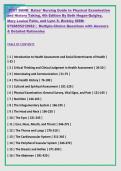
TEST BANK Bates' Nursing Guide to Physical Examination
and History Taking, 4th Edition By Beth Hogan-Quigley,
Mary Louise Palm, and Lynn S. Bickley ISBN:
9798855212082 | Multiple-Choice Questions with Answers
& Detailed Rationales
TABLE OF CONTENTS
| 1 | Introduction to Health Assessment and Social Determinants of Health |
1-25 |
| 2 | Critical Thinking and Clinical Judgment in Health Assessment | 26-50 |
| 3 | Interviewing and Communication | 51-75 |
| 4 | The Health History | 76-100 |
| 5 | Cultural and Spiritual Assessment | 101-120 |
| 6 | Physical Examination: General Survey, Vital Signs, and Pain | 121-145 |
| 7 | Nutrition | 146-165 |
| 8 | The Integumentary System | 166-195 |
| 9 | The Head and Neck | 196-220 |
| 10 | The Eyes | 221-245 |
| 11 | Ears, Nose, Mouth, and Throat | 246-275 |
| 12 | The Thorax and Lungs | 276-310 |
| 13 | The Cardiovascular System | 311-345 |
| 14 | The Peripheral Vascular System | 346-370 |
| 15 | The Breasts and Axillae | 371-390 |
| 16 | The Abdomen | 391-420 |
,2
| 17 | The Male Genitourinary System | 421-440 |
| 18 | The Female Genitourinary System | 441-465 |
| 19 | The Musculoskeletal System | 466-500 |
| 20 | The Neurologic System | 501-540 |
| 21 | The Anus, Rectum, and Prostate | 541-555 |
| 22 | The Pregnant Patient | 556-575 |
| 23 | The Pediatric Patient | 576-590 |
| 24 | The Older Adult Patient | 591-600 |
TEST BANK FINAL EXAM 2026 -2027
1. A 72-year-old patient presents with progressive memory loss, difficulty
finding words, and personality changes over the past 18 months. The family
reports the patient has gotten lost while driving to familiar locations. The
patient's Mini-Mental State Examination (MMSE) score is 22/30. Which
assessment approach is most appropriate for evaluating this patient's
cognitive status?**
- A) Repeat the MMSE in 6 months to monitor for progression
- B) Administer the Montreal Cognitive Assessment (MoCA) with evaluation of
executive function and visuospatial skills
- C) Perform a clock-drawing test only
- D) Refer for neuropsychological testing without further screening
,3
Answer: B
Rationale: The MoCA is more sensitive than the MMSE for detecting mild
cognitive impairment and early dementia because it assesses executive
function, visuospatial skills, and delayed recall. The patient's symptoms—
progressive memory loss, word-finding difficulty, personality changes, and
getting lost—suggest possible early dementia or mild cognitive impairment
requiring comprehensive cognitive screening. The MMSE score of 22/30 is
abnormal (normal ≥ 24) and warrants further evaluation. The clock-drawing
test alone (C) is insufficient as a screening tool. Neuropsychological testing (D)
may be indicated but should follow a more comprehensive screening.
2. During a cardiovascular assessment, the nurse palpates the chest and
identifies a thrill at the second intercostal space, left sternal border. This
finding is most consistent with:**
- A) Aortic stenosis
- B) Pulmonary stenosis
- C) Ventricular septal defect
- D) Mitral regurgitation
Answer: B
Rationale: A thrill is a palpable vibration that indicates turbulent blood flow.
The second left intercostal space at the left sternal border is the pulmonic
area. A thrill in this location is most consistent with pulmonary stenosis or
pulmonary valve pathology. Aortic stenosis (A) would be felt at the second
right intercostal space (aortic area). Ventricular septal defect (C) would be felt
at the third to fourth left intercostal spaces. Mitral regurgitation (D) would be
felt at the apex (fifth intercostal space, midclavicular line).
, 4
3. A 45-year-old patient with a history of hypertension presents with acute
onset of severe headache, nausea, vomiting, and photophobia. On
examination, the patient has nuchal rigidity. Which diagnostic procedure is
contraindicated before a CT scan?
- A) Lumbar puncture
- B) Magnetic resonance imaging (MRI)
- C) Computed tomography (CT) of the head
- D) Carotid ultrasound
Answer: A
Rationale: Lumbar puncture is contraindicated before a CT scan in a patient
with suspected subarachnoid hemorrhage because of the risk of cerebral
herniation if increased intracranial pressure is present. The patient's
symptoms—acute severe headache, nausea, vomiting, photophobia, and
nuchal rigidity—suggest possible subarachnoid hemorrhage or meningitis. CT
scan should be performed first to rule out mass effect or hemorrhage before
considering lumbar puncture. MRI (B) is not the first-line imaging for acute
head trauma. Carotid ultrasound (D) is not indicated for this presentation.
4. During a neurologic examination, the nurse asks the patient to close their
eyes and identify a familiar object placed in their hand. This test assesses
which function?
- A) Stereognosis
- B) Graphesthesia
- C) Two-point discrimination
- D) Proprioception
TEST BANK Bates' Nursing Guide to Physical Examination
and History Taking, 4th Edition By Beth Hogan-Quigley,
Mary Louise Palm, and Lynn S. Bickley ISBN:
9798855212082 | Multiple-Choice Questions with Answers
& Detailed Rationales
TABLE OF CONTENTS
| 1 | Introduction to Health Assessment and Social Determinants of Health |
1-25 |
| 2 | Critical Thinking and Clinical Judgment in Health Assessment | 26-50 |
| 3 | Interviewing and Communication | 51-75 |
| 4 | The Health History | 76-100 |
| 5 | Cultural and Spiritual Assessment | 101-120 |
| 6 | Physical Examination: General Survey, Vital Signs, and Pain | 121-145 |
| 7 | Nutrition | 146-165 |
| 8 | The Integumentary System | 166-195 |
| 9 | The Head and Neck | 196-220 |
| 10 | The Eyes | 221-245 |
| 11 | Ears, Nose, Mouth, and Throat | 246-275 |
| 12 | The Thorax and Lungs | 276-310 |
| 13 | The Cardiovascular System | 311-345 |
| 14 | The Peripheral Vascular System | 346-370 |
| 15 | The Breasts and Axillae | 371-390 |
| 16 | The Abdomen | 391-420 |
,2
| 17 | The Male Genitourinary System | 421-440 |
| 18 | The Female Genitourinary System | 441-465 |
| 19 | The Musculoskeletal System | 466-500 |
| 20 | The Neurologic System | 501-540 |
| 21 | The Anus, Rectum, and Prostate | 541-555 |
| 22 | The Pregnant Patient | 556-575 |
| 23 | The Pediatric Patient | 576-590 |
| 24 | The Older Adult Patient | 591-600 |
TEST BANK FINAL EXAM 2026 -2027
1. A 72-year-old patient presents with progressive memory loss, difficulty
finding words, and personality changes over the past 18 months. The family
reports the patient has gotten lost while driving to familiar locations. The
patient's Mini-Mental State Examination (MMSE) score is 22/30. Which
assessment approach is most appropriate for evaluating this patient's
cognitive status?**
- A) Repeat the MMSE in 6 months to monitor for progression
- B) Administer the Montreal Cognitive Assessment (MoCA) with evaluation of
executive function and visuospatial skills
- C) Perform a clock-drawing test only
- D) Refer for neuropsychological testing without further screening
,3
Answer: B
Rationale: The MoCA is more sensitive than the MMSE for detecting mild
cognitive impairment and early dementia because it assesses executive
function, visuospatial skills, and delayed recall. The patient's symptoms—
progressive memory loss, word-finding difficulty, personality changes, and
getting lost—suggest possible early dementia or mild cognitive impairment
requiring comprehensive cognitive screening. The MMSE score of 22/30 is
abnormal (normal ≥ 24) and warrants further evaluation. The clock-drawing
test alone (C) is insufficient as a screening tool. Neuropsychological testing (D)
may be indicated but should follow a more comprehensive screening.
2. During a cardiovascular assessment, the nurse palpates the chest and
identifies a thrill at the second intercostal space, left sternal border. This
finding is most consistent with:**
- A) Aortic stenosis
- B) Pulmonary stenosis
- C) Ventricular septal defect
- D) Mitral regurgitation
Answer: B
Rationale: A thrill is a palpable vibration that indicates turbulent blood flow.
The second left intercostal space at the left sternal border is the pulmonic
area. A thrill in this location is most consistent with pulmonary stenosis or
pulmonary valve pathology. Aortic stenosis (A) would be felt at the second
right intercostal space (aortic area). Ventricular septal defect (C) would be felt
at the third to fourth left intercostal spaces. Mitral regurgitation (D) would be
felt at the apex (fifth intercostal space, midclavicular line).
, 4
3. A 45-year-old patient with a history of hypertension presents with acute
onset of severe headache, nausea, vomiting, and photophobia. On
examination, the patient has nuchal rigidity. Which diagnostic procedure is
contraindicated before a CT scan?
- A) Lumbar puncture
- B) Magnetic resonance imaging (MRI)
- C) Computed tomography (CT) of the head
- D) Carotid ultrasound
Answer: A
Rationale: Lumbar puncture is contraindicated before a CT scan in a patient
with suspected subarachnoid hemorrhage because of the risk of cerebral
herniation if increased intracranial pressure is present. The patient's
symptoms—acute severe headache, nausea, vomiting, photophobia, and
nuchal rigidity—suggest possible subarachnoid hemorrhage or meningitis. CT
scan should be performed first to rule out mass effect or hemorrhage before
considering lumbar puncture. MRI (B) is not the first-line imaging for acute
head trauma. Carotid ultrasound (D) is not indicated for this presentation.
4. During a neurologic examination, the nurse asks the patient to close their
eyes and identify a familiar object placed in their hand. This test assesses
which function?
- A) Stereognosis
- B) Graphesthesia
- C) Two-point discrimination
- D) Proprioception