Crime and Punishment
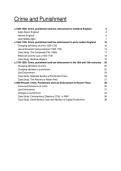
c.1000-1500: Crime, punishment and law enforcement in medieval England 2
Anglo Saxon England 2
Norman England 5
Later Middle Ages 7
c.1500-1700: Crime, punishment and law enforcement in early modern England 10
Changing definitions of crime 1500-1700 10
Law enforcement and punishment 1500-1700 13
Case Study: The Gunpowder Plot (1605) 17
Witchcraft and the Law c.1500-1700 18
Case Study: Matthew Hopkins 19
c.1700-1900: Crime, punishment and law enforcement in the 18th and 19th centuries 20
Changing definitions of crime 20
Changing attitudes to punishment 22
Law Enforcement 24
Case Study: Separate System at Pentonville Prison 26
Case Study: The Reforms of Robert Peel 27
c1900-Present: Crime, Punishment and Law Enforcement in Recent Times 29
Crime and Definitions of Crime 30
Law Enforcement 31
Changes in punishment 34
Case Study: Conscientious Objectors (COs) in WW1 36
Case Study: Derek Bentley Case and Abolition of Capital Punishment 38
,c.1000-1500: Crime, punishment and law
enforcement in medieval England
Key Dates
● 1072: Forest Laws introduced
● 1086: Domesday Book
● 1164: Constitutions of Clarendon
● 1194: Coroners are introduced
● 1215: Trial by ordeal ends
● 1348: Black death reaches England
● 1485: Henry Tudor becomes Henry VII
Anglo Saxon England
Overview
● Anglo-Saxon England = crime and punishment dealt with by local communities (some
involvement of Church and King
● 1066: Normans invade England and change structure → new punishments, redefinitions
of crimes.
○ Also sparked challenges to government authority
● Growth of towns = rise in crime rates and new ideas about law enforcement
● Church played an important part in defining and enforcing law
Anglo-Saxon England
● 1000: England’s population = c.1,700,000 and 2,000,000 and 90% lived in the
countryside
○ Lived in small scattered hamlets (small settlement) and farmsteads.
○ Vulnerable to failure of harvests and diseases like plague.
● Three important trends in crime and punishment in the Anglo-Saxon period
○ Power and influence of the King in crime and punishment grew → penalties
increasingly decided by the King
○ Role of the Church increased
○ Use of punishments increased (including capital punishment)
The Role of Anglo-Saxon Kings
● 978-1016: King Etherlred II ruled
○ During his reign, there were Viking attacks from border areas between England
and Scotland
○ Ethelred attacked some viking settlements and tried to stop them further by
making alliances with Normandy. (This gave him more control over the Kingdom)
● Ethelred’s new system was basic and relied on local customs.
, ○ As the territory of England grew, it was increasingly accepted the King would
make and enforce laws to maintain the King’s peace.
●
● Actions that threatened this social structure were classed as crimes from starting a fight
with a noble to treason.
○ These types of crimes are known as crimes against authority.
Crimes in Anglo-Saxon Communities, Towns, Villages and Abbeys
● Key towns: Hamwic (Southampton), Eoforwic (York) and Lundenwic (London)
○ Grew due to trade contacts with Europe, coined money and increasing
populations.
○ BUT most people still lived in villages
○ High concentration of trade goods = more theft and crimes against property
○ Also crimes against the person e.g., physical assault or murder.
● Local communities were expected to take collective responsibility for upholding the law
● Each areas had a reeve (a local official appointed from the community) who carried out
decisions made by local courts
● Increasing numbers of abbeys and monasteries required daily labourers for food and
supplies and to run the buildings.
○ The church focused on moral crimes → crimes that did not match up to society’s
views on decent behaviour.
Anglo-Saxon Law Enforcement
● Anglo-Saxon kings formally issued codes of law → with each new code, new laws could
be introduced, existing laws altered and laws strengthened.
● Severity of crime was based on organisation of Anglo-Saxon society. They believed that
○ The role of the local community in policing was important
, ○ God was the final judge of innocence or guilt
○ The status and position of different groups should be clear in law
The Role of the Community
● Victim should seek justice but local community should help (seen as duty)
● Hue and cry - shouting for help increasingly.
● English shires divided into hundreds and hundreds into ten tithings.
○ All men over the age 12 in a tithing were responsible for the behaviour of all
others
● One man from each hundred and one man from each tithing had to meet regularly with
the King’s shire reeve.
○ Crimes e..g, cattle theft → when chasing a cattle thief a ‘hundreds man’ was
entitled to take two ‘tinghingmen’ with him
Proving Innocence or Guilt
● Oaths were involved in proving people’s innocence → hearings took place in public and
accused would swear innocence under oath
○ Community members would also support their claims as ‘oath helpers’
○ Most of the time, people went free → small tight-knit communities it would be
hard for someone to get away with a repeat offence (these were not given the
option of swearing an oath of innocence)
● Trial by ordeal (used when there is limited evidence)
○ Injure someone, then if they heal well, it means God thinks they’re innocent, if
not, they’re guilty.
○ Examples: hot iron, hot water on hands. Throwing someone into cold water with
their arms tied (float = guilty, sink = not guilty)
● For some smaller crimes such as petty theft, the Church advised maiming (e..g, hand or
ear cut off, tongue cut out) → seen as giving them time to seek forgiveness from God.
Anglo-Saxon Punishments
● Wergild (man price) = fine paid to a victim's family if you’ve murdered them
○ Intended to reduce blood feuds
○ Fines payable by social status
■ Prince = 1500 shillings
■ Yeoman farmer = 100 shillings
■ Serf = 40 shillings
● Corporal punishment: range of punishments that cause harm or pain to the body (e.g.,
beaten or body parts removed
● Retribution: severe punishment meant to match the severity of the crime
● Deterrent: punishment that is frightening or painful with the intention of putting people off
committing the same crime.
● Treason and arson (serious because it damaged the property of the ruling classes) =
capital punishment (usually hanging).
● Public punishments e.g., stocks and pillory (catchneck)
c.1000-1500: Crime, punishment and law enforcement in medieval England 2
Anglo Saxon England 2
Norman England 5
Later Middle Ages 7
c.1500-1700: Crime, punishment and law enforcement in early modern England 10
Changing definitions of crime 1500-1700 10
Law enforcement and punishment 1500-1700 13
Case Study: The Gunpowder Plot (1605) 17
Witchcraft and the Law c.1500-1700 18
Case Study: Matthew Hopkins 19
c.1700-1900: Crime, punishment and law enforcement in the 18th and 19th centuries 20
Changing definitions of crime 20
Changing attitudes to punishment 22
Law Enforcement 24
Case Study: Separate System at Pentonville Prison 26
Case Study: The Reforms of Robert Peel 27
c1900-Present: Crime, Punishment and Law Enforcement in Recent Times 29
Crime and Definitions of Crime 30
Law Enforcement 31
Changes in punishment 34
Case Study: Conscientious Objectors (COs) in WW1 36
Case Study: Derek Bentley Case and Abolition of Capital Punishment 38
,c.1000-1500: Crime, punishment and law
enforcement in medieval England
Key Dates
● 1072: Forest Laws introduced
● 1086: Domesday Book
● 1164: Constitutions of Clarendon
● 1194: Coroners are introduced
● 1215: Trial by ordeal ends
● 1348: Black death reaches England
● 1485: Henry Tudor becomes Henry VII
Anglo Saxon England
Overview
● Anglo-Saxon England = crime and punishment dealt with by local communities (some
involvement of Church and King
● 1066: Normans invade England and change structure → new punishments, redefinitions
of crimes.
○ Also sparked challenges to government authority
● Growth of towns = rise in crime rates and new ideas about law enforcement
● Church played an important part in defining and enforcing law
Anglo-Saxon England
● 1000: England’s population = c.1,700,000 and 2,000,000 and 90% lived in the
countryside
○ Lived in small scattered hamlets (small settlement) and farmsteads.
○ Vulnerable to failure of harvests and diseases like plague.
● Three important trends in crime and punishment in the Anglo-Saxon period
○ Power and influence of the King in crime and punishment grew → penalties
increasingly decided by the King
○ Role of the Church increased
○ Use of punishments increased (including capital punishment)
The Role of Anglo-Saxon Kings
● 978-1016: King Etherlred II ruled
○ During his reign, there were Viking attacks from border areas between England
and Scotland
○ Ethelred attacked some viking settlements and tried to stop them further by
making alliances with Normandy. (This gave him more control over the Kingdom)
● Ethelred’s new system was basic and relied on local customs.
, ○ As the territory of England grew, it was increasingly accepted the King would
make and enforce laws to maintain the King’s peace.
●
● Actions that threatened this social structure were classed as crimes from starting a fight
with a noble to treason.
○ These types of crimes are known as crimes against authority.
Crimes in Anglo-Saxon Communities, Towns, Villages and Abbeys
● Key towns: Hamwic (Southampton), Eoforwic (York) and Lundenwic (London)
○ Grew due to trade contacts with Europe, coined money and increasing
populations.
○ BUT most people still lived in villages
○ High concentration of trade goods = more theft and crimes against property
○ Also crimes against the person e.g., physical assault or murder.
● Local communities were expected to take collective responsibility for upholding the law
● Each areas had a reeve (a local official appointed from the community) who carried out
decisions made by local courts
● Increasing numbers of abbeys and monasteries required daily labourers for food and
supplies and to run the buildings.
○ The church focused on moral crimes → crimes that did not match up to society’s
views on decent behaviour.
Anglo-Saxon Law Enforcement
● Anglo-Saxon kings formally issued codes of law → with each new code, new laws could
be introduced, existing laws altered and laws strengthened.
● Severity of crime was based on organisation of Anglo-Saxon society. They believed that
○ The role of the local community in policing was important
, ○ God was the final judge of innocence or guilt
○ The status and position of different groups should be clear in law
The Role of the Community
● Victim should seek justice but local community should help (seen as duty)
● Hue and cry - shouting for help increasingly.
● English shires divided into hundreds and hundreds into ten tithings.
○ All men over the age 12 in a tithing were responsible for the behaviour of all
others
● One man from each hundred and one man from each tithing had to meet regularly with
the King’s shire reeve.
○ Crimes e..g, cattle theft → when chasing a cattle thief a ‘hundreds man’ was
entitled to take two ‘tinghingmen’ with him
Proving Innocence or Guilt
● Oaths were involved in proving people’s innocence → hearings took place in public and
accused would swear innocence under oath
○ Community members would also support their claims as ‘oath helpers’
○ Most of the time, people went free → small tight-knit communities it would be
hard for someone to get away with a repeat offence (these were not given the
option of swearing an oath of innocence)
● Trial by ordeal (used when there is limited evidence)
○ Injure someone, then if they heal well, it means God thinks they’re innocent, if
not, they’re guilty.
○ Examples: hot iron, hot water on hands. Throwing someone into cold water with
their arms tied (float = guilty, sink = not guilty)
● For some smaller crimes such as petty theft, the Church advised maiming (e..g, hand or
ear cut off, tongue cut out) → seen as giving them time to seek forgiveness from God.
Anglo-Saxon Punishments
● Wergild (man price) = fine paid to a victim's family if you’ve murdered them
○ Intended to reduce blood feuds
○ Fines payable by social status
■ Prince = 1500 shillings
■ Yeoman farmer = 100 shillings
■ Serf = 40 shillings
● Corporal punishment: range of punishments that cause harm or pain to the body (e.g.,
beaten or body parts removed
● Retribution: severe punishment meant to match the severity of the crime
● Deterrent: punishment that is frightening or painful with the intention of putting people off
committing the same crime.
● Treason and arson (serious because it damaged the property of the ruling classes) =
capital punishment (usually hanging).
● Public punishments e.g., stocks and pillory (catchneck)