

Written by students who passed Immediately available after payment Read online or as PDF Wrong document? Swap it for free 4.6 TrustPilot
logo-home
Document preview thumbnail
Preview 2 out of 15 pages
Exam (elaborations)

Abnormal Psychology Test 1 Chapters 1–4 Questions & Answers 2026/2027 | Psychopathology, Biopsychosocial Model, DSM-5 & Clinical Assessment

Document preview thumbnail
Preview 2 out of 15 pages

This 15-page Abnormal Psychology Test 1 study document provides approximately 55 question-and-answer study items covering Chapters 1–4 for the 2026/2027 academic year. The material focuses on the foundations of psychopathology, definitions of psychological disorder, historical biological and psychological traditions, contemporary learning theory, the biopsychosocial/integrative model, diathesis-stress theory, gene–environment interactions, neuroscience, clinical assessment and diagnosis, DSM classification, and basic psychological research methods. The document gives particular attention to the integrative approach to psychopathology, examining how biological, psychological, social, environmental, and learning influences interact rather than treating mental disorders as products of a single cause. Important concepts include Wakefield's harmful dysfunction framework, person × environment interactions, genetic vulnerability, gene–environment correlation, environmental effects on gene functioning, neurons and neurotransmitters, brain structures, social and observational learning, and the influence of developmental environments. These themes closely correspond to the framework used in Barlow, Durand, and Hofmann's Abnormal Psychology: An Integrative Approach, which emphasizes interactions among biological, psychological, social, and cultural influences in understanding psychopathology. For clinical assessment and diagnosis, the study material reviews reliability, validity, standardization, the mental status examination, physical and behavioral assessment, personality assessment with the MMPI, neuropsychological testing, neuroimaging, psychophysiological assessment, diagnostic classification, dimensional and prototypical approaches, DSM-related concepts, and critiques such as comorbidity, stigma, diagnostic boundaries, reliability, and validity. It concludes with research fundamentals, including hypotheses, research design, independent and dependent variables, group research, and idiographic/single-case research. These subject areas align closely with the textbook's opening four chapters: abnormal behavior in historical context, the integrative approach to psychopathology, clinical assessment and diagnosis, and research methods. APA reference: Barlow, D. H., Durand, V. M., & Hofmann, S. G. (2018). Abnormal psychology: An integrative approach (8th ed.). Cengage Learning. Relevant students: This resource is most relevant to undergraduate students taking Abnormal Psychology, Psychopathology, Clinical Psychology, Mental Health, or closely related psychology courses. It may also support nursing, counseling, behavioral science, social work, and allied-health students whose courses introduce psychological disorders, clinical assessment, DSM classification, biopsychosocial explanations, and research methodology. The uploaded document does not identify a university or course code, so adding either to the title without further information would be inaccurate. Keywords: Abnormal Psychology Test 1, Abnormal Psychology Chapters 1–4, abnormal psychology questions and answers, abnormal psychology exam preparation, psychopathology, psychological disorders, harmful dysfunction, biopsychosocial model, integrative approach, diathesis stress model, gene environment interaction, biological tradition, psychological tradition, psychoanalytic tradition, behavioral tradition, contemporary learning theory, neuroscience, neurotransmitters, clinical assessment, psychological diagnosis, mental status examination, behavioral assessment, personality assessment, MMPI, neuropsychological testing, neuroimaging, DSM-5, diagnostic classification, comorbidity, research methods, independent variable, dependent variable, psychology practice questions, psychology exam

Content preview

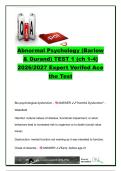
Abnormal Psychology (Barlow
& Durand) TEST 1 (ch 1-4)
2026/2027 Expert Verifed Ace
the Test


Bio-psychological dysfunction - ANSWER ✔✔"Harmful Dysfunction" -

Wakefield

Harmful: cultural values of distress, functional impairment, or what

behaviors lead to increased risk to organism or to death (social value

issue).

Dysfunction: mental function not working as it was intended to function.


Onset of disorder - ANSWER ✔✔Early: before age 21

, Late: 21 years and older

Acute: sudden

Insidious: develops over time


Research-practitioner role - ANSWER ✔✔Prominent model of

training prevalent today in the PhD clinical/counseling psychology

programs.


Biological tradition - ANSWER ✔✔Hippocrates: "balance theory of

personality" (sanguine, melancholic, calm, excitable)

Pasteur: 1870s; Germ Theory of Disease

Kraepelin: 1900s; biological causes of physical and mental illness

Gray: 1850; editor of American Journal of Insanity (psychiatry)

Cerletti & Beni: 1930s; electro-convulsive shock

1950s: major medicines introduced to treat severely mentally ill


Psychopathology - ANSWER ✔✔comes from inside the body issue.


Psychological tradition - ANSWER ✔✔Pinel: 1745 France


Tuke: 1732 England

Dorothea Dix: mid-19th century U.S.

Document information

Uploaded on
August 31, 2026
Number of pages
15
Written in
2026/2027
Type
Exam (elaborations)
Contains
Questions & answers
£14.46

Wrong document? Swap it for free Within 14 days of purchase and before downloading, you can choose a different document. You can simply spend the amount again.
Written by students who passed
Immediately available after payment
Read online or as PDF

Seller avatar
Reputation scores are based on the amount of documents a seller has sold for a fee and the reviews they have received for those documents. There are three levels: Bronze, Silver and Gold. The better the reputation, the more your can rely on the quality of the sellers work.
JOSHCLAY
3.5
(85)
Sold
394
Followers
15
Items
20625
Last sold
17 hours ago


Why students choose Stuvia

Created by fellow students, verified by reviews

Quality you can trust: written by students who passed their exams and reviewed by others who've used these revision notes.

Didn't get what you expected? Choose another document

No problem! You can straightaway pick a different document that better suits what you're after.

Pay as you like, start learning straight away

No subscription, no commitments. Pay the way you're used to via credit card and download your PDF document instantly.

Student with book image

“Bought, downloaded, and smashed it. It really can be that simple.”

Alisha Student

Working on your references?

Create accurate citations in APA, MLA and Harvard with our free citation generator.

Working on your references?

Frequently asked questions

