
Chapter 1- cell structure
Plant cell
:
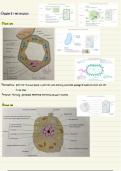
Plasmodesma pore like Structure
found in
plant cell walls ,
allowing controlled passage of materials from one cell
to the other.
Tonoplast Partially permeable
: membrane that Surrounds plant vacuoles .
Animal cell
·
, :
Microvilli
finger like extensions of the cell surface membrane
Increase
-
surface area for absorption and reabsorption .
Nucleus :
largest cell organelle.
Consists of 4 parts :
The
·
nuclear envelope
The nucleus surrounded
is
by two membranes .
Outer membrane is continuous with the endoplasmic reticulum .
Contains nuclear pores which allow and control
gas exchange with the
cytoplasm .
Leaving examples :
MRNA tRNA and
,
ribosomes .
Entering examples
-
:
proteins ,
nucleotides, ATP and hormones .
·
Chromosomes and chromatin
Nucleus contains chromosomes . Chromosomes contain DNA
,
which is
organized into genes, which control
cell activities.
DNA
-
molecules are so that be folded up to
long they have to , prevent tangling ,
this is done
by combining with
proteins /histones) .
DNA
-
+ Protein =
Chromatin
Nucleolus
·
function is to make ribosomes
Contains DNA , which contains
genes that code for ribosomal RNA
Different parts
-
for the manufacture of ribosomes then
come
together , Separate as ribosome
Synthesis ceases
,
the nucleous as a structure dissapears .
Plant cell
:
Plasmodesma pore like Structure
found in
plant cell walls ,
allowing controlled passage of materials from one cell
to the other.
Tonoplast Partially permeable
: membrane that Surrounds plant vacuoles .
Animal cell
·
, :
Microvilli
finger like extensions of the cell surface membrane
Increase
-
surface area for absorption and reabsorption .
Nucleus :
largest cell organelle.
Consists of 4 parts :
The
·
nuclear envelope
The nucleus surrounded
is
by two membranes .
Outer membrane is continuous with the endoplasmic reticulum .
Contains nuclear pores which allow and control
gas exchange with the
cytoplasm .
Leaving examples :
MRNA tRNA and
,
ribosomes .
Entering examples
-
:
proteins ,
nucleotides, ATP and hormones .
·
Chromosomes and chromatin
Nucleus contains chromosomes . Chromosomes contain DNA
,
which is
organized into genes, which control
cell activities.
DNA
-
molecules are so that be folded up to
long they have to , prevent tangling ,
this is done
by combining with
proteins /histones) .
DNA
-
+ Protein =
Chromatin
Nucleolus
·
function is to make ribosomes
Contains DNA , which contains
genes that code for ribosomal RNA
Different parts
-
for the manufacture of ribosomes then
come
together , Separate as ribosome
Synthesis ceases
,
the nucleous as a structure dissapears .


