

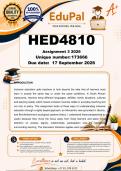
HED4810
Assignment 3 2026
Unique number: 173666
Due date: 17 September 2026
INTRODUCTION
Inclusive education asks teachers to look beyond the idea that all learners must
learn in exactly the same way or under the same conditions. In South African
classrooms, learners bring different languages, abilities, family situations, cultures
and learning needs, which means inclusion must be visible in everyday teaching and
not only in policy. This assignment looks at three ways of understanding inclusive
education through a rights based approach, an Afrocentric view grounded in Ubuntu,
and Bronfenbrenner's ecological systems theory. I understand these perspectives as
useful because they move the focus away from fixing learners and place more
attention on access, dignity, relationships, participation and the conditions
surrounding learning. The discussion therefore applies each perspective to practical
, INTRODUCTION
Inclusive education asks teachers to look beyond the idea that all learners must
learn in exactly the same way or under the same conditions. In South African
classrooms, learners bring different languages, abilities, family situations, cultures
and learning needs, which means inclusion must be visible in everyday teaching and
not only in policy. This assignment looks at three ways of understanding inclusive
education through a rights based approach, an Afrocentric view grounded in Ubuntu,
and Bronfenbrenner's ecological systems theory. I understand these perspectives as
useful because they move the focus away from fixing learners and place more
attention on access, dignity, relationships, participation and the conditions
surrounding learning. The discussion therefore applies each perspective to practical
classroom situations while still considering the realities of South African schools,
where unequal resources, large classes and different learner needs can make
inclusion difficult to practise consistently.
QUESTION 1: RIGHTS BASED EPISTEMOLOGY
A rights based approach starts from the position that every learner has a right to
education, dignity, participation and equal treatment, including learners with
disabilities. Article 24 of the United Nations Convention on the Rights of Persons with
Disabilities requires an inclusive education system where learners are not excluded
because of disability and where reasonable accommodation, individual support and
suitable communication methods are provided within general education. The same
article connects education with the development of human potential, self worth and
meaningful participation in society, which makes inclusion a right rather than a favour
given by a school when resources are available (United Nations, 2006).
My first classroom example would be changing how I present learning activities so
that one teaching method does not become a barrier for learners who process
information differently. I would combine clear spoken explanations with written
instructions, visual examples, practical demonstrations and extra processing time
where needed, while still teaching the same curriculum goals to the class. This
supports equal access because a learner should not be excluded simply because
Assignment 3 2026
Unique number: 173666
Due date: 17 September 2026
INTRODUCTION
Inclusive education asks teachers to look beyond the idea that all learners must
learn in exactly the same way or under the same conditions. In South African
classrooms, learners bring different languages, abilities, family situations, cultures
and learning needs, which means inclusion must be visible in everyday teaching and
not only in policy. This assignment looks at three ways of understanding inclusive
education through a rights based approach, an Afrocentric view grounded in Ubuntu,
and Bronfenbrenner's ecological systems theory. I understand these perspectives as
useful because they move the focus away from fixing learners and place more
attention on access, dignity, relationships, participation and the conditions
surrounding learning. The discussion therefore applies each perspective to practical
, INTRODUCTION
Inclusive education asks teachers to look beyond the idea that all learners must
learn in exactly the same way or under the same conditions. In South African
classrooms, learners bring different languages, abilities, family situations, cultures
and learning needs, which means inclusion must be visible in everyday teaching and
not only in policy. This assignment looks at three ways of understanding inclusive
education through a rights based approach, an Afrocentric view grounded in Ubuntu,
and Bronfenbrenner's ecological systems theory. I understand these perspectives as
useful because they move the focus away from fixing learners and place more
attention on access, dignity, relationships, participation and the conditions
surrounding learning. The discussion therefore applies each perspective to practical
classroom situations while still considering the realities of South African schools,
where unequal resources, large classes and different learner needs can make
inclusion difficult to practise consistently.
QUESTION 1: RIGHTS BASED EPISTEMOLOGY
A rights based approach starts from the position that every learner has a right to
education, dignity, participation and equal treatment, including learners with
disabilities. Article 24 of the United Nations Convention on the Rights of Persons with
Disabilities requires an inclusive education system where learners are not excluded
because of disability and where reasonable accommodation, individual support and
suitable communication methods are provided within general education. The same
article connects education with the development of human potential, self worth and
meaningful participation in society, which makes inclusion a right rather than a favour
given by a school when resources are available (United Nations, 2006).
My first classroom example would be changing how I present learning activities so
that one teaching method does not become a barrier for learners who process
information differently. I would combine clear spoken explanations with written
instructions, visual examples, practical demonstrations and extra processing time
where needed, while still teaching the same curriculum goals to the class. This
supports equal access because a learner should not be excluded simply because


