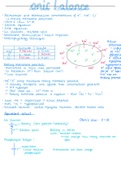
Ionic Balance
Intracellular and extracellular concentrations of Kt Nat CL
resting membrane potentials
Ohm's Law V IR
Nernst equation
GHK equation
Ion channels excitable cells
membrane stimulation tissue responses
Electrophysiology techniques
Ch g Nat Action
Nat Yat potentia
Outside Inside X q
Nat Kt of Nat
Kt i110mm
stint Hitomi nat at depolarize
g yn CL Ktefflux
Kt Kt Kt Nat repolarized
Resting membranepotential Nat hyper
polariz
membrane is much more permeable g Nat Kt influxrefract
to Potassium Kt than sodium Nat period Kthighi
y um Nathighout
Resting potential
Nat Kt pump maintains resting membrane potential
actively transports ions against their concentration gradients
ATP hydrolysis
3Nat move out 2kt move in
Resting membrane potential is negative 70mV Vm Vin Vout
more the depolarized action potential
more ve polarized
hyper
Excitableneurones cardiacmyocytes neurons skeletal muscle cells
Equivalent circuit
IonChannel Ohm's Law V IR
Battery concgradient selectivity
q Resistor pore Battery in series
with variable resistor
canchange how many channels are
Phospholipid bilayer open
capacitator
ionic solution membranes can store charge
phospholipid
, Equilibrium potentials
Nernst equation magnitude of the electrical gradient that would
exactly balance a given concentration gradient
of a given ion Gives us the equilibriumpotential
that ion
gasconstant temple for
II
condinside
Ex In x it at 370C Ex 60Log x o x i MV
T
Equilibrium
ÉraÉay instant
potentialfor valence of the
If I.tt
anion x ion e g
Eg Kt SMM outside 150mm inside 88 6mV 84mV
I Nat 150mm outside IS my inside 60mV
2mm outside 0.0001mm inside 129mV
66mV
1137mV
134 Eq 125m outside 9mm inside 69mV 1 64mV
Entwer
Tminus answer
70mV
Neurones
skeletalmuscle 80mV
more Ct channels
GHK equation
idealgasconstant temperature permeability of ion
Vm In Pk Kt o Pna Nat of PCLCCL Ji
t
RIgiggle
extra intra
Pk Kt t Pna Nat i t PCL CLJo Cellular
1
Membrane
T concentrations
Faradays of ions
potential
Ion Channels
Leak always open e g at rest Kt leakchannels
Voltagegated e g Nat and Kt channels in action
potentials
Ligand gated e g neurotransmitter receptors
e g synaptictransmission y
nicotinic
Primary active transport acetylcholine
ATPhydrolysis
against conc gradient
Secondary active transport
energy in electrochemical gradient of one molecule is used to
move another molecule against its electrochemical gradient
Intracellular and extracellular concentrations of Kt Nat CL
resting membrane potentials
Ohm's Law V IR
Nernst equation
GHK equation
Ion channels excitable cells
membrane stimulation tissue responses
Electrophysiology techniques
Ch g Nat Action
Nat Yat potentia
Outside Inside X q
Nat Kt of Nat
Kt i110mm
stint Hitomi nat at depolarize
g yn CL Ktefflux
Kt Kt Kt Nat repolarized
Resting membranepotential Nat hyper
polariz
membrane is much more permeable g Nat Kt influxrefract
to Potassium Kt than sodium Nat period Kthighi
y um Nathighout
Resting potential
Nat Kt pump maintains resting membrane potential
actively transports ions against their concentration gradients
ATP hydrolysis
3Nat move out 2kt move in
Resting membrane potential is negative 70mV Vm Vin Vout
more the depolarized action potential
more ve polarized
hyper
Excitableneurones cardiacmyocytes neurons skeletal muscle cells
Equivalent circuit
IonChannel Ohm's Law V IR
Battery concgradient selectivity
q Resistor pore Battery in series
with variable resistor
canchange how many channels are
Phospholipid bilayer open
capacitator
ionic solution membranes can store charge
phospholipid
, Equilibrium potentials
Nernst equation magnitude of the electrical gradient that would
exactly balance a given concentration gradient
of a given ion Gives us the equilibriumpotential
that ion
gasconstant temple for
II
condinside
Ex In x it at 370C Ex 60Log x o x i MV
T
Equilibrium
ÉraÉay instant
potentialfor valence of the
If I.tt
anion x ion e g
Eg Kt SMM outside 150mm inside 88 6mV 84mV
I Nat 150mm outside IS my inside 60mV
2mm outside 0.0001mm inside 129mV
66mV
1137mV
134 Eq 125m outside 9mm inside 69mV 1 64mV
Entwer
Tminus answer
70mV
Neurones
skeletalmuscle 80mV
more Ct channels
GHK equation
idealgasconstant temperature permeability of ion
Vm In Pk Kt o Pna Nat of PCLCCL Ji
t
RIgiggle
extra intra
Pk Kt t Pna Nat i t PCL CLJo Cellular
1
Membrane
T concentrations
Faradays of ions
potential
Ion Channels
Leak always open e g at rest Kt leakchannels
Voltagegated e g Nat and Kt channels in action
potentials
Ligand gated e g neurotransmitter receptors
e g synaptictransmission y
nicotinic
Primary active transport acetylcholine
ATPhydrolysis
against conc gradient
Secondary active transport
energy in electrochemical gradient of one molecule is used to
move another molecule against its electrochemical gradient