

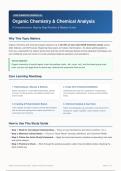
GCSE CHEMISTRY (GRADES 6–9)
Organic Chemistry & Chemical Analysis
A Comprehensive, Step-by-Step Revision & Mastery Guide
Why This Topic Matters
Organic chemistry and chemical analysis represent up to 20–25% of your total GCSE Chemistry marks across
AQA, Edexcel, and OCR exams. Mastering these topics isn't about memorization—it's about spotting patterns.
Once you understand how carbon atoms bond and how small molecules behave during separation techniques, you
can confidently score full marks on 6-mark extended response questions and calculations.
TUTOR INSIGHT
Organic chemistry is heavily logical. Learn the prefixes (meth-, eth-, prop-, but-) and functional group rules
once, and you can apply them to almost any molecule the examiners throw at you!
Core Learning Roadmap
1. Hydrocarbons: Alkanes & Alkenes 2. Crude Oil & Fractional Distillation
Master saturated vs. unsaturated hydrocarbons, general Understand how crude oil is separated in a fractionating
formulas, functional groups, and addition reactions with column based on boiling points, viscosity, and flammability
bromine water. trends.
3. Cracking & Polymerisation Basics 4. Chemical Analysis & Gas Tests
Learn catalytic and steam cracking, thermal decomposition, Master chromatography ( Rf calculations) and definitive test
and why thermal cracking turns surplus long chains into methods for oxygen, hydrogen, carbon dioxide, chlorine,
useful fuels and monomers. and water.
How to Use This Study Guide
• Step 1: Read for Conceptual Understanding — Focus on key mechanisms and rules in sections 1 to 4.
• Step 2: Memorize Callout Boxes — Focus on "Quick Recall" formulas, definitions, and "Common Pitfalls".
• Step 3: Follow the Active Study Framework — Apply the structured revision schedule incorporating mini rests
and active retrieval.
• Step 4: Practice & Check — Work through the practice questions under timed conditions before checking the
back answer key.
GCSE Chemistry Study Guide • Organic Chemistry & Analysis Page 1 of 15
, 1. Alkanes & Saturated Hydrocarbons
Hydrocarbons are compounds containing only hydrogen and carbon atoms. Alkanes are the simplest family
(homologous series) of hydrocarbons. They are described as saturated because all carbon-carbon bonds are
single covalent bonds ( C−C ), meaning each carbon forms four single covalent bonds to maximize its capacity.
The First Four Alkanes
You must memorize the names and structures of the first four straight-chain alkanes. A easy memory trick for the
prefixes is "Monkeys Eat Peanut Butter" (Meth-, Eth-, Prop-, But-).
Alkane Name Number of Carbons Molecular Formula Displayed Formula Structure
Methane 1 CH4 Central C bonded to 4 single H atoms
Ethane 2 C2H6 H3C − CH3
Propane 3 C3H8 H3C − CH2 − CH3
Butane 4 C4H10 H3C − CH2 − CH2 − CH3
QUICK RECALL — GENERAL FORMULA FOR ALKANES
For any alkane with n carbon atoms, the formula is:
CnH2n+2
Example: If an alkane has 6 carbons ( n = 6 ), it has (2 × 6) + 2 = 14 hydrogens. Formula = C6H14 .
Properties & Trends of Alkanes
As the molecular chain length (number of carbon atoms) increases, physical properties change predictably:
• Boiling Point: Increases with molecular size due to stronger intermolecular forces requiring more energy to
break.
• Viscosity: Long-chain alkanes are thick and flow slowly (high viscosity) due to entangled molecules.
• Flammability: Short-chain alkanes ignite very easily, producing clean blue flames. Long-chain hydrocarbons
burn with smoky flames and are harder to ignite.
COMMON PITFALL TO AVOID
Never say "covalent bonds break when an alkane boils." During boiling or evaporation, only weak
intermolecular forces between molecules are broken! Strong covalent bonds inside the molecule remain
intact.
Combustion Reactions
Alkanes are primary fuels because complete combustion releases large amounts of energy:
• Complete Combustion (Excess Oxygen):
Hydrocarbon + Oxygen → Carbon Dioxide + Water
GCSE Chemistry Study Guide • Organic Chemistry & Analysis Page 2 of 15
Organic Chemistry & Chemical Analysis
A Comprehensive, Step-by-Step Revision & Mastery Guide
Why This Topic Matters
Organic chemistry and chemical analysis represent up to 20–25% of your total GCSE Chemistry marks across
AQA, Edexcel, and OCR exams. Mastering these topics isn't about memorization—it's about spotting patterns.
Once you understand how carbon atoms bond and how small molecules behave during separation techniques, you
can confidently score full marks on 6-mark extended response questions and calculations.
TUTOR INSIGHT
Organic chemistry is heavily logical. Learn the prefixes (meth-, eth-, prop-, but-) and functional group rules
once, and you can apply them to almost any molecule the examiners throw at you!
Core Learning Roadmap
1. Hydrocarbons: Alkanes & Alkenes 2. Crude Oil & Fractional Distillation
Master saturated vs. unsaturated hydrocarbons, general Understand how crude oil is separated in a fractionating
formulas, functional groups, and addition reactions with column based on boiling points, viscosity, and flammability
bromine water. trends.
3. Cracking & Polymerisation Basics 4. Chemical Analysis & Gas Tests
Learn catalytic and steam cracking, thermal decomposition, Master chromatography ( Rf calculations) and definitive test
and why thermal cracking turns surplus long chains into methods for oxygen, hydrogen, carbon dioxide, chlorine,
useful fuels and monomers. and water.
How to Use This Study Guide
• Step 1: Read for Conceptual Understanding — Focus on key mechanisms and rules in sections 1 to 4.
• Step 2: Memorize Callout Boxes — Focus on "Quick Recall" formulas, definitions, and "Common Pitfalls".
• Step 3: Follow the Active Study Framework — Apply the structured revision schedule incorporating mini rests
and active retrieval.
• Step 4: Practice & Check — Work through the practice questions under timed conditions before checking the
back answer key.
GCSE Chemistry Study Guide • Organic Chemistry & Analysis Page 1 of 15
, 1. Alkanes & Saturated Hydrocarbons
Hydrocarbons are compounds containing only hydrogen and carbon atoms. Alkanes are the simplest family
(homologous series) of hydrocarbons. They are described as saturated because all carbon-carbon bonds are
single covalent bonds ( C−C ), meaning each carbon forms four single covalent bonds to maximize its capacity.
The First Four Alkanes
You must memorize the names and structures of the first four straight-chain alkanes. A easy memory trick for the
prefixes is "Monkeys Eat Peanut Butter" (Meth-, Eth-, Prop-, But-).
Alkane Name Number of Carbons Molecular Formula Displayed Formula Structure
Methane 1 CH4 Central C bonded to 4 single H atoms
Ethane 2 C2H6 H3C − CH3
Propane 3 C3H8 H3C − CH2 − CH3
Butane 4 C4H10 H3C − CH2 − CH2 − CH3
QUICK RECALL — GENERAL FORMULA FOR ALKANES
For any alkane with n carbon atoms, the formula is:
CnH2n+2
Example: If an alkane has 6 carbons ( n = 6 ), it has (2 × 6) + 2 = 14 hydrogens. Formula = C6H14 .
Properties & Trends of Alkanes
As the molecular chain length (number of carbon atoms) increases, physical properties change predictably:
• Boiling Point: Increases with molecular size due to stronger intermolecular forces requiring more energy to
break.
• Viscosity: Long-chain alkanes are thick and flow slowly (high viscosity) due to entangled molecules.
• Flammability: Short-chain alkanes ignite very easily, producing clean blue flames. Long-chain hydrocarbons
burn with smoky flames and are harder to ignite.
COMMON PITFALL TO AVOID
Never say "covalent bonds break when an alkane boils." During boiling or evaporation, only weak
intermolecular forces between molecules are broken! Strong covalent bonds inside the molecule remain
intact.
Combustion Reactions
Alkanes are primary fuels because complete combustion releases large amounts of energy:
• Complete Combustion (Excess Oxygen):
Hydrocarbon + Oxygen → Carbon Dioxide + Water
GCSE Chemistry Study Guide • Organic Chemistry & Analysis Page 2 of 15


