

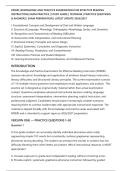
KPEERI (KNOWLEDGE AND PRACTICE EXAMINATION FOR EFFECTIVE READING
INSTRUCTION) EXAM PRACTICE | STUDY GUIDE | TESTBANK | PRACTICE QUESTIONS
& ANSWERS | EXAM PREPARATION | LATEST UPDATE 2026/2027
I. Foundational Concepts and Development of Oral and Written Language
II. Structure of Language: Phonology, Orthography, Morphology, Syntax, and Semantics
III. Recognition and Characteristics of Reading Difficulties
IV. Assessment, Data Interpretation, and Instructional Planning
V. Structured Literacy Principles and Lesson Design
VI. Explicit, Systematic, Cumulative, and Diagnostic Instruction
VII. Reading Fluency, Vocabulary, and Comprehension
VIII. Intervention Practices and Student Response
IX. Learning Environment, Instructional Routines, and Professional Practice
INTRODUCTION
The Knowledge and Practice Examination for Effective Reading Instruction (KPEERI)
assesses educators’ knowledge and application of evidence-based literacy instruction,
literacy difficulties, and Structured Literacy principles. The current examination consists
of 110 multiple-choice questions and emphasizes recall, application, and analysis. This
practice set is designed as original study material rather than actual examination
content. Questions emphasize advanced instructional decision-making, language
structure, assessment interpretation, intervention planning, explicit instruction, and
professional judgment. Candidates should expect increasingly complex scenarios
requiring them to connect student data with appropriate instructional responses. The
material is aligned broadly with the knowledge and practice areas associated with
KPEERI and is intended to support rigorous 2026/2027 preparation.
VERSION ONE — PRACTICE QUESTIONS 1–30
Question 1
A first-grade student can accurately identify individual phonemes when orally
segmenting simple CVC words but consistently confuses graphemes representing
phonemes during decoding. The student can produce the sounds in isolation but has
difficulty blending them when letters are present. Which instructional response is MOST
appropriate?
A. Increase exposure to grade-level independent reading without correcting errors
B. Provide explicit, systematic grapheme-phoneme instruction followed by guided
,blending practice
C. Focus primarily on memorizing high-frequency words before continuing phonics
instruction
D. Replace phonics instruction with vocabulary activities until oral language improves
🔴 Correct Answer: B. Provide explicit, systematic grapheme-phoneme instruction
followed by guided blending practice.
🔵 Explanation: The student demonstrates a disconnect between phonemic awareness
and orthographic mapping. Explicitly connecting phonemes to their corresponding
graphemes and immediately practicing blending helps establish efficient decoding
pathways.
Question 2
A teacher observes that a student reads ship as /s/ /h/ /i/ /p/ and treats the word as
containing four separate phonemes. Which underlying concept should the teacher
prioritize?
A. Morphological analysis
B. Phoneme-grapheme correspondence
C. Digraph recognition
D. Syntactic parsing
🔴 Correct Answer: C. Digraph recognition.
🔵 Explanation: In ship, the letters sh represent one phoneme. Explicit instruction should
help the student understand that a grapheme can contain multiple letters while
representing a single speech sound.
Question 3
A student reads unfamiliar multisyllabic words accurately when the teacher provides
syllable boundaries but becomes inaccurate when those boundaries are removed.
Which intervention would BEST promote independence?
A. Increase whole-word memorization
B. Teach a consistent procedure for analyzing syllable types and combining the parts
C. Have the student repeatedly copy the words
D. Reduce exposure to multisyllabic vocabulary
🔴 Correct Answer: B. Teach a consistent procedure for analyzing syllable types and
combining the parts.
,🔵 Explanation: The student's performance indicates dependence on external
segmentation. Explicit instruction in syllable analysis provides a transferable strategy for
independently decoding increasingly complex words.
Question 4
A reading specialist reviews assessment data and finds that a student has adequate
phonemic awareness and decoding accuracy but reads connected text very slowly and
with frequent pauses. Comprehension decreases substantially when text becomes
longer. Which instructional target should receive the greatest emphasis?
A. Advanced phonemic awareness
B. Reading fluency
C. Letter-name knowledge
D. Basic sound isolation
🔴 Correct Answer: B. Reading fluency.
🔵 Explanation: Accurate but effortful reading indicates a fluency problem rather than a
primary decoding deficit. Instruction should develop automaticity, appropriate phrasing,
and prosody while maintaining accuracy.
Question 5
A student frequently substitutes semantically related words while reading—for
example, reading automobile as car—but has difficulty decoding unfamiliar words.
Which interpretation is MOST defensible?
A. The student demonstrates strong orthographic mapping
B. Contextual guessing is compensating for insufficient decoding skills
C. The student has mastered phonological processing
D. Semantic knowledge should replace phonics instruction
🔴 Correct Answer: B. Contextual guessing is compensating for insufficient decoding
skills.
🔵 Explanation: Semantic substitutions can indicate reliance on context when word-
recognition skills are insufficient. Instruction should strengthen accurate, efficient
decoding rather than encourage guessing from meaning.
Question 6
, During a Structured Literacy lesson, a teacher introduces a new spelling pattern,
practices it with previously taught patterns, dictates words containing the pattern, and
then has students read sentences using those words. Which principle is MOST clearly
demonstrated?
A. Incidental instruction
B. Explicit and cumulative instruction
C. Unstructured discovery learning
D. Whole-language immersion
🔴 Correct Answer: B. Explicit and cumulative instruction.
🔵 Explanation: The lesson directly teaches the new pattern while integrating previously
learned material. This cumulative structure supports retention and systematic
progression.
Question 7
A student consistently spells jumped as jumpt despite correctly reading the word.
Which instructional analysis is MOST appropriate?
A. The student has no understanding of phonemes
B. The student may require explicit instruction in the morphological function of the
suffix -ed
C. The student should memorize jumped as an irregular word
D. The student should discontinue spelling instruction
🔴 Correct Answer: B. The student may require explicit instruction in the
morphological function of the suffix -ed.
🔵 Explanation: The spelling reflects a plausible phonological representation but fails to
capture the grammatical morpheme marking past tense. Explicit morphology instruction
can connect meaning, grammatical function, pronunciation, and spelling.
Question 8
Which instructional sequence BEST reflects a Structured Literacy approach when
introducing a new linguistic concept?
A. Independent discovery → worksheet → correction
B. Explanation/modeling → guided practice → cumulative practice → independent
application
INSTRUCTION) EXAM PRACTICE | STUDY GUIDE | TESTBANK | PRACTICE QUESTIONS
& ANSWERS | EXAM PREPARATION | LATEST UPDATE 2026/2027
I. Foundational Concepts and Development of Oral and Written Language
II. Structure of Language: Phonology, Orthography, Morphology, Syntax, and Semantics
III. Recognition and Characteristics of Reading Difficulties
IV. Assessment, Data Interpretation, and Instructional Planning
V. Structured Literacy Principles and Lesson Design
VI. Explicit, Systematic, Cumulative, and Diagnostic Instruction
VII. Reading Fluency, Vocabulary, and Comprehension
VIII. Intervention Practices and Student Response
IX. Learning Environment, Instructional Routines, and Professional Practice
INTRODUCTION
The Knowledge and Practice Examination for Effective Reading Instruction (KPEERI)
assesses educators’ knowledge and application of evidence-based literacy instruction,
literacy difficulties, and Structured Literacy principles. The current examination consists
of 110 multiple-choice questions and emphasizes recall, application, and analysis. This
practice set is designed as original study material rather than actual examination
content. Questions emphasize advanced instructional decision-making, language
structure, assessment interpretation, intervention planning, explicit instruction, and
professional judgment. Candidates should expect increasingly complex scenarios
requiring them to connect student data with appropriate instructional responses. The
material is aligned broadly with the knowledge and practice areas associated with
KPEERI and is intended to support rigorous 2026/2027 preparation.
VERSION ONE — PRACTICE QUESTIONS 1–30
Question 1
A first-grade student can accurately identify individual phonemes when orally
segmenting simple CVC words but consistently confuses graphemes representing
phonemes during decoding. The student can produce the sounds in isolation but has
difficulty blending them when letters are present. Which instructional response is MOST
appropriate?
A. Increase exposure to grade-level independent reading without correcting errors
B. Provide explicit, systematic grapheme-phoneme instruction followed by guided
,blending practice
C. Focus primarily on memorizing high-frequency words before continuing phonics
instruction
D. Replace phonics instruction with vocabulary activities until oral language improves
🔴 Correct Answer: B. Provide explicit, systematic grapheme-phoneme instruction
followed by guided blending practice.
🔵 Explanation: The student demonstrates a disconnect between phonemic awareness
and orthographic mapping. Explicitly connecting phonemes to their corresponding
graphemes and immediately practicing blending helps establish efficient decoding
pathways.
Question 2
A teacher observes that a student reads ship as /s/ /h/ /i/ /p/ and treats the word as
containing four separate phonemes. Which underlying concept should the teacher
prioritize?
A. Morphological analysis
B. Phoneme-grapheme correspondence
C. Digraph recognition
D. Syntactic parsing
🔴 Correct Answer: C. Digraph recognition.
🔵 Explanation: In ship, the letters sh represent one phoneme. Explicit instruction should
help the student understand that a grapheme can contain multiple letters while
representing a single speech sound.
Question 3
A student reads unfamiliar multisyllabic words accurately when the teacher provides
syllable boundaries but becomes inaccurate when those boundaries are removed.
Which intervention would BEST promote independence?
A. Increase whole-word memorization
B. Teach a consistent procedure for analyzing syllable types and combining the parts
C. Have the student repeatedly copy the words
D. Reduce exposure to multisyllabic vocabulary
🔴 Correct Answer: B. Teach a consistent procedure for analyzing syllable types and
combining the parts.
,🔵 Explanation: The student's performance indicates dependence on external
segmentation. Explicit instruction in syllable analysis provides a transferable strategy for
independently decoding increasingly complex words.
Question 4
A reading specialist reviews assessment data and finds that a student has adequate
phonemic awareness and decoding accuracy but reads connected text very slowly and
with frequent pauses. Comprehension decreases substantially when text becomes
longer. Which instructional target should receive the greatest emphasis?
A. Advanced phonemic awareness
B. Reading fluency
C. Letter-name knowledge
D. Basic sound isolation
🔴 Correct Answer: B. Reading fluency.
🔵 Explanation: Accurate but effortful reading indicates a fluency problem rather than a
primary decoding deficit. Instruction should develop automaticity, appropriate phrasing,
and prosody while maintaining accuracy.
Question 5
A student frequently substitutes semantically related words while reading—for
example, reading automobile as car—but has difficulty decoding unfamiliar words.
Which interpretation is MOST defensible?
A. The student demonstrates strong orthographic mapping
B. Contextual guessing is compensating for insufficient decoding skills
C. The student has mastered phonological processing
D. Semantic knowledge should replace phonics instruction
🔴 Correct Answer: B. Contextual guessing is compensating for insufficient decoding
skills.
🔵 Explanation: Semantic substitutions can indicate reliance on context when word-
recognition skills are insufficient. Instruction should strengthen accurate, efficient
decoding rather than encourage guessing from meaning.
Question 6
, During a Structured Literacy lesson, a teacher introduces a new spelling pattern,
practices it with previously taught patterns, dictates words containing the pattern, and
then has students read sentences using those words. Which principle is MOST clearly
demonstrated?
A. Incidental instruction
B. Explicit and cumulative instruction
C. Unstructured discovery learning
D. Whole-language immersion
🔴 Correct Answer: B. Explicit and cumulative instruction.
🔵 Explanation: The lesson directly teaches the new pattern while integrating previously
learned material. This cumulative structure supports retention and systematic
progression.
Question 7
A student consistently spells jumped as jumpt despite correctly reading the word.
Which instructional analysis is MOST appropriate?
A. The student has no understanding of phonemes
B. The student may require explicit instruction in the morphological function of the
suffix -ed
C. The student should memorize jumped as an irregular word
D. The student should discontinue spelling instruction
🔴 Correct Answer: B. The student may require explicit instruction in the
morphological function of the suffix -ed.
🔵 Explanation: The spelling reflects a plausible phonological representation but fails to
capture the grammatical morpheme marking past tense. Explicit morphology instruction
can connect meaning, grammatical function, pronunciation, and spelling.
Question 8
Which instructional sequence BEST reflects a Structured Literacy approach when
introducing a new linguistic concept?
A. Independent discovery → worksheet → correction
B. Explanation/modeling → guided practice → cumulative practice → independent
application


