

Written by students who passed Immediately available after payment Read online or as PDF Wrong document? Swap it for free 4.6 TrustPilot
logo-home
Document preview thumbnail
Preview 1 out of 4 pages
Summary

Summary TEFL Unit 5 – Teaching Listening Skills | Study Notes

Document preview thumbnail
Preview 1 out of 4 pages

TEFL Unit 5 – Teaching Listening Skills Concise 4-page TEFL study notes covering the nature of listening, different types of listening, the difficulties learners face when listening in a foreign language, and the standard procedure for planning and teaching a listening lesson. The notes explain how teachers can create context, help students predict what they will hear, develop listening for gist and detail, and provide follow-on activities. Topics covered include: What listening involves Using context to predict content and language The importance of prediction before listening Mimicking real-life listening in the classroom How native speakers approach listening Having a reason for listening Knowing what information to listen for Filtering out unnecessary information Why listening can be more difficult than reading The inability to control the speed of spoken language Difficulty asking speakers to repeat or slow down Becoming distracted by unfamiliar sections of speech Differences between written and spoken forms of English Connected spoken language and words being uttered as a single unit Unfamiliar accents and dialects Background noise and other distractions Intensive listening Extensive listening Interactive listening Non-interactive listening The four types of listening: Interactive intensive listening Non-interactive intensive listening Interactive extensive listening Non-interactive extensive listening Examples of each type of listening The standard listening and reading lesson procedure Leading in and creating context Pre-teaching vocabulary Setting a gist task First listening Feedback Setting a detailed listening task Second listening Feedback Follow-on tasks Listening for gist Listening for specific details Developing intensive listening skills Using coursebook audio materials Advantages of coursebook recordings Exposure to voices other than the teacher's Exposure to different accents Matching recordings to students' level Limitations of classroom recordings The importance of authentic listening materials Real-world listening, including faster speech, slang and colloquialisms Combining coursebook materials with authentic materials The notes are suitable for TEFL/TESOL students, teacher training, course revision and exam preparation, providing a concise reference for understanding how listening works and how to structure an effective listening lesson.

Content preview

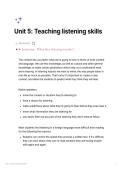
Unit 5: Teaching listening skills
Reviewed

✦ Listening – What does listening involve?


The context lets us predict what we’re going to hear in terms of both content
and language. We use this knowledge, as well as cultural and other general
knowledge, to make certain predictions which help us to understand what
we’re hearing. In listening lessons we want to mimic the way people listen in
real-life as much as possible. That’s why it’s important to create a clear
context, and allow the students to predict what they think they will hear.


Native speakers:

know the context or situation they’re listening to

have a reason for listening

make predictions about what they’re going to hear before they even hear it

know what information they are listening for

can easily filter out any part of the listening they don’t need to follow


Most students find listening in a foreign language more difficult than reading
for the following the reasons:

Readers can control the speed they process a written text. If it's difficult,
they can slow down; they can re-read sections they are having trouble
with again and again.


Unit 5: Teaching listening skills 1

Document information

Study
Uploaded on
August 21, 2026
Number of pages
4
Written in
2025/2026
Type
Summary
£3.49

Wrong document? Swap it for free Within 14 days of purchase and before downloading, you can choose a different document. You can simply spend the amount again.
Written by students who passed
Immediately available after payment
Read online or as PDF

Sold
0
Followers
0
Items
12
Last sold
-


Why students choose Stuvia

Created by fellow students, verified by reviews

Quality you can trust: written by students who passed their exams and reviewed by others who've used these revision notes.

Didn't get what you expected? Choose another document

No problem! You can straightaway pick a different document that better suits what you're after.

Pay as you like, start learning straight away

No subscription, no commitments. Pay the way you're used to via credit card and download your PDF document instantly.

Student with book image

“Bought, downloaded, and smashed it. It really can be that simple.”

Alisha Student

Working on your references?

Create accurate citations in APA, MLA and Harvard with our free citation generator.

Working on your references?

Frequently asked questions

