

Unit 3: Aspects of pronunciation
Reviewed
✦ Aspects of pronunciation − W ordstress
Words can be broken up into syllables – if you tap out the rhythm of a word, it
shows you how many syllables the word has. When an English word has more
than one syllable, these syllables are not pronounced with the same weight.
One receives more emphasis than the others. This is known as word stress. It
is important that students know which syllable carries the main stress (this is
often referred to as primary stress).
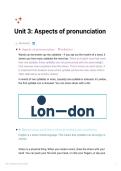
In words of two syllables or more, (usually) one syllable is stressed. In London,
the first syllable Lon is stressed. You can show stress with a dot:
✦ Representing word stress when presenting new vocabulary
English is a stress-timed language. This means that syllables can be longer or
shorter.
Stress is a physical thing. When you model a word, show the stress with your
hand. You can push your fist onto your hand, or click your fingers, or tap your
Unit 3: Aspects of pronunciation 1
, leg, or anything like that, but do something visual and physical when you say a
stressed syllable.
Writing the stressed syllable in capital letters can be confusing for students,
especially for those who do not use the Latin alphabet in their own language.
They may think that we always write it like that, so we need another way of
showing students where the stressed syllable is.
Unit 3: Aspects of pronunciation 2
Reviewed
✦ Aspects of pronunciation − W ordstress
Words can be broken up into syllables – if you tap out the rhythm of a word, it
shows you how many syllables the word has. When an English word has more
than one syllable, these syllables are not pronounced with the same weight.
One receives more emphasis than the others. This is known as word stress. It
is important that students know which syllable carries the main stress (this is
often referred to as primary stress).
In words of two syllables or more, (usually) one syllable is stressed. In London,
the first syllable Lon is stressed. You can show stress with a dot:
✦ Representing word stress when presenting new vocabulary
English is a stress-timed language. This means that syllables can be longer or
shorter.
Stress is a physical thing. When you model a word, show the stress with your
hand. You can push your fist onto your hand, or click your fingers, or tap your
Unit 3: Aspects of pronunciation 1
, leg, or anything like that, but do something visual and physical when you say a
stressed syllable.
Writing the stressed syllable in capital letters can be confusing for students,
especially for those who do not use the Latin alphabet in their own language.
They may think that we always write it like that, so we need another way of
showing students where the stressed syllable is.
Unit 3: Aspects of pronunciation 2


