

Unit 2: Vocabulary teaching techniques
Reviewed
✦ Ways of conveying meaning : Step 1 : C reate a clear context
The most effective way to make meaning clear is to create a context - as you know, a situation or
story - into which you place your vocabulary. This means that the words or phrases you’re going
to teach are all linked together in a situation that students will recognise.
✦ Ways of conveying meaning : Step 2 : Elicit, elicit, elicit!
Elicitation is when you don’t say the word that you’re teaching.
For example, if the teacher says this first:
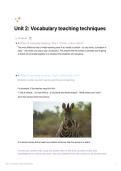
“I see an animal… it’s from Africa… it has black and white stripes!” “What animal can I see?”
And, then shows them this picture:
It is almost certain that at least one student will know that this animal is a zebra.
Provide your students with visual and spoken clues so that they can draw on their prior
knowledge to try to tell you the word. Only once students have had a chance to tell you the word,
Unit 2: Vocabulary teaching techniques 1
, do you say it yourself.
Why should we elicit? This technique means that the whole class is involved; they have to follow
what the teacher and other students are saying. They are being encouraged to use the language
they already know, so the students are required to participate in the lesson rather than just sitting
passively and listening to what the teacher says. Those students who already know the target
language are able to show that and are less likely to complain that the lesson is too easy.
✦ Ways of conveying meaning : Step 3 : U se only language your students already know
When you’re teaching new vocabulary, it’s really important to grade your language. This means
using language learners can understand, whether it’s how fast or slow you speak, or your choice
of grammar and vocabulary. Here we’re looking at choosing words that are appropriate for your
students' level. A helpful way to know is to use the CEFR levels as a guide.
When you’re teaching a new word or phrase, it’s easy to accidentally use another piece of
unfamiliar vocabulary. Instead, you should try to talk or ask about the vocabulary item in the
simplest way possible, while using correct and natural language.
A summary of the key points:
grade your language - do not use language students don't know when explaining a new
item
decide what vocabulary you will teach and how you will explain it when you are planning
your lesson
where possible, explain new items by relating them to language students already know,
e.g. categories, examples
✦ Ways of conveying meaning : Step 4 : U se CCQs
After you’ve elicited the target vocabulary from the students without saying it yourself, you’ll then
need to check that students actually do understand the meaning. Checking students'
understanding is called concept checking and asking concept check questions (CCQs) is a vital
skill in language teaching.
✦ C hecking understanding
We have seen that presenting a new vocabulary item involves:
putting the item in context
explaining the meaning
Unit 2: Vocabulary teaching techniques 2
Reviewed
✦ Ways of conveying meaning : Step 1 : C reate a clear context
The most effective way to make meaning clear is to create a context - as you know, a situation or
story - into which you place your vocabulary. This means that the words or phrases you’re going
to teach are all linked together in a situation that students will recognise.
✦ Ways of conveying meaning : Step 2 : Elicit, elicit, elicit!
Elicitation is when you don’t say the word that you’re teaching.
For example, if the teacher says this first:
“I see an animal… it’s from Africa… it has black and white stripes!” “What animal can I see?”
And, then shows them this picture:
It is almost certain that at least one student will know that this animal is a zebra.
Provide your students with visual and spoken clues so that they can draw on their prior
knowledge to try to tell you the word. Only once students have had a chance to tell you the word,
Unit 2: Vocabulary teaching techniques 1
, do you say it yourself.
Why should we elicit? This technique means that the whole class is involved; they have to follow
what the teacher and other students are saying. They are being encouraged to use the language
they already know, so the students are required to participate in the lesson rather than just sitting
passively and listening to what the teacher says. Those students who already know the target
language are able to show that and are less likely to complain that the lesson is too easy.
✦ Ways of conveying meaning : Step 3 : U se only language your students already know
When you’re teaching new vocabulary, it’s really important to grade your language. This means
using language learners can understand, whether it’s how fast or slow you speak, or your choice
of grammar and vocabulary. Here we’re looking at choosing words that are appropriate for your
students' level. A helpful way to know is to use the CEFR levels as a guide.
When you’re teaching a new word or phrase, it’s easy to accidentally use another piece of
unfamiliar vocabulary. Instead, you should try to talk or ask about the vocabulary item in the
simplest way possible, while using correct and natural language.
A summary of the key points:
grade your language - do not use language students don't know when explaining a new
item
decide what vocabulary you will teach and how you will explain it when you are planning
your lesson
where possible, explain new items by relating them to language students already know,
e.g. categories, examples
✦ Ways of conveying meaning : Step 4 : U se CCQs
After you’ve elicited the target vocabulary from the students without saying it yourself, you’ll then
need to check that students actually do understand the meaning. Checking students'
understanding is called concept checking and asking concept check questions (CCQs) is a vital
skill in language teaching.
✦ C hecking understanding
We have seen that presenting a new vocabulary item involves:
putting the item in context
explaining the meaning
Unit 2: Vocabulary teaching techniques 2


