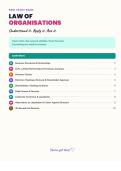
PGDL STUDY GUIDE
LAW OF
ORGANISATIONS
Understand it. Apply it. Ace it.
Clear notes. Key cases & statutes. Exam focused.
Everything you need to succeed.
CONTENTS
01 Business Structures & Partnerships 2
02 LLPs, Limited Partnerships & Forming a Company 3
03 Directors' Duties 4
04 Directors: Meetings, Removal & Shareholder Approval 5
05 Shareholders, Meetings & Shares 6
06 Debt Finance & Security 7
07 Corporate Insolvency & Liquidation 8
08 Alternatives to Liquidation & Claims Against Directors 9
★ 30-Second Full Revision 10
You've got this! ♡
, 01 BUSINESS STRUCTURES & PARTNERSHIPS
INCORPORATED UNINCORPORATED
Limited company, plc, LLP — separate legal personality, own rights/obligations. Sole trader, partnership, limited partnership — no separate entity; owners have
Owners generally have limited liability (lose only their investment). full personal liability for debts.
GENERAL PARTNERSHIPS — s1 PARTNERSHIP ACT 1890
Exists once 2+ persons 'carry on a business in common with a view of profit'. No separate legal personality. PA 1890 is a default contract — ss1-2 (existence)
and ss5-18 (third-party relations) can't be overridden.
PARTNERS' DUTIES & DEFAULT RULES
Fairness & good faith (ss28-30): full disclosure to each other; account for private profits; must not compete without consent.
Decisions (s24): ordinary matters by majority; changing the business, admitting a new partner, or amending the agreement need UNANIMITY.
Profits/losses/capital (s24): shared EQUALLY by default, regardless of capital contributed, unless agreed otherwise.
LIABILITY TO THIRD PARTIES
Firm bound by actual authority (s6) or apparent authority: (a) usual type of business, (b) usually within a partner's authority, (c) third party didn't know of any lack of
authority, (d) dealt with someone known/believed to be a partner. Partners are jointly & severally liable for debts incurred while a partner (ss9,17); after leaving, need
notice under s36 to escape future liability. Holding out (s14) can make even a non-partner liable if relied upon.
2
LAW OF
ORGANISATIONS
Understand it. Apply it. Ace it.
Clear notes. Key cases & statutes. Exam focused.
Everything you need to succeed.
CONTENTS
01 Business Structures & Partnerships 2
02 LLPs, Limited Partnerships & Forming a Company 3
03 Directors' Duties 4
04 Directors: Meetings, Removal & Shareholder Approval 5
05 Shareholders, Meetings & Shares 6
06 Debt Finance & Security 7
07 Corporate Insolvency & Liquidation 8
08 Alternatives to Liquidation & Claims Against Directors 9
★ 30-Second Full Revision 10
You've got this! ♡
, 01 BUSINESS STRUCTURES & PARTNERSHIPS
INCORPORATED UNINCORPORATED
Limited company, plc, LLP — separate legal personality, own rights/obligations. Sole trader, partnership, limited partnership — no separate entity; owners have
Owners generally have limited liability (lose only their investment). full personal liability for debts.
GENERAL PARTNERSHIPS — s1 PARTNERSHIP ACT 1890
Exists once 2+ persons 'carry on a business in common with a view of profit'. No separate legal personality. PA 1890 is a default contract — ss1-2 (existence)
and ss5-18 (third-party relations) can't be overridden.
PARTNERS' DUTIES & DEFAULT RULES
Fairness & good faith (ss28-30): full disclosure to each other; account for private profits; must not compete without consent.
Decisions (s24): ordinary matters by majority; changing the business, admitting a new partner, or amending the agreement need UNANIMITY.
Profits/losses/capital (s24): shared EQUALLY by default, regardless of capital contributed, unless agreed otherwise.
LIABILITY TO THIRD PARTIES
Firm bound by actual authority (s6) or apparent authority: (a) usual type of business, (b) usually within a partner's authority, (c) third party didn't know of any lack of
authority, (d) dealt with someone known/believed to be a partner. Partners are jointly & severally liable for debts incurred while a partner (ss9,17); after leaving, need
notice under s36 to escape future liability. Holding out (s14) can make even a non-partner liable if relied upon.
2