
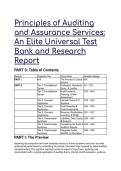
Principles of Auditing
and Assurance Services:
An Elite Universal Test
Bank and Research
Report
PART 0: Table of Contents
Section Cognitive Tier Focus Area Question Range
PART I N/A The Preview & Critical N/A
Axioms
PART II Tier 1: Foundational Profession, Standards, Q1 – Q12
Syntax Ethics, & Liability
Tier 1: Foundational Audit Evidence, Q13 – Q18
Syntax Planning, & Risk
Assessment
Tier 2: Complex Internal Control & IT Q19 – Q23
Application Systems
Tier 2: Complex Audit Sampling & Q24 – Q30
Application Cash/Investments
Tier 2: Complex Revenue, Receivables, Q31 – Q37
Application Inventory, & PP&E
Tier 3: Grandmaster Liabilities, Debt, Equity, Q38 – Q43
Synthesis & Analytics
Tier 3: Grandmaster Completing the Audit & Q44 – Q48
Synthesis Auditors' Reports
Tier 3: Grandmaster Integrated Audits, Q49 – Q55
Synthesis SSARS, & Attestation
PART I: The Preview
Mastering this exhaustive test bank translates directly to A-level academic execution and elite
professional performance by embedding the precise, risk-based logic required by global auditing
standard-setters. The cognitive leap from novice to expert is forged here, replacing rote
memorization with a surgical application of auditing theory, internal control evaluation, evidence
,synthesis, and regulatory compliance.
The auditing profession operates within a highly complex environment defined by the
continuous tension between public expectations and technical limitations. Historically,
catastrophic corporate failures—such as the collapses of Enron and WorldCom—precipitated a
crisis of credibility that fundamentally reshaped the regulatory landscape. In response,
legislative actions like the Sarbanes-Oxley Act of 2002 (SOX) established the Public Company
Accounting Oversight Board (PCAOB), shifting the profession from a purely transactional
oversight model to a deeply integrated, risk-centric framework. This evolution mandates that
auditors possess a profound understanding of corporate governance, internal controls, and the
specific vectors through which material misstatements manifest.
Central to the profession's challenges is the "audit expectation gap," defined as the divergence
between the public's perception of an auditor's responsibilities and the actual statutory and
professional duties performed. The public frequently assumes that an unqualified audit opinion
represents an absolute guarantee of financial accuracy and a total absence of fraud. In reality,
the probabilistic nature of audit sampling, the inherent limitations of internal controls, and the
extensive use of management estimates restrict the auditor to providing only "reasonable
assurance". Standard-setters continue to address this gap by enhancing the transparency and
communicative value of the auditor's report, though bridging the technical and psychological
divide remains a persistent challenge.
To navigate these risks, the modern audit relies heavily on the Audit Risk Model (ARM) and
rigorous sampling methodologies. Recent standard revisions, particularly SAS No. 145 (AU-C
315), emphasize a highly granular approach to risk assessment, strictly requiring the
independent evaluation of inherent risk and control risk to drive the appropriate detection risk
strategy. Correspondingly, auditors deploy sophisticated sampling techniques, such as Monetary
Unit Sampling (MUS), to efficiently isolate material deviations within massive financial
populations. The synthesis of these theoretical models into practical audit procedures forms the
foundation of modern attestation engagements.
Risk Component Origin Definition Auditor's Action
Inherent Risk (IR) The Client / The susceptibility of an Assessed
Environment assertion to material independently on a
misstatement, spectrum of risk.
assuming no related
controls exist.
Control Risk (CR) The Client's Systems The risk that a material Evaluated through tests
misstatement will not of design,
be prevented, or implementation, and
detected and corrected, operating effectiveness.
by internal controls.
Detection Risk (DR) The Auditor The risk that the Mathematically
procedures performed adjusted (inversely to
by the auditor will fail to IR x CR) by changing
detect a material the nature, timing, and
misstatement. extent of substantive
testing.
Sampling Methodology Mechanism Primary Advantage Primary Weakness
Monetary Unit Probability-Proportional Highly efficient for Mathematically blind to
, Sampling Methodology Mechanism Primary Advantage Primary Weakness
Sampling (MUS) -to-Size; treats detecting zero or negative
individual dollars as the overstatements; balances; struggles
sampling unit. naturally stratifies large with understatements.
balances.
Attribute Sampling Tests the rate of Ideal for testing internal Does not project a
occurrence of a specific controls (e.g., verifying monetary misstatement
trait within a population. signature approvals). value.
Classical Variables Uses normal Handles Computationally
distribution theory (e.g., understatements, zero complex; requires an
mean-per-unit, balances, and negative estimate of population
difference estimation). balances effectively. standard deviation.
The "Critical Axioms" Cheat Sheet
● The Audit Risk Model (ARM): AR = IR \times CR \times DR. Audit Risk is the product of
the Risk of Material Misstatement (IR \times CR) and Detection Risk (DR). The auditor
controls only DR; as RMM increases, DR must decrease via more rigorous substantive
testing.
● The Independence Imperative: Independence in both fact (mental objectivity) and
appearance (public perception) is the non-negotiable bedrock of the attest function.
Without it, the audit opinion is void.
● The Assertion Framework: All substantive testing must map directly to management
assertions (Existence/Occurrence, Completeness, Valuation/Allocation,
Rights/Obligations, Presentation/Disclosure). Tracing tests completeness; vouching tests
existence.
● SAS 145 / AU-C 315 Mandate: Auditors must separately assess inherent risk and control
risk, fundamentally linking these assessments to the design of further audit procedures.
Standardized, generic risk assessment without tailored linkage is an audit failure.
● The Material Weakness Threshold: A material weakness exists if there is a reasonable
possibility that a material misstatement of the financial statements will not be prevented or
detected on a timely basis. It mandates an adverse opinion on internal control over
financial reporting (ICFR) under AS 2201.
PART II: THE ELITE TEST BANK
Tier 1: Foundational Syntax & Application
Q1: A CPA is engaged to issue a written report evaluating a client's greenhouse gas emissions
against recognized environmental standards. The client's management prepared the emissions
data. Based on the principles of professional services, which classification is the MOST
ACCURATE? A) A consulting engagement providing no assurance. B) An assurance service
that falls outside the attest function. C) An attest engagement, as the CPA is issuing a report on
subject matter that is the responsibility of another party. D) A financial statement audit governed
by the PCAOB.
● Answer: C (An attest engagement, as the CPA is issuing a report on subject matter that is
the responsibility of another party.)
● Distractor Analysis:
and Assurance Services:
An Elite Universal Test
Bank and Research
Report
PART 0: Table of Contents
Section Cognitive Tier Focus Area Question Range
PART I N/A The Preview & Critical N/A
Axioms
PART II Tier 1: Foundational Profession, Standards, Q1 – Q12
Syntax Ethics, & Liability
Tier 1: Foundational Audit Evidence, Q13 – Q18
Syntax Planning, & Risk
Assessment
Tier 2: Complex Internal Control & IT Q19 – Q23
Application Systems
Tier 2: Complex Audit Sampling & Q24 – Q30
Application Cash/Investments
Tier 2: Complex Revenue, Receivables, Q31 – Q37
Application Inventory, & PP&E
Tier 3: Grandmaster Liabilities, Debt, Equity, Q38 – Q43
Synthesis & Analytics
Tier 3: Grandmaster Completing the Audit & Q44 – Q48
Synthesis Auditors' Reports
Tier 3: Grandmaster Integrated Audits, Q49 – Q55
Synthesis SSARS, & Attestation
PART I: The Preview
Mastering this exhaustive test bank translates directly to A-level academic execution and elite
professional performance by embedding the precise, risk-based logic required by global auditing
standard-setters. The cognitive leap from novice to expert is forged here, replacing rote
memorization with a surgical application of auditing theory, internal control evaluation, evidence
,synthesis, and regulatory compliance.
The auditing profession operates within a highly complex environment defined by the
continuous tension between public expectations and technical limitations. Historically,
catastrophic corporate failures—such as the collapses of Enron and WorldCom—precipitated a
crisis of credibility that fundamentally reshaped the regulatory landscape. In response,
legislative actions like the Sarbanes-Oxley Act of 2002 (SOX) established the Public Company
Accounting Oversight Board (PCAOB), shifting the profession from a purely transactional
oversight model to a deeply integrated, risk-centric framework. This evolution mandates that
auditors possess a profound understanding of corporate governance, internal controls, and the
specific vectors through which material misstatements manifest.
Central to the profession's challenges is the "audit expectation gap," defined as the divergence
between the public's perception of an auditor's responsibilities and the actual statutory and
professional duties performed. The public frequently assumes that an unqualified audit opinion
represents an absolute guarantee of financial accuracy and a total absence of fraud. In reality,
the probabilistic nature of audit sampling, the inherent limitations of internal controls, and the
extensive use of management estimates restrict the auditor to providing only "reasonable
assurance". Standard-setters continue to address this gap by enhancing the transparency and
communicative value of the auditor's report, though bridging the technical and psychological
divide remains a persistent challenge.
To navigate these risks, the modern audit relies heavily on the Audit Risk Model (ARM) and
rigorous sampling methodologies. Recent standard revisions, particularly SAS No. 145 (AU-C
315), emphasize a highly granular approach to risk assessment, strictly requiring the
independent evaluation of inherent risk and control risk to drive the appropriate detection risk
strategy. Correspondingly, auditors deploy sophisticated sampling techniques, such as Monetary
Unit Sampling (MUS), to efficiently isolate material deviations within massive financial
populations. The synthesis of these theoretical models into practical audit procedures forms the
foundation of modern attestation engagements.
Risk Component Origin Definition Auditor's Action
Inherent Risk (IR) The Client / The susceptibility of an Assessed
Environment assertion to material independently on a
misstatement, spectrum of risk.
assuming no related
controls exist.
Control Risk (CR) The Client's Systems The risk that a material Evaluated through tests
misstatement will not of design,
be prevented, or implementation, and
detected and corrected, operating effectiveness.
by internal controls.
Detection Risk (DR) The Auditor The risk that the Mathematically
procedures performed adjusted (inversely to
by the auditor will fail to IR x CR) by changing
detect a material the nature, timing, and
misstatement. extent of substantive
testing.
Sampling Methodology Mechanism Primary Advantage Primary Weakness
Monetary Unit Probability-Proportional Highly efficient for Mathematically blind to
, Sampling Methodology Mechanism Primary Advantage Primary Weakness
Sampling (MUS) -to-Size; treats detecting zero or negative
individual dollars as the overstatements; balances; struggles
sampling unit. naturally stratifies large with understatements.
balances.
Attribute Sampling Tests the rate of Ideal for testing internal Does not project a
occurrence of a specific controls (e.g., verifying monetary misstatement
trait within a population. signature approvals). value.
Classical Variables Uses normal Handles Computationally
distribution theory (e.g., understatements, zero complex; requires an
mean-per-unit, balances, and negative estimate of population
difference estimation). balances effectively. standard deviation.
The "Critical Axioms" Cheat Sheet
● The Audit Risk Model (ARM): AR = IR \times CR \times DR. Audit Risk is the product of
the Risk of Material Misstatement (IR \times CR) and Detection Risk (DR). The auditor
controls only DR; as RMM increases, DR must decrease via more rigorous substantive
testing.
● The Independence Imperative: Independence in both fact (mental objectivity) and
appearance (public perception) is the non-negotiable bedrock of the attest function.
Without it, the audit opinion is void.
● The Assertion Framework: All substantive testing must map directly to management
assertions (Existence/Occurrence, Completeness, Valuation/Allocation,
Rights/Obligations, Presentation/Disclosure). Tracing tests completeness; vouching tests
existence.
● SAS 145 / AU-C 315 Mandate: Auditors must separately assess inherent risk and control
risk, fundamentally linking these assessments to the design of further audit procedures.
Standardized, generic risk assessment without tailored linkage is an audit failure.
● The Material Weakness Threshold: A material weakness exists if there is a reasonable
possibility that a material misstatement of the financial statements will not be prevented or
detected on a timely basis. It mandates an adverse opinion on internal control over
financial reporting (ICFR) under AS 2201.
PART II: THE ELITE TEST BANK
Tier 1: Foundational Syntax & Application
Q1: A CPA is engaged to issue a written report evaluating a client's greenhouse gas emissions
against recognized environmental standards. The client's management prepared the emissions
data. Based on the principles of professional services, which classification is the MOST
ACCURATE? A) A consulting engagement providing no assurance. B) An assurance service
that falls outside the attest function. C) An attest engagement, as the CPA is issuing a report on
subject matter that is the responsibility of another party. D) A financial statement audit governed
by the PCAOB.
● Answer: C (An attest engagement, as the CPA is issuing a report on subject matter that is
the responsibility of another party.)
● Distractor Analysis:


