

Topics Diagrams Examples
Economic N/A In his 1953 essay titled "The Methodology
methodology of Positive Economics, Milton Friedman
explained why economists need to make
assumptions to provide useful
predictions. Friedman understood
economics couldn't use the scientific
method as neatly as chemistry or
physics, but he still saw the scientific
method as the basis. Friedman stated
economists would have to rely on
"uncontrolled experience rather than on
controlled experiment."
Circular flow UK Government spending ~£1.2 trillion
(2024/25) = injection; income tax and
VAT = withdrawals
2026 Iran War → higher import costs
(oil/gas) = increased withdrawal via M,
reducing circular flow and cutting growth
forecast from 1.1% to 0.4–0.7%
Capital and Fiscal multiplier UK Business investment fell ~15% during
accelerator COVID-19 (2020) as GDP contracted, then
theory rebounded sharply as output recovered —
classic accelerator effect
Poland Amazon's £6.23bn FDI into Poland
driven by rapid GDP growth; when Polish
growth slows, investment growth slows
disproportionately
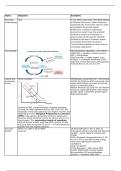
Starting at AD1, the government increases spending,
causing an initial rightward shift to AD2 (Y1 to Y2). the
recipients of this new spending have higher incomes and
depending on their Marginal Propensity to Consume
(MPC), they spend a proportion of this on goods and
services, which becomes income for others, who in turn
spend again. This successive rounds of spending
shift AD further to AD3, with Real GDP rising to Y3 and
the price level rising from P1 to P2 — a final increase far
greater than the original injection.
Economic Short run- shift in AD or SRAS UK Real GDP grew 7.5% in 2021 as
growth Long run furloughed workers returned and demand
surged — spare capacity utilised post-
COVID
2026 UK growth downgraded from 1.1%
to 0.4–0.7% as Iran War raised energy
costs and suppressed consumer
confidence
Long run growth
China Averaged ~10% annual GDP
growth 1980–2010 through capital
accumulation, FDI and technology
transfer — textbook LRAS shift
, Poland GDP per capita (PPP) rose from
50% to 81–83% of the EU average in two
decades; EU structural funds financed
infrastructure = LRAS shift right
Output gaps/ UK Large negative output gap during
trade cycle 2008–09 financial crisis; GDP fell ~6%
and unemployment peaked at ~8%
UK Positive output gap and overheating in
2021–22 contributed to CPI hitting 11.1%
(Oct 2022)
USA US regularly runs trade deficits
during boom phases as imports surge
AD 2026 Iran War: higher oil prices → rising
household energy bills → fall in real
disposable income → C falls → AD shifts
left
UK Post-2008: emergency fiscal stimulus
(G↑) and base rate cut to 0.5% boosted C
and I, shifting AD right
UK Triple Lock pension increase (4.8%
April 2026) raises pensioner incomes →
small positive effect on C component of
AD
AS 2026 Wholesale UK gas prices ↑75%
(Feb–March 2026) → costs of production
rise → SRAS shifts left → stagflation risk
China Massive investment in renewables
(56% of installed capacity by 2024)
lowers long-run energy costs → LRAS
shifts right
UK Deindustrialisation in 1980s reduced
productive capacity in manufacturing;
LRAS in those sectors shifted left
Monetary Transmission mechanism- MPC sets base rate → asset Bank rate:
policy prices, credit, exchange rate, expectations → AD. QE- the Bank of England (BoE) has used
Transmission lags: 18–24 months Quantitative Easing (QE) since 2009 to
QE transmissions mechanism- demand for loanable stimulate the UK economy by
funds increase… electronically creating new money to
purchase government bonds (gilts) and
corporate bonds. Totalling £895 billion at
its peak, this policy lowered long-term
interest rates, encouraging borrowing and
spending to meet the 2% inflation target.
The BoE is now reversing this through
Quantitative Tightening
Fiscal Spending and tax affects on AD and SRAS Case study:
Regulation increasing costs? The Triple Lock
Fiscal multiplier A high profile, often controversial UK
fiscal policy used to determine the annual
increase in the State Retirement Pension
Introduced in 2011, is a guarantee that
Economic N/A In his 1953 essay titled "The Methodology
methodology of Positive Economics, Milton Friedman
explained why economists need to make
assumptions to provide useful
predictions. Friedman understood
economics couldn't use the scientific
method as neatly as chemistry or
physics, but he still saw the scientific
method as the basis. Friedman stated
economists would have to rely on
"uncontrolled experience rather than on
controlled experiment."
Circular flow UK Government spending ~£1.2 trillion
(2024/25) = injection; income tax and
VAT = withdrawals
2026 Iran War → higher import costs
(oil/gas) = increased withdrawal via M,
reducing circular flow and cutting growth
forecast from 1.1% to 0.4–0.7%
Capital and Fiscal multiplier UK Business investment fell ~15% during
accelerator COVID-19 (2020) as GDP contracted, then
theory rebounded sharply as output recovered —
classic accelerator effect
Poland Amazon's £6.23bn FDI into Poland
driven by rapid GDP growth; when Polish
growth slows, investment growth slows
disproportionately
Starting at AD1, the government increases spending,
causing an initial rightward shift to AD2 (Y1 to Y2). the
recipients of this new spending have higher incomes and
depending on their Marginal Propensity to Consume
(MPC), they spend a proportion of this on goods and
services, which becomes income for others, who in turn
spend again. This successive rounds of spending
shift AD further to AD3, with Real GDP rising to Y3 and
the price level rising from P1 to P2 — a final increase far
greater than the original injection.
Economic Short run- shift in AD or SRAS UK Real GDP grew 7.5% in 2021 as
growth Long run furloughed workers returned and demand
surged — spare capacity utilised post-
COVID
2026 UK growth downgraded from 1.1%
to 0.4–0.7% as Iran War raised energy
costs and suppressed consumer
confidence
Long run growth
China Averaged ~10% annual GDP
growth 1980–2010 through capital
accumulation, FDI and technology
transfer — textbook LRAS shift
, Poland GDP per capita (PPP) rose from
50% to 81–83% of the EU average in two
decades; EU structural funds financed
infrastructure = LRAS shift right
Output gaps/ UK Large negative output gap during
trade cycle 2008–09 financial crisis; GDP fell ~6%
and unemployment peaked at ~8%
UK Positive output gap and overheating in
2021–22 contributed to CPI hitting 11.1%
(Oct 2022)
USA US regularly runs trade deficits
during boom phases as imports surge
AD 2026 Iran War: higher oil prices → rising
household energy bills → fall in real
disposable income → C falls → AD shifts
left
UK Post-2008: emergency fiscal stimulus
(G↑) and base rate cut to 0.5% boosted C
and I, shifting AD right
UK Triple Lock pension increase (4.8%
April 2026) raises pensioner incomes →
small positive effect on C component of
AD
AS 2026 Wholesale UK gas prices ↑75%
(Feb–March 2026) → costs of production
rise → SRAS shifts left → stagflation risk
China Massive investment in renewables
(56% of installed capacity by 2024)
lowers long-run energy costs → LRAS
shifts right
UK Deindustrialisation in 1980s reduced
productive capacity in manufacturing;
LRAS in those sectors shifted left
Monetary Transmission mechanism- MPC sets base rate → asset Bank rate:
policy prices, credit, exchange rate, expectations → AD. QE- the Bank of England (BoE) has used
Transmission lags: 18–24 months Quantitative Easing (QE) since 2009 to
QE transmissions mechanism- demand for loanable stimulate the UK economy by
funds increase… electronically creating new money to
purchase government bonds (gilts) and
corporate bonds. Totalling £895 billion at
its peak, this policy lowered long-term
interest rates, encouraging borrowing and
spending to meet the 2% inflation target.
The BoE is now reversing this through
Quantitative Tightening
Fiscal Spending and tax affects on AD and SRAS Case study:
Regulation increasing costs? The Triple Lock
Fiscal multiplier A high profile, often controversial UK
fiscal policy used to determine the annual
increase in the State Retirement Pension
Introduced in 2011, is a guarantee that


