

1. (a) (i) Oxidative phosphorylation/electron transport chain/ETC; 1
(ii) Link reaction and Krebs cycle (or clear descriptions); 1
(b) Respiring anaerobically;
Less efficient/requires more glucose for same amount of ATP; 2
(c) Energy from chemical reaction/oxidation/not from light; 1
[5]
2.
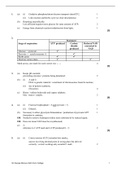
Statement
Stage of respiration ATP produced Carbon Reduced NAD
dioxide converted to
produced NAD
Glucose pyruvate
Pyruvate acetylcoenzyme A
Krebs cycle
Electron carrier chain
Mark across, one mark for each correct row ; ; ; ; 4
[4]
3. (a) Keeps pH constant;
preventing enzymes / proteins being denatured; 2
(b) (i) A and C;
DNA is genetic material / constituent of chromosomes found in nucleus;
(ii) site of protein synthesis;
ribosomes; 4
(c) Biuret / sodium hydroxide and copper sulphate;
lilac / mauve / purple; 2
[8]
4. (a) (i) Fructose bisphosphate = 6 and pyruvate = 3; 1
(ii) Ethanol; 1
(b) Necessary to allow glycolysis/fermentation / production of pyruvate/ATP 1
formation to continue;
OR Needed to remove hydrogen/oxidise more substrate/to be reduced again;
OR Does not mean NAD must be resynthesised;
(c) 2;
reference to 2 ATP used and 4 ATP produced/4 – 2; 2
[5]
5. (a) (i) Correct answer (0.5%) awarded two marks;;
answer involving decimal point in wrong place but derived
correctly / correct working only awarded 1 mark 2
Sir George Monoux Sixth Form College 1
, (ii) Some fails to encounter chloroplasts/chlorophyll in producers
(e.g. some absorbed by water);
reflection;
inappropriate wavelength; max. 2
(b) Only a certain amount of light energy available / not enough energy left;
respiratory loss between each trophic level / loss in faeces; 2
(c) Incorporated in tissues of decomposers;
passed on to other organisms in decomposer food chain;
lost in respiration by decomposers; max. 2
(d) (i) Excites/raises energy level of electrons;
which pass to carriers/leave chlorophyll; 2
(ii) Fall in production of triose phosphate/no more triose phosphate produced;
triose phosphate production requires ATP/reduced NADP;
produced during passage of electrons along electron transport chain; 3
(e) Energy is available more rapidly because released in single reaction /
does not go through as many processes;
ATP releases its energy in small/manageable quantities; 2
(f) (i) Activity / needs of cell linked to level of ATP / ADP ;
link made between high level of one and low level of the other;
level of ADP linked to electron transport and ATP production; 3
(ii) Energy released as heat;
because not used to produce ATP; 2
[20]
6. (a) (i)
Stage Name of stage Location in cell
A Glycolysis Cytoplasm
B Krebs cycle / citric acid cycle / Mitochondrion (ignore
TCA cycle named part)
1 mark per row;; 2
(ii) 3; 1
(iii) To oxygen;
Produce water; 2
(b) (i) 4; 1
(ii) 34; 1
[answerfrom (b)(i) (ii)] x 31] 100;
(c) (i) Correct calculation - 2880
Answer correct from calculation;
OR
Correct answer from (b) / 41% (no working) = 2 marks;; 2
(ii) Lost as heat; 1
(iii) Energy available (more) rapidly / released in a single reaction;
Energy released in small quantities / manageable quantities; 2
Sir George Monoux Sixth Form College 2
, (iv) Any three from:
Active transport;
Phagocytosis;
Synthesis of glycogen;
Protein / enzyme;
DNA / RNA;
Lipid / cholesterol;
Urea in glycolysis;
Bile production;
Cell division;
Any other valid suggestion; 3 max
[15]
7. (a) More work done / more energy / ATP required;
To overcome greater buoyancy;
Look for idea of buoyancy, not term. 2
(b) (i) Retains oxygen until the partial pressure is low / myoglobin
has high affinity for oxygen;
Partial pressure of oxygen late in dive low;
Gives up oxygen (readily) at low partial pressures; 2 max
(ii) Remains under water for long time;
Unable to breathe while under water;
Greater amount of myoglobin can release / provide more oxygen;
More myoglobin, the darker the muscle; 3 max
(c) (i) 0.267 hours or 16 minutes;; 2
3
Error, but 30 00 cm divided by 250 = 1 mark
(ii) Heart rate slows;
Less blood flowing to / from muscles / liver / gut / blood flow to
body other than brain reduced by 90%;
Large volume of blood compared with body mass;
Greater concentration of haemoglobin;
Less blood required to supply heart / to heart muscle; 2 max
Reject imprecise answers relating to ‘organs’ / ‘the body’.
(d) Less blood to muscles / heart muscle / skin; 1
[12]
8. (a) 1 and 3; 1
(b) Some energy lost as heat; 1
(c) (i) Arrow indicates between Glucose to Triose phosphate;
(ii) Arrow indicates between Triose phosphate to Pyruvate; 2
[Note: Extra arrow cancels]
[Reject: Ambiguous labels /arrows]
(d) 4; 1
(e) (i) Grana/ thylakolds/ internal membranes; 1
(ii) Reduces/ reducing power/ source of hydrogen/ electrons;
Glycerate-3-phosphate to Triose phosphate/ GP to TP; 2
[Ignore: Reference to molecules]
Sir George Monoux Sixth Form College 3
(ii) Link reaction and Krebs cycle (or clear descriptions); 1
(b) Respiring anaerobically;
Less efficient/requires more glucose for same amount of ATP; 2
(c) Energy from chemical reaction/oxidation/not from light; 1
[5]
2.
Statement
Stage of respiration ATP produced Carbon Reduced NAD
dioxide converted to
produced NAD
Glucose pyruvate
Pyruvate acetylcoenzyme A
Krebs cycle
Electron carrier chain
Mark across, one mark for each correct row ; ; ; ; 4
[4]
3. (a) Keeps pH constant;
preventing enzymes / proteins being denatured; 2
(b) (i) A and C;
DNA is genetic material / constituent of chromosomes found in nucleus;
(ii) site of protein synthesis;
ribosomes; 4
(c) Biuret / sodium hydroxide and copper sulphate;
lilac / mauve / purple; 2
[8]
4. (a) (i) Fructose bisphosphate = 6 and pyruvate = 3; 1
(ii) Ethanol; 1
(b) Necessary to allow glycolysis/fermentation / production of pyruvate/ATP 1
formation to continue;
OR Needed to remove hydrogen/oxidise more substrate/to be reduced again;
OR Does not mean NAD must be resynthesised;
(c) 2;
reference to 2 ATP used and 4 ATP produced/4 – 2; 2
[5]
5. (a) (i) Correct answer (0.5%) awarded two marks;;
answer involving decimal point in wrong place but derived
correctly / correct working only awarded 1 mark 2
Sir George Monoux Sixth Form College 1
, (ii) Some fails to encounter chloroplasts/chlorophyll in producers
(e.g. some absorbed by water);
reflection;
inappropriate wavelength; max. 2
(b) Only a certain amount of light energy available / not enough energy left;
respiratory loss between each trophic level / loss in faeces; 2
(c) Incorporated in tissues of decomposers;
passed on to other organisms in decomposer food chain;
lost in respiration by decomposers; max. 2
(d) (i) Excites/raises energy level of electrons;
which pass to carriers/leave chlorophyll; 2
(ii) Fall in production of triose phosphate/no more triose phosphate produced;
triose phosphate production requires ATP/reduced NADP;
produced during passage of electrons along electron transport chain; 3
(e) Energy is available more rapidly because released in single reaction /
does not go through as many processes;
ATP releases its energy in small/manageable quantities; 2
(f) (i) Activity / needs of cell linked to level of ATP / ADP ;
link made between high level of one and low level of the other;
level of ADP linked to electron transport and ATP production; 3
(ii) Energy released as heat;
because not used to produce ATP; 2
[20]
6. (a) (i)
Stage Name of stage Location in cell
A Glycolysis Cytoplasm
B Krebs cycle / citric acid cycle / Mitochondrion (ignore
TCA cycle named part)
1 mark per row;; 2
(ii) 3; 1
(iii) To oxygen;
Produce water; 2
(b) (i) 4; 1
(ii) 34; 1
[answerfrom (b)(i) (ii)] x 31] 100;
(c) (i) Correct calculation - 2880
Answer correct from calculation;
OR
Correct answer from (b) / 41% (no working) = 2 marks;; 2
(ii) Lost as heat; 1
(iii) Energy available (more) rapidly / released in a single reaction;
Energy released in small quantities / manageable quantities; 2
Sir George Monoux Sixth Form College 2
, (iv) Any three from:
Active transport;
Phagocytosis;
Synthesis of glycogen;
Protein / enzyme;
DNA / RNA;
Lipid / cholesterol;
Urea in glycolysis;
Bile production;
Cell division;
Any other valid suggestion; 3 max
[15]
7. (a) More work done / more energy / ATP required;
To overcome greater buoyancy;
Look for idea of buoyancy, not term. 2
(b) (i) Retains oxygen until the partial pressure is low / myoglobin
has high affinity for oxygen;
Partial pressure of oxygen late in dive low;
Gives up oxygen (readily) at low partial pressures; 2 max
(ii) Remains under water for long time;
Unable to breathe while under water;
Greater amount of myoglobin can release / provide more oxygen;
More myoglobin, the darker the muscle; 3 max
(c) (i) 0.267 hours or 16 minutes;; 2
3
Error, but 30 00 cm divided by 250 = 1 mark
(ii) Heart rate slows;
Less blood flowing to / from muscles / liver / gut / blood flow to
body other than brain reduced by 90%;
Large volume of blood compared with body mass;
Greater concentration of haemoglobin;
Less blood required to supply heart / to heart muscle; 2 max
Reject imprecise answers relating to ‘organs’ / ‘the body’.
(d) Less blood to muscles / heart muscle / skin; 1
[12]
8. (a) 1 and 3; 1
(b) Some energy lost as heat; 1
(c) (i) Arrow indicates between Glucose to Triose phosphate;
(ii) Arrow indicates between Triose phosphate to Pyruvate; 2
[Note: Extra arrow cancels]
[Reject: Ambiguous labels /arrows]
(d) 4; 1
(e) (i) Grana/ thylakolds/ internal membranes; 1
(ii) Reduces/ reducing power/ source of hydrogen/ electrons;
Glycerate-3-phosphate to Triose phosphate/ GP to TP; 2
[Ignore: Reference to molecules]
Sir George Monoux Sixth Form College 3


