

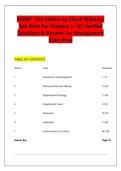
MGMT 13th Edition by Chuck Williams:
Test Bank for Chapters 1–18 | Verified
Questions & Answers for Management
Exam Prep
TABLE OF CONTENTS
Section Topic Questions
1 Introduction to Management 1-15
2 Planning & Decision Making 16-30
3 Organizational Strategy 31-40
4 Organizing & Teams 41-55
5 Motivation 56-70
6 Leadership 71-85
7 Communication & Control 86-100
Answer Key Page 18
,SECTION 1: INTRODUCTION TO MANAGEMENT (Questions 1-
15)
Question 1
Management is defined as:
A) The process of achieving organizational goals through the use of resources
B) The art of getting things done through people
C) The process of planning, organizing, leading, and controlling to achieve
organizational goals
D) The science of maximizing efficiency
Correct Answer: C
Rationale: Management is the process of planning, organizing, leading, and controlling
to achieve organizational goals. This definition encompasses all the key functions that
managers perform in organizations .
Question 2
Which of the following is NOT one of the four functions of management?
A) Planning
B) Organizing
C) Directing
D) Controlling
,Correct Answer: C
Rationale: The four functions of management are Planning, Organizing, Leading, and
Controlling. "Directing" is not one of the four recognized functions .
Question 3
A manager who is determining what needs to be done and how it will be done is
engaged in which management function?
A) Planning
B) Organizing
C) Leading
D) Controlling
Correct Answer: A
Rationale: Planning involves determining organizational goals and the means for
achieving them. It answers "what needs to be done and how it will be done" .
Question 4
__________ is the degree to which a leader structures the roles of followers by
setting goals, giving directions, setting deadlines, and assigning tasks.
A) Task structure
B) Initiating structure
C) Consideration
D) Position power
, Correct Answer: B
Rationale: Initiating structure is the degree to which a leader structures the roles of
followers by setting goals, giving directions, setting deadlines, and assigning tasks. A
leader's ability to initiate structure primarily affects subordinates' job performance .
Question 5
The extent to which a leader is friendly, approachable, and supportive and shows
concern for employees is called:
A) Initiating structure
B) Task structure
C) Consideration
D) Position power
Correct Answer: C
Rationale: Consideration is the extent to which a leader is friendly, approachable, and
supportive and shows concern for employees. This leadership behavior primarily affects
subordinates' job satisfaction .
Question 6
__________ refers to the degree to which outcomes and rewards are fairly distributed
or allocated.
A) Procedural justice
B) Distributive justice
Test Bank for Chapters 1–18 | Verified
Questions & Answers for Management
Exam Prep
TABLE OF CONTENTS
Section Topic Questions
1 Introduction to Management 1-15
2 Planning & Decision Making 16-30
3 Organizational Strategy 31-40
4 Organizing & Teams 41-55
5 Motivation 56-70
6 Leadership 71-85
7 Communication & Control 86-100
Answer Key Page 18
,SECTION 1: INTRODUCTION TO MANAGEMENT (Questions 1-
15)
Question 1
Management is defined as:
A) The process of achieving organizational goals through the use of resources
B) The art of getting things done through people
C) The process of planning, organizing, leading, and controlling to achieve
organizational goals
D) The science of maximizing efficiency
Correct Answer: C
Rationale: Management is the process of planning, organizing, leading, and controlling
to achieve organizational goals. This definition encompasses all the key functions that
managers perform in organizations .
Question 2
Which of the following is NOT one of the four functions of management?
A) Planning
B) Organizing
C) Directing
D) Controlling
,Correct Answer: C
Rationale: The four functions of management are Planning, Organizing, Leading, and
Controlling. "Directing" is not one of the four recognized functions .
Question 3
A manager who is determining what needs to be done and how it will be done is
engaged in which management function?
A) Planning
B) Organizing
C) Leading
D) Controlling
Correct Answer: A
Rationale: Planning involves determining organizational goals and the means for
achieving them. It answers "what needs to be done and how it will be done" .
Question 4
__________ is the degree to which a leader structures the roles of followers by
setting goals, giving directions, setting deadlines, and assigning tasks.
A) Task structure
B) Initiating structure
C) Consideration
D) Position power
, Correct Answer: B
Rationale: Initiating structure is the degree to which a leader structures the roles of
followers by setting goals, giving directions, setting deadlines, and assigning tasks. A
leader's ability to initiate structure primarily affects subordinates' job performance .
Question 5
The extent to which a leader is friendly, approachable, and supportive and shows
concern for employees is called:
A) Initiating structure
B) Task structure
C) Consideration
D) Position power
Correct Answer: C
Rationale: Consideration is the extent to which a leader is friendly, approachable, and
supportive and shows concern for employees. This leadership behavior primarily affects
subordinates' job satisfaction .
Question 6
__________ refers to the degree to which outcomes and rewards are fairly distributed
or allocated.
A) Procedural justice
B) Distributive justice


