

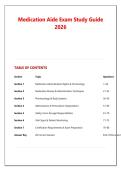
Medication Aide Exam Study Guide
2026
TABLE OF CONTENTS
Section Topic Questions
Section 1 Medication Administration Rights & Terminology 1–20
Section 2 Medication Routes & Administration Techniques 21–35
Section 3 Pharmacology & Body Systems 36–50
Section 4 Abbreviations & Prescription Interpretation 51–60
Section 5 Safety, Errors & Legal Responsibilities 61–70
Section 6 Vital Signs & Patient Monitoring 71–75
Section 7 Certification Requirements & Exam Preparation 76–80
Answer Key All Correct Answers End of Document
,SECTION 1: MEDICATION ADMINISTRATION RIGHTS &
TERMINOLOGY
1. How many "Rights" of Medication Administration are generally taught to
Medication Aides?
A) 5
B) 6
C) 7
D) 10
Correct Answer: B) 6
Rationale: The standard for medication administration includes six rights: Right
Resident/Patient, Right Drug, Right Dose, Right Route, Right Time, and Right
Documentation . Some facilities or states may include a seventh "Right" such as Right
Technique or Right to Refuse.
2. What does the abbreviation "PRN" stand for in medical terminology?
A) Prior to noon
B) As needed
C) After meals
D) Immediately
Correct Answer: B) As needed
,Rationale: PRN stands for "pro re nata," a Latin phrase meaning "as the situation arises,"
which translates to "as needed." A PRN medication is administered only when specific
symptoms or conditions are present .
3. The abbreviation "po" on a medication order indicates the medication should be
given:
A) By injection
B) Under the tongue
C) By mouth
D) In the ear
Correct Answer: C) By mouth
Rationale: "po" is an abbreviation for the Latin term "per os," which means "by mouth."
This is the most common route for medication administration and includes tablets,
capsules, and liquids that are swallowed .
4. The Six Rights of Medication Administration are:
A) Right Patient, Right Drug, Right Dose, Right Route, Right Time, Right
Documentation
B) Right Patient, Right Drug, Right Dose, Right Route, Right Time, Right Reason
C) Right Patient, Right Drug, Right Dose, Right Order, Right Time, Right
Documentation
D) Right Patient, Right Drug, Right Amount, Right Route, Right Time, Right
Documentation
, Correct Answer: A) Right Patient, Right Drug, Right Dose, Right Route, Right Time,
Right Documentation
Rationale: The Six Rights are the foundation of safe medication administration. The
correct sequence and rights are the Right Patient (verify identity using two identifiers),
Right Drug (check the label three times), Right Dose (confirm the amount is correct),
Right Route (administer via the prescribed route), Right Time (administer within the
acceptable time frame), and Right Documentation (record immediately after
administration) .
5. The abbreviation "SL" on a prescription indicates the medication should be
given:
A) Subcutaneously
B) Sublingually
C) Intramuscularly
D) Topically
Correct Answer: B) Sublingually
Rationale: "SL" stands for sublingual, meaning the medication is placed under the
tongue and allowed to dissolve. This route provides rapid absorption through the
mucous membranes directly into the bloodstream .
6. What is the abbreviation for "immediately" in medication orders?
A) PRN
B) STAT
2026
TABLE OF CONTENTS
Section Topic Questions
Section 1 Medication Administration Rights & Terminology 1–20
Section 2 Medication Routes & Administration Techniques 21–35
Section 3 Pharmacology & Body Systems 36–50
Section 4 Abbreviations & Prescription Interpretation 51–60
Section 5 Safety, Errors & Legal Responsibilities 61–70
Section 6 Vital Signs & Patient Monitoring 71–75
Section 7 Certification Requirements & Exam Preparation 76–80
Answer Key All Correct Answers End of Document
,SECTION 1: MEDICATION ADMINISTRATION RIGHTS &
TERMINOLOGY
1. How many "Rights" of Medication Administration are generally taught to
Medication Aides?
A) 5
B) 6
C) 7
D) 10
Correct Answer: B) 6
Rationale: The standard for medication administration includes six rights: Right
Resident/Patient, Right Drug, Right Dose, Right Route, Right Time, and Right
Documentation . Some facilities or states may include a seventh "Right" such as Right
Technique or Right to Refuse.
2. What does the abbreviation "PRN" stand for in medical terminology?
A) Prior to noon
B) As needed
C) After meals
D) Immediately
Correct Answer: B) As needed
,Rationale: PRN stands for "pro re nata," a Latin phrase meaning "as the situation arises,"
which translates to "as needed." A PRN medication is administered only when specific
symptoms or conditions are present .
3. The abbreviation "po" on a medication order indicates the medication should be
given:
A) By injection
B) Under the tongue
C) By mouth
D) In the ear
Correct Answer: C) By mouth
Rationale: "po" is an abbreviation for the Latin term "per os," which means "by mouth."
This is the most common route for medication administration and includes tablets,
capsules, and liquids that are swallowed .
4. The Six Rights of Medication Administration are:
A) Right Patient, Right Drug, Right Dose, Right Route, Right Time, Right
Documentation
B) Right Patient, Right Drug, Right Dose, Right Route, Right Time, Right Reason
C) Right Patient, Right Drug, Right Dose, Right Order, Right Time, Right
Documentation
D) Right Patient, Right Drug, Right Amount, Right Route, Right Time, Right
Documentation
, Correct Answer: A) Right Patient, Right Drug, Right Dose, Right Route, Right Time,
Right Documentation
Rationale: The Six Rights are the foundation of safe medication administration. The
correct sequence and rights are the Right Patient (verify identity using two identifiers),
Right Drug (check the label three times), Right Dose (confirm the amount is correct),
Right Route (administer via the prescribed route), Right Time (administer within the
acceptable time frame), and Right Documentation (record immediately after
administration) .
5. The abbreviation "SL" on a prescription indicates the medication should be
given:
A) Subcutaneously
B) Sublingually
C) Intramuscularly
D) Topically
Correct Answer: B) Sublingually
Rationale: "SL" stands for sublingual, meaning the medication is placed under the
tongue and allowed to dissolve. This route provides rapid absorption through the
mucous membranes directly into the bloodstream .
6. What is the abbreviation for "immediately" in medication orders?
A) PRN
B) STAT


