

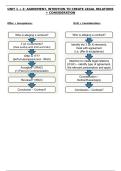
UNIT 1 + 2: AGREEMENT, INTENTION TO CREATE LEGAL RELATIONS
+ CONSIDERATION
Offer + Acceptance: ICLR + Consideration:
,1. Identify who is seeking to show a contract exists and state the elements needed
to form a contract
Three elements of a contract:
a. Agreement
b. Intention to create legal relations
c. Consideration
2. Is a party making an offer or an invitation to treat? Define offer and identify offer
on the facts.
An offer is a definite promise to be bound by specified terms and must be distinguished from
an invitation to treat where there is no such intention to be bound.
Smith v Hughes [1871] Courts adopt an ‘objective’ approach to deciding whether
there was agreement between the parties.
Allied Marine Transport v Vale Although test is predominantly objective, there is a
do Rio Doce Navegacao SA subjective element as the offeree must believe that the
(The Leonidas) [1985] offeror actually intended to make an offer.
Pharmaceutical Society of Goods on display in self-service shops are invitations to
Great Britain v Boots Cash treat; offer occurs at checkout, acceptance when paid.
Chemists [1953]
Fisher v Bell [1961] D charged with offering for sale a flick knife → acquitted as
court held displaying knife was an invitation to treat.
Partridge v Crittenden [1968] Adverts are usually an invitation to treat.
If adverts were offers, it would mean that anyone
asking for the advertised goods would be accepting, in
which case it would be a problem if the advertiser had
run out of stock.
Williams v Carwardine [1833] Adverts of rewards = offer.
Money has to be paid once the offer is accepted by the
supply of the information → encourages people to come
forward.
Carlill v Carbolic Smoke Ball In exceptional cases, adverts may be an offer of a unilateral
Company [1893] contract if there is a clear intention to be bound.
‘If you do X, I promise to do Y.’
Company offered a reward of £100 to anyone who used
the remedy and contracted flu.
,Auctions + Tenders:
s 57(2) Sale of Goods Act Auctioneer’s call for bids = invitation to treat.
1979 Bids = offers.
Acceptance occurs on fall of hammer → auctioneer is
agent for owner; contract forms between owner and
bidder.
s57(3) SGA 1979 Reserve price = price agreed between the auctioneer and
the seller as being the lowest price which the auctioneer
may accept. If bidding does not reach the reserve price, the
lot will be withdrawn from the sale.
Barry v Davies [2000] Auctions without reserve constitutes an offer of unilateral
contract: promise to sell to the highest bidder.
If auctioneer refuses to accept the bid, highest bidder
will have a claim in damaged against auctioneer (not
owner). Damages = loss of expectation, can claim
difference in price between bid and item’s value.
Spencer v Harding [1870] Tenders are generally an invitation to treat. Tenders
submitted are offers which can be accepted or rejected.
Harvela Investments Ltd v If the inviter expressly promises to accept a certain tender
Royal Trust Company of (eg the cheapest), a unilateral contract arises. Acceptance
Canada Ltd [1986] occurs when the specified tender is submitted.
Blackpool & Fylde Aero Club v Invitation for tenders from a specific group with clear
Blackpool Borough Council procedure → D had made an offer of a unilateral contract to
[1990] consider all timely bids with C (implied promise).
, 3. Has an offer been accepted? Define acceptance and apply to the facts.
Acceptance = a final and unqualified expression of assent to the terms of the offer - Treitel,
The Law of Contract, 13th edn, p 17.
A. Must be complete and unqualified acceptance of all the terms:
Offeree must also know of the offer to accept - Australian case of R v Clarke [1927].
Counteroffer or request for information?
Hyde v Wrench [1840] If the offeree suggests even slightly different terms in
response to an offer, it cannot be an acceptance. It will be a
counteroffer and an implied rejection of the offer.
A counteroffer destroys the original offer, which cannot then
be accepted.
Stevenson Jacques and Co v An inquiry is not acceptance or a counteroffer. It is a request
McLean [1880] for further information which does not destroy the original
offer.
Battle of the forms?
Butler Machine Tool v Ex-Cell- In a battle of the forms, each set of terms sent is a
O Corp [1979] counteroffer. The contract is formed on the last set of terms
that is accepted
Brogden v Metropolitan No acknowledgement slip = Acceptance by conduct;
Railway Co [187] performance can conclude contract on last terms.
TRW Ltd v Panasonic Industry Last shot rule does not always apply: if one party’s standard
Europe GmbH and another terms have been expressly acknowledged or signed earlier,
company [2021 those terms may apply to later dealings -even if the other
party fires a later ‘shot.’
Certainty and completeness?
Courts consider: whether parties are in same trade, trade usage, whether agreement has
been acted on for any length of time + whether there is an objective mechanism for
resolving any uncertainty.
Scammell v Ouston [1941] Buying a car. Absence of key details of hire purchase
agreement, eg duration, no.+ number of repayments = too
vague to be a contract.
Hillas v Arcos [1932] Agreement to buy ‘timber of fair specification’ was not too
vague in context as parties both in timber trade and had
dealt with each other before.
Hussey v Horne-Payne [1878] Parties are not bound until all essential terms are agreed.
+ CONSIDERATION
Offer + Acceptance: ICLR + Consideration:
,1. Identify who is seeking to show a contract exists and state the elements needed
to form a contract
Three elements of a contract:
a. Agreement
b. Intention to create legal relations
c. Consideration
2. Is a party making an offer or an invitation to treat? Define offer and identify offer
on the facts.
An offer is a definite promise to be bound by specified terms and must be distinguished from
an invitation to treat where there is no such intention to be bound.
Smith v Hughes [1871] Courts adopt an ‘objective’ approach to deciding whether
there was agreement between the parties.
Allied Marine Transport v Vale Although test is predominantly objective, there is a
do Rio Doce Navegacao SA subjective element as the offeree must believe that the
(The Leonidas) [1985] offeror actually intended to make an offer.
Pharmaceutical Society of Goods on display in self-service shops are invitations to
Great Britain v Boots Cash treat; offer occurs at checkout, acceptance when paid.
Chemists [1953]
Fisher v Bell [1961] D charged with offering for sale a flick knife → acquitted as
court held displaying knife was an invitation to treat.
Partridge v Crittenden [1968] Adverts are usually an invitation to treat.
If adverts were offers, it would mean that anyone
asking for the advertised goods would be accepting, in
which case it would be a problem if the advertiser had
run out of stock.
Williams v Carwardine [1833] Adverts of rewards = offer.
Money has to be paid once the offer is accepted by the
supply of the information → encourages people to come
forward.
Carlill v Carbolic Smoke Ball In exceptional cases, adverts may be an offer of a unilateral
Company [1893] contract if there is a clear intention to be bound.
‘If you do X, I promise to do Y.’
Company offered a reward of £100 to anyone who used
the remedy and contracted flu.
,Auctions + Tenders:
s 57(2) Sale of Goods Act Auctioneer’s call for bids = invitation to treat.
1979 Bids = offers.
Acceptance occurs on fall of hammer → auctioneer is
agent for owner; contract forms between owner and
bidder.
s57(3) SGA 1979 Reserve price = price agreed between the auctioneer and
the seller as being the lowest price which the auctioneer
may accept. If bidding does not reach the reserve price, the
lot will be withdrawn from the sale.
Barry v Davies [2000] Auctions without reserve constitutes an offer of unilateral
contract: promise to sell to the highest bidder.
If auctioneer refuses to accept the bid, highest bidder
will have a claim in damaged against auctioneer (not
owner). Damages = loss of expectation, can claim
difference in price between bid and item’s value.
Spencer v Harding [1870] Tenders are generally an invitation to treat. Tenders
submitted are offers which can be accepted or rejected.
Harvela Investments Ltd v If the inviter expressly promises to accept a certain tender
Royal Trust Company of (eg the cheapest), a unilateral contract arises. Acceptance
Canada Ltd [1986] occurs when the specified tender is submitted.
Blackpool & Fylde Aero Club v Invitation for tenders from a specific group with clear
Blackpool Borough Council procedure → D had made an offer of a unilateral contract to
[1990] consider all timely bids with C (implied promise).
, 3. Has an offer been accepted? Define acceptance and apply to the facts.
Acceptance = a final and unqualified expression of assent to the terms of the offer - Treitel,
The Law of Contract, 13th edn, p 17.
A. Must be complete and unqualified acceptance of all the terms:
Offeree must also know of the offer to accept - Australian case of R v Clarke [1927].
Counteroffer or request for information?
Hyde v Wrench [1840] If the offeree suggests even slightly different terms in
response to an offer, it cannot be an acceptance. It will be a
counteroffer and an implied rejection of the offer.
A counteroffer destroys the original offer, which cannot then
be accepted.
Stevenson Jacques and Co v An inquiry is not acceptance or a counteroffer. It is a request
McLean [1880] for further information which does not destroy the original
offer.
Battle of the forms?
Butler Machine Tool v Ex-Cell- In a battle of the forms, each set of terms sent is a
O Corp [1979] counteroffer. The contract is formed on the last set of terms
that is accepted
Brogden v Metropolitan No acknowledgement slip = Acceptance by conduct;
Railway Co [187] performance can conclude contract on last terms.
TRW Ltd v Panasonic Industry Last shot rule does not always apply: if one party’s standard
Europe GmbH and another terms have been expressly acknowledged or signed earlier,
company [2021 those terms may apply to later dealings -even if the other
party fires a later ‘shot.’
Certainty and completeness?
Courts consider: whether parties are in same trade, trade usage, whether agreement has
been acted on for any length of time + whether there is an objective mechanism for
resolving any uncertainty.
Scammell v Ouston [1941] Buying a car. Absence of key details of hire purchase
agreement, eg duration, no.+ number of repayments = too
vague to be a contract.
Hillas v Arcos [1932] Agreement to buy ‘timber of fair specification’ was not too
vague in context as parties both in timber trade and had
dealt with each other before.
Hussey v Horne-Payne [1878] Parties are not bound until all essential terms are agreed.


