

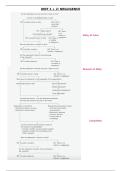
UNIT 1 + 2: NEGLIGENCE
Duty of Care
Breach of Duty
Causation
,Defences
, 1. Did the defendant owe the claimant a duty of care?
Is there an established duty of care?
Doctor → patient, employer → employee, etc.
Rescuers: duty if rescue foreseeable response to danger → Baker v TE Hopkins [1959].
If no: novel duty situation – Caparo Test
1. Was harm to the claimant foreseeable?
Bourhill v Young [1943]: miscarriage (shock) not foreseeable victim of motorcycle
crash.
2. Were the claimant and defendant close in proximity?
3. Would it be fair, just and reasonable to impose a duty of care on the defendant?
Marc Rich v Bishop Rock Marine Co Ltd [1996]: unfair to impose on non-profit
safety body.
Donoghue v Stevenson [1932]: ‘Neighbour Principle’ (1+2)
Policy and Public Authority Cases
Hill v Chief Constable of West Yorkshire Duty to public at large, not individuals.
[1989]
No duty to victims/witnesses in investigating
Brooks v Commissioner of Police for the crimes.
Metropolis [2005]
Kirkham v Chief Constable of Greater Duty arises if police assume responsibility (failed
Manchester Police [1990] to warn prison of suicide risk)
Osman v UK [1999] No blanket immunity (breaches Art. 6 ECHR)
Z v UK [2002] ‘Fair, just and reasonable approach’ =
acceptable.
Robinson v Chief Constable of West Liable for actions, not omissions.
Yorkshire Police [2018]
Omissions
General rule: no duty to prevent harm → Stovin v Wise [1996]
, If you do act, not liable unless you make matters worse - East Suffolk Rivers Catchment
Board v Kent and another [1940] 4 All ER 527.
Exception: control or assumed responsibility:
Home Office v Dorset Yacht Co Ltd [1970]: officers had control over offenders.
Carmarthenshire Country Council v Lewis [1955]: council assumed responsibility for
child.
Smith v Littlewoods Organisation Ltd [1987]: not required to prevent third party
wrongdoing (no knowledge/control over vandals causing fire)
2. Was the defendant in breach of duty?
Law: how D ought to have behaved
D must exercise the standard of care which would be expected of an ordinary
reasonable person in their position - Blyth v Birmingham Waterworks (1856).
Objective test – Glasgow Corp v Muir (1943)
Exceptions: special standards.
Professionals/ Standard of a competent professional - Bolam v Friern Hospital
skilled Management Committee [1957]
Court can reject professional opinion if illogical – Bolitho v City
and Hackney Health Authority [1997]
Under-skilled/ Learner driver = standard of reasonably competent driver –
learners Nettleship v Weston [1971]
Junior doctor = standard of competent doctor in post – Wilsher
v Essex Area Health Authority [1987]
DIY/amateurs Judged by reasonably competent amateur - Wells v Cooper
[1958]
Attempting tasks beyond normal capability = likely negligent.
Children Reasonable child of same age – Mullin v Richards [1998]
Fact: did D’s conduct fall below required standard?
Assess risk against practicality of taking the precaution.
Magnitude of Higher likelihood/seriousness → greater care.
Risk Bolton v Stone [1951]: very low risk → no breach.
Paris v Stepney Borough Council [1951]: serious consequences →
breach.
Cost & Cheap/easy → should take; expensive/impractical → may not be
Practicability of required if risk small - Latimer v AEC [1953]
Precautions
Duty of Care
Breach of Duty
Causation
,Defences
, 1. Did the defendant owe the claimant a duty of care?
Is there an established duty of care?
Doctor → patient, employer → employee, etc.
Rescuers: duty if rescue foreseeable response to danger → Baker v TE Hopkins [1959].
If no: novel duty situation – Caparo Test
1. Was harm to the claimant foreseeable?
Bourhill v Young [1943]: miscarriage (shock) not foreseeable victim of motorcycle
crash.
2. Were the claimant and defendant close in proximity?
3. Would it be fair, just and reasonable to impose a duty of care on the defendant?
Marc Rich v Bishop Rock Marine Co Ltd [1996]: unfair to impose on non-profit
safety body.
Donoghue v Stevenson [1932]: ‘Neighbour Principle’ (1+2)
Policy and Public Authority Cases
Hill v Chief Constable of West Yorkshire Duty to public at large, not individuals.
[1989]
No duty to victims/witnesses in investigating
Brooks v Commissioner of Police for the crimes.
Metropolis [2005]
Kirkham v Chief Constable of Greater Duty arises if police assume responsibility (failed
Manchester Police [1990] to warn prison of suicide risk)
Osman v UK [1999] No blanket immunity (breaches Art. 6 ECHR)
Z v UK [2002] ‘Fair, just and reasonable approach’ =
acceptable.
Robinson v Chief Constable of West Liable for actions, not omissions.
Yorkshire Police [2018]
Omissions
General rule: no duty to prevent harm → Stovin v Wise [1996]
, If you do act, not liable unless you make matters worse - East Suffolk Rivers Catchment
Board v Kent and another [1940] 4 All ER 527.
Exception: control or assumed responsibility:
Home Office v Dorset Yacht Co Ltd [1970]: officers had control over offenders.
Carmarthenshire Country Council v Lewis [1955]: council assumed responsibility for
child.
Smith v Littlewoods Organisation Ltd [1987]: not required to prevent third party
wrongdoing (no knowledge/control over vandals causing fire)
2. Was the defendant in breach of duty?
Law: how D ought to have behaved
D must exercise the standard of care which would be expected of an ordinary
reasonable person in their position - Blyth v Birmingham Waterworks (1856).
Objective test – Glasgow Corp v Muir (1943)
Exceptions: special standards.
Professionals/ Standard of a competent professional - Bolam v Friern Hospital
skilled Management Committee [1957]
Court can reject professional opinion if illogical – Bolitho v City
and Hackney Health Authority [1997]
Under-skilled/ Learner driver = standard of reasonably competent driver –
learners Nettleship v Weston [1971]
Junior doctor = standard of competent doctor in post – Wilsher
v Essex Area Health Authority [1987]
DIY/amateurs Judged by reasonably competent amateur - Wells v Cooper
[1958]
Attempting tasks beyond normal capability = likely negligent.
Children Reasonable child of same age – Mullin v Richards [1998]
Fact: did D’s conduct fall below required standard?
Assess risk against practicality of taking the precaution.
Magnitude of Higher likelihood/seriousness → greater care.
Risk Bolton v Stone [1951]: very low risk → no breach.
Paris v Stepney Borough Council [1951]: serious consequences →
breach.
Cost & Cheap/easy → should take; expensive/impractical → may not be
Practicability of required if risk small - Latimer v AEC [1953]
Precautions


