
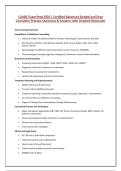
Exam Coverage Summary
Foundations of Addiction Counselling
Historical models of addiction (Moral, Disease, Psychological, Sociocultural, Spiritual)
Key theorists and their contributions (Jellinek, Rush, Freud, Rogers, Ellis, Perls, Adler,
Glasser, Berne)
Neurobiology of addiction (neurotransmitters, brain structures, CNS/PNS)
Pharmacological concepts (agonists, antagonists, tolerance, routes of administration)
Assessment and Evaluation
Screening instruments (AUDIT, CAGE, MAST, DAST, SASSI, ASI, CRAFFT)
Diagnostic criteria for substance use disorders
Biopsychosocial assessment components
Suicide risk assessment and crisis intervention
Treatment Planning and Implementation
ASAM criteria and 6 dimensions
5 Levels of Care (ASAM continuum)
Treatment planning components (problem statements, goals, objectives, interventions)
12 Core Functions of addiction counseling
Stages of Change (Pre-contemplation through Maintenance)
Counseling Theories and Techniques
Major therapeutic approaches (CBT, MET, MI, Person-Centered, Gestalt, REBT, Reality, TA,
Adlerian, Existential)
Group counseling principles and Yalom's curative factors
Family roles and systems theory
Crisis intervention strategies
Ethical and Legal Issues
42 CFR Part 2 and HIPAA compliance
Informed consent and confidentiality
Duty to warn (Tarasoff decision)
Professional boundaries and dual relationships
MCBAP Code of Ethics
,Special Populations and Co-occurring Disorders
Cultural competence and stages
Dual diagnosis and integrated treatment
Adolescent and geriatric considerations
Gender-specific treatment issues
Pharmacology and Medical Aspects
Withdrawal timelines and symptoms
Medications for addiction treatment (Antabuse, Campral, Suboxone, Naltrexone,
Methadone)
Drug classifications (Schedules 1-5)
Common side effects and drug interactions
Relapse Prevention and Recovery
Relapse prevention models (Marlatt & Gordon)
Recovery management and ROSC
12-step programs and mutual support groups
Post-discharge planning and continuing care
1. A client in the early stages of treatment appears unmotivated and denies having any problems
related to substance use. According to the Stages of Change model, which stage best describes this
client?
A) Contemplation
B) Preparation
C) Pre-contemplation
D) Maintenance
Rationale: Pre-contemplation is characterized by denial and lack of awareness of problems; clients in
this stage do not see their behavior as problematic and have no intention of changing in the
foreseeable future.
2. A 45-year-old client presents with a 20-year history of alcohol use and reports experiencing
tremors, sweating, and nausea when attempting to stop drinking. Based on ASAM dimensions,
which dimension is of primary concern during initial assessment?
,A) Dimension 3 (Emotional/Behavioral)
B) Dimension 4 (Readiness to Change)
C) Dimension 1 (Acute Intoxication/Withdrawal)
D) Dimension 6 (Recovery/Living Environment)
Rationale: The symptoms described indicate acute withdrawal, which falls under ASAM Dimension 1,
addressing the immediate medical and detoxification needs of the client.
3. A therapist notices that a client consistently interrupts other group members and redirects
conversations to their own experiences. The therapist is facilitating a process group and wants to
address this behavior. Which leadership intervention is most appropriate initially?
A) Confront the client directly about their disruptive behavior
B) Ask the group how they feel about the interruption pattern
C) Ignore the behavior to avoid conflict in the group
D) Redirect the conversation back to the original speaker
Rationale: In process groups, it is most therapeutic to address interpersonal dynamics as they occur;
asking the group to share their feelings promotes group processing and shared responsibility for
group functioning.
4. A client completes a standard drink diary and reports consuming 24 beers over a weekend, 8
mixed drinks on weeknights, and several glasses of wine with dinner. The counselor wants to
calculate weekly alcohol consumption. One standard drink contains approximately how much
pure alcohol?
A) 0.3 ounces
B) 0.5 ounces
C) 0.6 ounces
D) 1.0 ounces
Rationale: One standard drink contains approximately 0.5 to 0.6 ounces of pure alcohol, equivalent
to 12 ounces of beer, 5 ounces of wine, or 1.5 ounces of distilled spirits.
, 5. During an initial session, a client tells their counselor that they feel "ready to make some
changes" but expresses ambivalence about giving up their social circle of substance-using friends.
Which ASAM dimension is most relevant to this client's presenting concern?
A) Dimension 1: Acute Intoxication/Withdrawal
B) Dimension 2: Biomedical Conditions
C) Dimension 4: Readiness to Change
D) Dimension 5: Relapse Potential
Rationale: Dimension 4 specifically addresses the client's readiness to change and motivation for
treatment; the client's ambivalence about social support systems is directly relevant to this
dimension.
6. A 35-year-old male client is being admitted to a residential treatment program and appears
hostile and defensive during the intake process. He states, "I don't need to be here; my wife made
me come." Which counseling skill would be most effective in building rapport with this client?
A) Direct confrontation about his denial
B) Reflective listening to acknowledge his feelings
C) Immediate referral to another counselor
D) Educating him about the consequences of addiction
Rationale: Reflective listening validates the client's feelings without judgment, which is essential for
building therapeutic alliance and reducing defensiveness in mandated or reluctant clients.
7. A counselor is assessing a new client who reports using heroin daily for the past three years and
has attempted detoxification three times without success. The client reports being "sick and tired
of being sick and tired." This statement most clearly indicates which of the following?
A) The client is in the Pre-contemplation stage
B) The client is experiencing internal motivation for change
C) The client needs medication-assisted treatment
D) The client is seeking secondary gain from treatment
Rationale: The client's statement reflects frustration with their addiction and desire for change,
which indicates internal motivation; this is a key component of the Contemplation or Preparation
stage of change.
Foundations of Addiction Counselling
Historical models of addiction (Moral, Disease, Psychological, Sociocultural, Spiritual)
Key theorists and their contributions (Jellinek, Rush, Freud, Rogers, Ellis, Perls, Adler,
Glasser, Berne)
Neurobiology of addiction (neurotransmitters, brain structures, CNS/PNS)
Pharmacological concepts (agonists, antagonists, tolerance, routes of administration)
Assessment and Evaluation
Screening instruments (AUDIT, CAGE, MAST, DAST, SASSI, ASI, CRAFFT)
Diagnostic criteria for substance use disorders
Biopsychosocial assessment components
Suicide risk assessment and crisis intervention
Treatment Planning and Implementation
ASAM criteria and 6 dimensions
5 Levels of Care (ASAM continuum)
Treatment planning components (problem statements, goals, objectives, interventions)
12 Core Functions of addiction counseling
Stages of Change (Pre-contemplation through Maintenance)
Counseling Theories and Techniques
Major therapeutic approaches (CBT, MET, MI, Person-Centered, Gestalt, REBT, Reality, TA,
Adlerian, Existential)
Group counseling principles and Yalom's curative factors
Family roles and systems theory
Crisis intervention strategies
Ethical and Legal Issues
42 CFR Part 2 and HIPAA compliance
Informed consent and confidentiality
Duty to warn (Tarasoff decision)
Professional boundaries and dual relationships
MCBAP Code of Ethics
,Special Populations and Co-occurring Disorders
Cultural competence and stages
Dual diagnosis and integrated treatment
Adolescent and geriatric considerations
Gender-specific treatment issues
Pharmacology and Medical Aspects
Withdrawal timelines and symptoms
Medications for addiction treatment (Antabuse, Campral, Suboxone, Naltrexone,
Methadone)
Drug classifications (Schedules 1-5)
Common side effects and drug interactions
Relapse Prevention and Recovery
Relapse prevention models (Marlatt & Gordon)
Recovery management and ROSC
12-step programs and mutual support groups
Post-discharge planning and continuing care
1. A client in the early stages of treatment appears unmotivated and denies having any problems
related to substance use. According to the Stages of Change model, which stage best describes this
client?
A) Contemplation
B) Preparation
C) Pre-contemplation
D) Maintenance
Rationale: Pre-contemplation is characterized by denial and lack of awareness of problems; clients in
this stage do not see their behavior as problematic and have no intention of changing in the
foreseeable future.
2. A 45-year-old client presents with a 20-year history of alcohol use and reports experiencing
tremors, sweating, and nausea when attempting to stop drinking. Based on ASAM dimensions,
which dimension is of primary concern during initial assessment?
,A) Dimension 3 (Emotional/Behavioral)
B) Dimension 4 (Readiness to Change)
C) Dimension 1 (Acute Intoxication/Withdrawal)
D) Dimension 6 (Recovery/Living Environment)
Rationale: The symptoms described indicate acute withdrawal, which falls under ASAM Dimension 1,
addressing the immediate medical and detoxification needs of the client.
3. A therapist notices that a client consistently interrupts other group members and redirects
conversations to their own experiences. The therapist is facilitating a process group and wants to
address this behavior. Which leadership intervention is most appropriate initially?
A) Confront the client directly about their disruptive behavior
B) Ask the group how they feel about the interruption pattern
C) Ignore the behavior to avoid conflict in the group
D) Redirect the conversation back to the original speaker
Rationale: In process groups, it is most therapeutic to address interpersonal dynamics as they occur;
asking the group to share their feelings promotes group processing and shared responsibility for
group functioning.
4. A client completes a standard drink diary and reports consuming 24 beers over a weekend, 8
mixed drinks on weeknights, and several glasses of wine with dinner. The counselor wants to
calculate weekly alcohol consumption. One standard drink contains approximately how much
pure alcohol?
A) 0.3 ounces
B) 0.5 ounces
C) 0.6 ounces
D) 1.0 ounces
Rationale: One standard drink contains approximately 0.5 to 0.6 ounces of pure alcohol, equivalent
to 12 ounces of beer, 5 ounces of wine, or 1.5 ounces of distilled spirits.
, 5. During an initial session, a client tells their counselor that they feel "ready to make some
changes" but expresses ambivalence about giving up their social circle of substance-using friends.
Which ASAM dimension is most relevant to this client's presenting concern?
A) Dimension 1: Acute Intoxication/Withdrawal
B) Dimension 2: Biomedical Conditions
C) Dimension 4: Readiness to Change
D) Dimension 5: Relapse Potential
Rationale: Dimension 4 specifically addresses the client's readiness to change and motivation for
treatment; the client's ambivalence about social support systems is directly relevant to this
dimension.
6. A 35-year-old male client is being admitted to a residential treatment program and appears
hostile and defensive during the intake process. He states, "I don't need to be here; my wife made
me come." Which counseling skill would be most effective in building rapport with this client?
A) Direct confrontation about his denial
B) Reflective listening to acknowledge his feelings
C) Immediate referral to another counselor
D) Educating him about the consequences of addiction
Rationale: Reflective listening validates the client's feelings without judgment, which is essential for
building therapeutic alliance and reducing defensiveness in mandated or reluctant clients.
7. A counselor is assessing a new client who reports using heroin daily for the past three years and
has attempted detoxification three times without success. The client reports being "sick and tired
of being sick and tired." This statement most clearly indicates which of the following?
A) The client is in the Pre-contemplation stage
B) The client is experiencing internal motivation for change
C) The client needs medication-assisted treatment
D) The client is seeking secondary gain from treatment
Rationale: The client's statement reflects frustration with their addiction and desire for change,
which indicates internal motivation; this is a key component of the Contemplation or Preparation
stage of change.


