

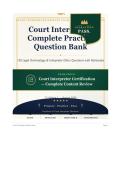
COURT INTERPRETER WRITTEN EXAM · LEGAL TERMINOLOGY
Court Interpreter
GUARANTEED
PASS.
Complete Practice
Question Bank
130 Legal Terminology & Interpreter Ethics Questions with Rationales
EXAM FOCUS:
Court Interpreter Certification
— Complete Content Review
Edition 1 · August 2026
Prepare · Practice · Pass
Excellence in Court Interpreter Education
EXAM DETAILED HIGH-YIELD CONFIDENCE
Court Interpreter Written Exam Page 1
,COURT INTERPRETER WRITTEN EXAM TABLE OF CONTENTS
Table of Contents
1. Instructions for Use 3
2. Court Terminology & Procedures (Q1-13) 3
3. Legal Vocabulary (Q14-54) 4
4. English Idioms & Expressions (Q55-78) 6
5. Legal Procedures & Concepts (Q79-120) 7
6. Interpreter Ethics & Courtroom Sequence (Q121-130) 9
Court Interpreter Written Exam Page 2
,COURT INTERPRETER WRITTEN EXAM INSTRUCTIONS & PRACTICE QUESTIONS
How to Use This Guide
Read each stem, choose your answer, then check the rationale directly below it. The correct
option is marked, and each wrong option is explained so you understand why it's wrong — not
just that it is. This guide contains 130 questions covering court interpreter written exam
content including legal terminology, court procedures, vocabulary, idioms, and interpreter
ethics.
Court Terminology & Procedures (Questions 1-13)
1 Before conveying an offer, a district attorney will first check a defendant's:
A Credit report
B Rap sheet
C Employment record
D Address history
Why B is correct: A district attorney will check a defendant's rap sheet (criminal record)
before conveying a plea offer.
A — Credit reports are not typically reviewed in this context.
C — Employment records are not the primary concern.
D — Address history is not the primary concern.
, 2 A person must report to a probation officer on a regular basis if he or she is on:
A Bail
B Formal probation
C Parole
D Pretrial release
Why B is correct: A person on formal probation must report to a probation officer on a
regular basis.
A — Bail is a security deposit for court appearance.
C — Parole is release after imprisonment, similar but distinct.
D — Pretrial release does not typically require probation officer reporting.
3 A repeat offender is also known as a:
A Recidivist
B Perpetrator
C Delinquent
D Fugitive
Why A is correct: A recidivist is a repeat offender.
B — Perpetrator is someone who commits a crime.
C — Delinquent is a young offender.
D — Fugitive is someone fleeing from law enforcement.
Court Interpreter
GUARANTEED
PASS.
Complete Practice
Question Bank
130 Legal Terminology & Interpreter Ethics Questions with Rationales
EXAM FOCUS:
Court Interpreter Certification
— Complete Content Review
Edition 1 · August 2026
Prepare · Practice · Pass
Excellence in Court Interpreter Education
EXAM DETAILED HIGH-YIELD CONFIDENCE
Court Interpreter Written Exam Page 1
,COURT INTERPRETER WRITTEN EXAM TABLE OF CONTENTS
Table of Contents
1. Instructions for Use 3
2. Court Terminology & Procedures (Q1-13) 3
3. Legal Vocabulary (Q14-54) 4
4. English Idioms & Expressions (Q55-78) 6
5. Legal Procedures & Concepts (Q79-120) 7
6. Interpreter Ethics & Courtroom Sequence (Q121-130) 9
Court Interpreter Written Exam Page 2
,COURT INTERPRETER WRITTEN EXAM INSTRUCTIONS & PRACTICE QUESTIONS
How to Use This Guide
Read each stem, choose your answer, then check the rationale directly below it. The correct
option is marked, and each wrong option is explained so you understand why it's wrong — not
just that it is. This guide contains 130 questions covering court interpreter written exam
content including legal terminology, court procedures, vocabulary, idioms, and interpreter
ethics.
Court Terminology & Procedures (Questions 1-13)
1 Before conveying an offer, a district attorney will first check a defendant's:
A Credit report
B Rap sheet
C Employment record
D Address history
Why B is correct: A district attorney will check a defendant's rap sheet (criminal record)
before conveying a plea offer.
A — Credit reports are not typically reviewed in this context.
C — Employment records are not the primary concern.
D — Address history is not the primary concern.
, 2 A person must report to a probation officer on a regular basis if he or she is on:
A Bail
B Formal probation
C Parole
D Pretrial release
Why B is correct: A person on formal probation must report to a probation officer on a
regular basis.
A — Bail is a security deposit for court appearance.
C — Parole is release after imprisonment, similar but distinct.
D — Pretrial release does not typically require probation officer reporting.
3 A repeat offender is also known as a:
A Recidivist
B Perpetrator
C Delinquent
D Fugitive
Why A is correct: A recidivist is a repeat offender.
B — Perpetrator is someone who commits a crime.
C — Delinquent is a young offender.
D — Fugitive is someone fleeing from law enforcement.


