Cultural variations in attachment
Studies of cultural variations
Key study- van Ijzendoorn
Procedures
- Investigating proportions of secure, insecure-avoidant, and insecure-
resistant attachments across a range of countries.
- 32 studies using the Strange Situation.
- All 32 studies were conducted in eight countries; 15 were in the USA.
- Yielded results from 1,990 children.
- Data was meta analysed, combined, and weighted for sample size.
Findings
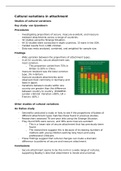
- Wide variation between the proportions of attachment types.
- In all 32 countries, secure attachment was
most common.
→ This proportion varied from 75% in
Britain to 50% in China.
- Insecure-resistant was the least common
type, 3% in Britain.
- Insecure-avoidant attachments were
observed most commonly in Germany and
least in Japan.
- Variations between results within one
country are greater than the difference
between country to country. (EXAMPLE-
London v Bristol. Variation =90%, UK v
France= 40%.)
-
Other studies of cultural variations
An Italian study
- Simonella conducted a study in Italy to see if the proportions of babies of
different attachment types matches those found in previous studies.
- Researchers assessed 76 one-year olds using the Strange Situation.
- They found 50% were secure, and 36% were insecure-avoidant.
→ This is a lower rate of secure attachment that has previously been
found.
→ The researchers suggest this is because of increasing numbers of
mothers with young children working long hours and using
professional childcare.
- These findings suggest that cultural changes can make a dramatic
difference to patterns of secure and insecure attachment.
Conclusions
- Secure attachment seems to be the norm in a wide range of cultures,
supporting Bowlby’s idea that attachment is innate and universal.
Studies of cultural variations
Key study- van Ijzendoorn
Procedures
- Investigating proportions of secure, insecure-avoidant, and insecure-
resistant attachments across a range of countries.
- 32 studies using the Strange Situation.
- All 32 studies were conducted in eight countries; 15 were in the USA.
- Yielded results from 1,990 children.
- Data was meta analysed, combined, and weighted for sample size.
Findings
- Wide variation between the proportions of attachment types.
- In all 32 countries, secure attachment was
most common.
→ This proportion varied from 75% in
Britain to 50% in China.
- Insecure-resistant was the least common
type, 3% in Britain.
- Insecure-avoidant attachments were
observed most commonly in Germany and
least in Japan.
- Variations between results within one
country are greater than the difference
between country to country. (EXAMPLE-
London v Bristol. Variation =90%, UK v
France= 40%.)
-
Other studies of cultural variations
An Italian study
- Simonella conducted a study in Italy to see if the proportions of babies of
different attachment types matches those found in previous studies.
- Researchers assessed 76 one-year olds using the Strange Situation.
- They found 50% were secure, and 36% were insecure-avoidant.
→ This is a lower rate of secure attachment that has previously been
found.
→ The researchers suggest this is because of increasing numbers of
mothers with young children working long hours and using
professional childcare.
- These findings suggest that cultural changes can make a dramatic
difference to patterns of secure and insecure attachment.
Conclusions
- Secure attachment seems to be the norm in a wide range of cultures,
supporting Bowlby’s idea that attachment is innate and universal.