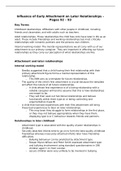
Influence of Early Attachment on Later Relationships –
Pages 92 – 93
Key Terms
Childhood relationships- Affiliations with other people in childhood, including
friends and classmates, and with adults such as teachers.
Adult relationships- Those relationships the child foes onto have later in life as an
adult. These include friendships and working relationships but most critically
relationships with romantic partners and the persons own children.
Internal working model- The mental representations we all carry with us of our
attachment to our primary caregiver. They are important in affecting our future
relationships as they carry our perception of what relationships are like.
Attachment and later relationships
Internal working model
- Bowlby suggested that a child having their first relationship with their
primary attachment figure forma a mental representation of this
relationship.
→ This IWM acts as a template for future relationships.
- The quality of the child’s first attachment is crucial because the template
will affect the nature of all future relationships.
→ A child whose first experience is of a loving relationship with a
reliable caregiver will tend to assume that this is how relationships
are meant to be.
→ They will then seek out functional relationships and behave
functionally within them type A) or being controlling and
argumentative (type B)
- A child that had bad experiences with their first attachment will bring
these bad experiences to bear on later relationships.
→ This may bean they struggle to form relationships in the first place,
or they may not behave appropriately when they have them,
displaying type A or C behaviour towards friends and partners.
Relationships in later childhood
- Attachment type is associated with the quality of peer relationships in
childhood.
- Securely attached infants tend to go on to form the best quality childhood
friendships whereas insecurely attached infants later have friendship
difficulties.
→ Bullying behaviour can be predicted by attachment type.
→ Rowan Myron-Wilson and Peter Smith assessed attachment type
and bullying involvement using standard questionnaires in 196
children aged 7-11 from London.
→ secure children were very unlikely to be involved in bullying.
Pages 92 – 93
Key Terms
Childhood relationships- Affiliations with other people in childhood, including
friends and classmates, and with adults such as teachers.
Adult relationships- Those relationships the child foes onto have later in life as an
adult. These include friendships and working relationships but most critically
relationships with romantic partners and the persons own children.
Internal working model- The mental representations we all carry with us of our
attachment to our primary caregiver. They are important in affecting our future
relationships as they carry our perception of what relationships are like.
Attachment and later relationships
Internal working model
- Bowlby suggested that a child having their first relationship with their
primary attachment figure forma a mental representation of this
relationship.
→ This IWM acts as a template for future relationships.
- The quality of the child’s first attachment is crucial because the template
will affect the nature of all future relationships.
→ A child whose first experience is of a loving relationship with a
reliable caregiver will tend to assume that this is how relationships
are meant to be.
→ They will then seek out functional relationships and behave
functionally within them type A) or being controlling and
argumentative (type B)
- A child that had bad experiences with their first attachment will bring
these bad experiences to bear on later relationships.
→ This may bean they struggle to form relationships in the first place,
or they may not behave appropriately when they have them,
displaying type A or C behaviour towards friends and partners.
Relationships in later childhood
- Attachment type is associated with the quality of peer relationships in
childhood.
- Securely attached infants tend to go on to form the best quality childhood
friendships whereas insecurely attached infants later have friendship
difficulties.
→ Bullying behaviour can be predicted by attachment type.
→ Rowan Myron-Wilson and Peter Smith assessed attachment type
and bullying involvement using standard questionnaires in 196
children aged 7-11 from London.
→ secure children were very unlikely to be involved in bullying.