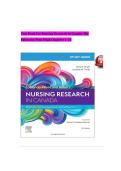
,Test Bank for Nursing Research in Canada: Methods, Critical Appraisal,
and Utilization, 5th Edition by Mina D. Singh, Lorraine Thirsk, Sarah
Stahlke, Ramesh Venkatesa Perumal, Geri LoBiondo-Wood & Judith
Haber | Chapters 1-21
Part I: Research Overview
Research Vignette: A Program of Research in Transcultural Nursing
1. The Role of Research in Nursing
2. Theoretical Framework
3. Critical Reading Strategies: Overview of the Research Process
4. Developing Research Questions, Hypotheses, and Clinical Questions
5. Finding and Appraising the Literature
6. Legal and Ethical Issues
Part II: Qualitative Research
Research Vignette: Creating Qualitatively Derived Knowledge for a Practice Discipline
7. Introduction to Qualitative Research
8. Qualitative Approaches to Research
Part III: Quantitative Research
Research Vignette: Tackling the Prevention of Falls Among Older Adults
9. Introduction to Quantitative Research
10. Experimental and Quasiexperimental Designs
11. Non-experimental Designs
Part IV: Processes Related to Research
Research Vignette: Partnering with Parents to Reduce Newborn Pain—Evidence and Implementation
12. Sampling
13. Data Collection Methods
14. Rigour in Research
15. Qualitative Data Analysis
, 16. Quantitative Data Analysis
17. Presenting the Findings
Part V: Critiquing Research
Research Vignette: A Program of Research
18. Critiquing Qualitative Research
19. Critiquing Quantitative Research
Part VI: Application of Research: Evidence-Informed Practice
Research Vignette: From My PhD to Her Post-Doctoral Studies: Building a Survivorship Cancer Care
Program
20. Developing an Evidence-Informed Practice
1. The primary purpose of nursing research is to:
A. Increase hospital profits
B. Develop evidence that improves nursing practice and patient
outcomes
C. Replace clinical judgment with standardized protocols
D. Eliminate the need for continuing education
Answer: B. Develop evidence that improves nursing practice and
patient outcomes
Rationale: Nursing research generates scientific evidence that guides
safe, effective, and patient-centered care. Rather than replacing
clinical judgment, research strengthens decision-making by providing
evidence to support nursing interventions.
, 2. Evidence-based practice (EBP) is best described as:
A. Using only published research findings
B. Following physician recommendations exclusively
C. Integrating the best available evidence, clinical expertise, and
patient preferences
D. Applying traditional nursing routines without modification
Answer: C. Integrating the best available evidence, clinical expertise,
and patient preferences
Rationale: Evidence-based practice combines current research
evidence, the clinician's expertise, and patient values to achieve
optimal health outcomes.
3. Which research paradigm primarily emphasizes measurable
variables and objective data?
A. Qualitative
B. Constructivist
C. Quantitative
D. Phenomenological
Answer: C. Quantitative
Rationale: Quantitative research uses numerical measurements,
structured methods, and statistical analyses to test hypotheses and
establish relationships between variables.
4. A qualitative researcher is most interested in:
A. Measuring blood pressure changes
and Utilization, 5th Edition by Mina D. Singh, Lorraine Thirsk, Sarah
Stahlke, Ramesh Venkatesa Perumal, Geri LoBiondo-Wood & Judith
Haber | Chapters 1-21
Part I: Research Overview
Research Vignette: A Program of Research in Transcultural Nursing
1. The Role of Research in Nursing
2. Theoretical Framework
3. Critical Reading Strategies: Overview of the Research Process
4. Developing Research Questions, Hypotheses, and Clinical Questions
5. Finding and Appraising the Literature
6. Legal and Ethical Issues
Part II: Qualitative Research
Research Vignette: Creating Qualitatively Derived Knowledge for a Practice Discipline
7. Introduction to Qualitative Research
8. Qualitative Approaches to Research
Part III: Quantitative Research
Research Vignette: Tackling the Prevention of Falls Among Older Adults
9. Introduction to Quantitative Research
10. Experimental and Quasiexperimental Designs
11. Non-experimental Designs
Part IV: Processes Related to Research
Research Vignette: Partnering with Parents to Reduce Newborn Pain—Evidence and Implementation
12. Sampling
13. Data Collection Methods
14. Rigour in Research
15. Qualitative Data Analysis
, 16. Quantitative Data Analysis
17. Presenting the Findings
Part V: Critiquing Research
Research Vignette: A Program of Research
18. Critiquing Qualitative Research
19. Critiquing Quantitative Research
Part VI: Application of Research: Evidence-Informed Practice
Research Vignette: From My PhD to Her Post-Doctoral Studies: Building a Survivorship Cancer Care
Program
20. Developing an Evidence-Informed Practice
1. The primary purpose of nursing research is to:
A. Increase hospital profits
B. Develop evidence that improves nursing practice and patient
outcomes
C. Replace clinical judgment with standardized protocols
D. Eliminate the need for continuing education
Answer: B. Develop evidence that improves nursing practice and
patient outcomes
Rationale: Nursing research generates scientific evidence that guides
safe, effective, and patient-centered care. Rather than replacing
clinical judgment, research strengthens decision-making by providing
evidence to support nursing interventions.
, 2. Evidence-based practice (EBP) is best described as:
A. Using only published research findings
B. Following physician recommendations exclusively
C. Integrating the best available evidence, clinical expertise, and
patient preferences
D. Applying traditional nursing routines without modification
Answer: C. Integrating the best available evidence, clinical expertise,
and patient preferences
Rationale: Evidence-based practice combines current research
evidence, the clinician's expertise, and patient values to achieve
optimal health outcomes.
3. Which research paradigm primarily emphasizes measurable
variables and objective data?
A. Qualitative
B. Constructivist
C. Quantitative
D. Phenomenological
Answer: C. Quantitative
Rationale: Quantitative research uses numerical measurements,
structured methods, and statistical analyses to test hypotheses and
establish relationships between variables.
4. A qualitative researcher is most interested in:
A. Measuring blood pressure changes