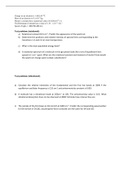
Charge on an electron is 1.602x10⁻¹⁹C
Mass of an electron is 9.1x10⁻³¹ kg
Planck’s constant has a numerical value of 6.626x10 -34 J s
The Boltzmann Constant has a value of 1.38 x 10 -23 J K-1
Speed of light c= 299,792,458 m/s
Test problems (rotational):
a) Rotational constant B=5 cm-1. Predict the appearance of the spectrum
b) Determine the positions and relative intensity of spectral lines corresponding to the
transitions 1-2 and 4-5 at room temperature.
c) What is the most populated energy level?
d) A rotational spectrum of a molecule in the gas phase looks like a set of equidistant lines
spaced at 1 cm-1 apart. What are the rotational constant and moment of inertia? How would
the spectrum change upon isotopic substitution?
Test problems (vibrational):
a) Calculate the relative intensities of the fundamental and the first hot bands at 300K if the
equilibrium oscillator frequency is 215 cm-1 and anharmonicity constant is 0.003
b) A molecule has a vibrational mode at 260cm-1 at 10K. The anharmonicity value is 0.01. What
vibrational absorption lines can be observed at 400K? Estimate how intense they are.
c) The sample of CH3OH shows an OH stretch at 3400 cm-1. Predict the corresponding wavenumber
for OD stretch in CH3OD, assuming the force constants are the same for OH and OD.
Mass of an electron is 9.1x10⁻³¹ kg
Planck’s constant has a numerical value of 6.626x10 -34 J s
The Boltzmann Constant has a value of 1.38 x 10 -23 J K-1
Speed of light c= 299,792,458 m/s
Test problems (rotational):
a) Rotational constant B=5 cm-1. Predict the appearance of the spectrum
b) Determine the positions and relative intensity of spectral lines corresponding to the
transitions 1-2 and 4-5 at room temperature.
c) What is the most populated energy level?
d) A rotational spectrum of a molecule in the gas phase looks like a set of equidistant lines
spaced at 1 cm-1 apart. What are the rotational constant and moment of inertia? How would
the spectrum change upon isotopic substitution?
Test problems (vibrational):
a) Calculate the relative intensities of the fundamental and the first hot bands at 300K if the
equilibrium oscillator frequency is 215 cm-1 and anharmonicity constant is 0.003
b) A molecule has a vibrational mode at 260cm-1 at 10K. The anharmonicity value is 0.01. What
vibrational absorption lines can be observed at 400K? Estimate how intense they are.
c) The sample of CH3OH shows an OH stretch at 3400 cm-1. Predict the corresponding wavenumber
for OD stretch in CH3OD, assuming the force constants are the same for OH and OD.