

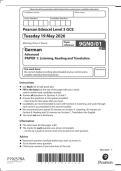
Please check the examination details below before entering your candidate information
Candidate surname Other names
Centre Number Candidate Number
Pearson Edexcel Level 3 GCE
Tuesday 19 May 2026
Morning (Time: 2 hours) Paper
reference 9GN0/01
German
Advanced
PAPER 1: Listening, Reading and Translation
You must have: Total Marks
the correct digital recording (downloaded at your centre) and a
suitable individual listening device
Instructions
•• Use black ink or ball-point pen.
Fill in the boxes at the top of this page with your name,
centre number and candidate number.
•• Answer all questions in Sections A, B and C.
Answer the questions in the spaces provided
– there may be more space than you need.
• Candidates are recommended to start with Section A: Listening, and work through
each section as presented in the answer booklet.
• We recommend you spend 50 minutes on Section A: Listening, 50 minutes on
Section B: Reading and 20 minutes on Section C: Translation into English.
• You must not use a dictionary.
Information
•• The total mark for this paper is 80.
The marks for each question are shown in brackets
– use this as a guide as to how much time to spend on each question.
Advice
•• Read each question carefully before you start to answer it.
Try to answer every question.
• Check your answers if you have time at the end. Turn over
P79257RA
©2026 Pearson Education Ltd.
P:1/1/1/1/1
*P79257RA0120*
, Answer ALL questions. Write your answers in the spaces provided.
Some questions must be answered with a cross in a box . If you change your mind about an
DO NOT WRITE IN THIS AREA DO NOT WRITE IN THIS AREA DO NOT WRITE IN THIS AREA
answer, put a line through the box and then mark your new answer with a cross .
SECTION A
Listening
We recommend you spend no more than 50 minutes on this section.
Questions 2, 3 and 4(a) do not require full sentences and you may respond using
single words or phrases.
Summary Question 4(b) does not require full sentences and you may respond using
short phrases.
You may use words from the listening passages but you must not transcribe whole
sections.
You are going to listen to 5 passages. The duration of each passage is
approximately:
Passage 1 = 1 minute 26 seconds
Passage 2 = 1 minute 27 seconds
Passage 3 = 2 minutes 42 seconds
Passage 4a = 1 minute 50 seconds
Passage 4b = 2 minutes 02 seconds
You will be in charge of the recording and you may listen to each passage as often
as you wish, and write your answers whenever you wish to do so.
2
*P79257RA0220*
, Hörtext 1– Das deutsche Jugendorchester
1 Sie hören diesen Bericht über das deutsche Jugendorchester. Kreuzen Sie die
DO NOT WRITE IN THIS AREA DO NOT WRITE IN THIS AREA DO NOT WRITE IN THIS AREA
jeweils richtige Antwort an.
(i) Um beim Bundesjugendorchester Mitglied zu werden, muss man …
A zwischen 13 und 19 Jahren alt sein.
B internationales Reisen lieben.
C an einem Probespiel teilnehmen.
D aus einem der deutschsprachigen Länder sein.
(ii) Das Orchester geht … auf Konzertreise.
A nur im Sommer
B vor Weihnachten
C in den Herbstferien
D dreimal im Jahr
(iii) Die Jugendlichen genießen vor allem …
A das Musizieren.
B eine gemeinsame Leidenschaft.
C das Gefühl eine Gruppe zu sein.
D neue Erfahrungen.
(iv) … gründete das Projekt „Bundesjugendorchester“.
A Der Deutsche Musikrat
B Mercedes
C Das Goethe-Institut
D Ein Instrumentenhersteller
(Total for Question 1 = 4 marks)
3
*P79257RA0320* Turn over
Candidate surname Other names
Centre Number Candidate Number
Pearson Edexcel Level 3 GCE
Tuesday 19 May 2026
Morning (Time: 2 hours) Paper
reference 9GN0/01
German
Advanced
PAPER 1: Listening, Reading and Translation
You must have: Total Marks
the correct digital recording (downloaded at your centre) and a
suitable individual listening device
Instructions
•• Use black ink or ball-point pen.
Fill in the boxes at the top of this page with your name,
centre number and candidate number.
•• Answer all questions in Sections A, B and C.
Answer the questions in the spaces provided
– there may be more space than you need.
• Candidates are recommended to start with Section A: Listening, and work through
each section as presented in the answer booklet.
• We recommend you spend 50 minutes on Section A: Listening, 50 minutes on
Section B: Reading and 20 minutes on Section C: Translation into English.
• You must not use a dictionary.
Information
•• The total mark for this paper is 80.
The marks for each question are shown in brackets
– use this as a guide as to how much time to spend on each question.
Advice
•• Read each question carefully before you start to answer it.
Try to answer every question.
• Check your answers if you have time at the end. Turn over
P79257RA
©2026 Pearson Education Ltd.
P:1/1/1/1/1
*P79257RA0120*
, Answer ALL questions. Write your answers in the spaces provided.
Some questions must be answered with a cross in a box . If you change your mind about an
DO NOT WRITE IN THIS AREA DO NOT WRITE IN THIS AREA DO NOT WRITE IN THIS AREA
answer, put a line through the box and then mark your new answer with a cross .
SECTION A
Listening
We recommend you spend no more than 50 minutes on this section.
Questions 2, 3 and 4(a) do not require full sentences and you may respond using
single words or phrases.
Summary Question 4(b) does not require full sentences and you may respond using
short phrases.
You may use words from the listening passages but you must not transcribe whole
sections.
You are going to listen to 5 passages. The duration of each passage is
approximately:
Passage 1 = 1 minute 26 seconds
Passage 2 = 1 minute 27 seconds
Passage 3 = 2 minutes 42 seconds
Passage 4a = 1 minute 50 seconds
Passage 4b = 2 minutes 02 seconds
You will be in charge of the recording and you may listen to each passage as often
as you wish, and write your answers whenever you wish to do so.
2
*P79257RA0220*
, Hörtext 1– Das deutsche Jugendorchester
1 Sie hören diesen Bericht über das deutsche Jugendorchester. Kreuzen Sie die
DO NOT WRITE IN THIS AREA DO NOT WRITE IN THIS AREA DO NOT WRITE IN THIS AREA
jeweils richtige Antwort an.
(i) Um beim Bundesjugendorchester Mitglied zu werden, muss man …
A zwischen 13 und 19 Jahren alt sein.
B internationales Reisen lieben.
C an einem Probespiel teilnehmen.
D aus einem der deutschsprachigen Länder sein.
(ii) Das Orchester geht … auf Konzertreise.
A nur im Sommer
B vor Weihnachten
C in den Herbstferien
D dreimal im Jahr
(iii) Die Jugendlichen genießen vor allem …
A das Musizieren.
B eine gemeinsame Leidenschaft.
C das Gefühl eine Gruppe zu sein.
D neue Erfahrungen.
(iv) … gründete das Projekt „Bundesjugendorchester“.
A Der Deutsche Musikrat
B Mercedes
C Das Goethe-Institut
D Ein Instrumentenhersteller
(Total for Question 1 = 4 marks)
3
*P79257RA0320* Turn over


