

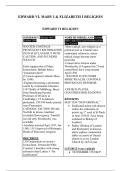
EDWARD VI, MARY I & ELIZABETH I RELIGION
EDWARD VI RELIGION
SOMERSET February 1547 – NORTHUMBERLAND October
October 1549 1549 – July 1553 “Lord President of the
Privy Council”
WANTED CONTINUE -More radical, saw religion as a
PROTESTANT REFORMATION political tool as Cranmer and
INTO SCOTLAND BUT WITH continental reformers, senior
CAUTION, AND PLUNDER radical clergy become more
WEALTH powerful
-Conservative faction under
Early suppression of Mass, Wriothesley (14 against his 7 loyal
Iconoclasm, Ballads held a councillors) led a coup around
“protestant dawn” April 1550
(31 tracts against Catholic Mass - WANTED TO PLUNDER
by 1548) MORE WEALTH, CONTINUE
-England becoming a protestant PROTESTANT REFORMS
centre by continental reformers
1547 Battle of Mühlberg, Bucer -CHURCH PLATES,
from Strasbourg become CHANTRIES BOILED DOWN
Professor of Divinity at
Cambridge (1/5 Londoners REFORMS
protestant, 159/394 books printed MAY 1550 “NEW ORDINAL”
were Protestant) • Eradicated minor sub-deacon
CATHOLIC FACTION WEAK- orders for ordination of
Norfolk in prison, Gardiner priests eg 1st used at St Pauls
excluded from regency, Tunstall in June 1550 (J. Foxe being
too old only Wriothesley was ordained as Bishop of
available London)
-Gardiner arrested Sept 1547, Jan • Ridley (Bishop of London
1548, 1551 deprived of Bishopric, and Rochester) in diocese,
Heath of Worcester resigned alters replace communion
tables in centre of church
DOCTRINE almost in every London
1538 Injunctions re-issued + Church by end of year
Iconoclasm, Vernacular bible,
Cranmer’s homilies with strong LITURGY (very radical)
reformist slant Luther’s “On • NOVEMBER 1552 BCP
Justification”
, NOV 1547- Removed 6 Articles, • “Matin” “Evesong” replaced
Kings Book and Act for with Morning and Evening
Advancement of True religion, song
Released an Act on giving • BLACK RUBRIC to
communion of both kind remove implication of
FEB 1549- Act allowing Clerical adoration at communion
Marriage • Alters replaced with
(20% remarried) communion tables
JUNE 1549- Prayer Book + Act • Priests’ vestments become
of Uniformity plain white surplice
“Lutheran “Priesthood of • Transubstantiation excluded
believers” BUT Vestments still 42 ARTICLES JUNE 1553
worn, candles used, railed alters • Allowed clerical marriage
for priests with a decisive protestant
CHANTRIES- interpretation of faith, 1/3
£160,000 cash yield, 20% of married (not all protestant)
money from the dissolution • NOT PASSED BECAUSE
2374 chantries, 90 colleges, 110 EDWARD VI DIED
hospitals dissolved in 1547
SCOTLAND (failed attempt at
-1551 Hooper (Bishop of
a Scottish reformation)
Gloucester) found 168/311 clergy
• Garrisons and Forts to couldn’t repeat the 10
fledge a “second commandments showing the need
reformation” for education
• July 1547- Pro English
protestant Scottish faction
fell to the French
• April 1548- Mary taken to
marry Catholic Dauphin
SOMERSET’S RELIGIOUS POLICIES SIGNIFICANCE
His policies began England’s decisive shift towards Protestantism after Henry
VIII’s turbulent religious policies by making a clear break from conservative
Catholic traditions in allowing priests to marry. The introduction of the book of
homilies and injunctions introduced these protestant policies to the ordinary
people as a means of establishing protestant worship yet in the long term helped
lay the identity for future protestant extremism and inspired rebellions in the
West Country showing religious opposition. Yet the emphasis of his policies
was less on religion and more foreign policy focused.
, NORTHUMBERLANDS RELIGIOUS POLICIES SIGNIFICANCE
These policies were seen as much more radical as a way of securing his own
political power amongst the Catholic faction at court. He completed England’s
move towards Protestantism with the 1552 Common Prayer book and 42
articles influencing long term protestant theology and changing physical
worship, but Mary’s future reversal highlights the weakness of his policies.
EDWARD VI RELIGION
SOMERSET February 1547 – NORTHUMBERLAND October
October 1549 1549 – July 1553 “Lord President of the
Privy Council”
WANTED CONTINUE -More radical, saw religion as a
PROTESTANT REFORMATION political tool as Cranmer and
INTO SCOTLAND BUT WITH continental reformers, senior
CAUTION, AND PLUNDER radical clergy become more
WEALTH powerful
-Conservative faction under
Early suppression of Mass, Wriothesley (14 against his 7 loyal
Iconoclasm, Ballads held a councillors) led a coup around
“protestant dawn” April 1550
(31 tracts against Catholic Mass - WANTED TO PLUNDER
by 1548) MORE WEALTH, CONTINUE
-England becoming a protestant PROTESTANT REFORMS
centre by continental reformers
1547 Battle of Mühlberg, Bucer -CHURCH PLATES,
from Strasbourg become CHANTRIES BOILED DOWN
Professor of Divinity at
Cambridge (1/5 Londoners REFORMS
protestant, 159/394 books printed MAY 1550 “NEW ORDINAL”
were Protestant) • Eradicated minor sub-deacon
CATHOLIC FACTION WEAK- orders for ordination of
Norfolk in prison, Gardiner priests eg 1st used at St Pauls
excluded from regency, Tunstall in June 1550 (J. Foxe being
too old only Wriothesley was ordained as Bishop of
available London)
-Gardiner arrested Sept 1547, Jan • Ridley (Bishop of London
1548, 1551 deprived of Bishopric, and Rochester) in diocese,
Heath of Worcester resigned alters replace communion
tables in centre of church
DOCTRINE almost in every London
1538 Injunctions re-issued + Church by end of year
Iconoclasm, Vernacular bible,
Cranmer’s homilies with strong LITURGY (very radical)
reformist slant Luther’s “On • NOVEMBER 1552 BCP
Justification”
, NOV 1547- Removed 6 Articles, • “Matin” “Evesong” replaced
Kings Book and Act for with Morning and Evening
Advancement of True religion, song
Released an Act on giving • BLACK RUBRIC to
communion of both kind remove implication of
FEB 1549- Act allowing Clerical adoration at communion
Marriage • Alters replaced with
(20% remarried) communion tables
JUNE 1549- Prayer Book + Act • Priests’ vestments become
of Uniformity plain white surplice
“Lutheran “Priesthood of • Transubstantiation excluded
believers” BUT Vestments still 42 ARTICLES JUNE 1553
worn, candles used, railed alters • Allowed clerical marriage
for priests with a decisive protestant
CHANTRIES- interpretation of faith, 1/3
£160,000 cash yield, 20% of married (not all protestant)
money from the dissolution • NOT PASSED BECAUSE
2374 chantries, 90 colleges, 110 EDWARD VI DIED
hospitals dissolved in 1547
SCOTLAND (failed attempt at
-1551 Hooper (Bishop of
a Scottish reformation)
Gloucester) found 168/311 clergy
• Garrisons and Forts to couldn’t repeat the 10
fledge a “second commandments showing the need
reformation” for education
• July 1547- Pro English
protestant Scottish faction
fell to the French
• April 1548- Mary taken to
marry Catholic Dauphin
SOMERSET’S RELIGIOUS POLICIES SIGNIFICANCE
His policies began England’s decisive shift towards Protestantism after Henry
VIII’s turbulent religious policies by making a clear break from conservative
Catholic traditions in allowing priests to marry. The introduction of the book of
homilies and injunctions introduced these protestant policies to the ordinary
people as a means of establishing protestant worship yet in the long term helped
lay the identity for future protestant extremism and inspired rebellions in the
West Country showing religious opposition. Yet the emphasis of his policies
was less on religion and more foreign policy focused.
, NORTHUMBERLANDS RELIGIOUS POLICIES SIGNIFICANCE
These policies were seen as much more radical as a way of securing his own
political power amongst the Catholic faction at court. He completed England’s
move towards Protestantism with the 1552 Common Prayer book and 42
articles influencing long term protestant theology and changing physical
worship, but Mary’s future reversal highlights the weakness of his policies.


