

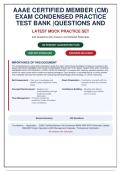
AAAE CERTIFIED MEMBER (CM)
EXAM CONDENSED PRACTICE
TEST BANK |QUESTIONS AND
LATEST MOCK PRACTICE SET
240 Questions with Answers and Detailed Rationales
100 PERCENT GUARANTEED PASS
INSTANT DOWNLOAD ANSWERS INCLUDED
IMPORTANCE OF THIS DOCUMENT
This comprehensive examination preparation guide has been meticulously developed to help you succeed in the
AAAE CERTIFIED MEMBER (CM) EXAM CONDENSED PRACTICE TEST BANK |QUESTIONS AND VERIFIED
ANSWERS WITH RATIONALES | LATEST UPDATE 2026/2027. It contains 240 carefully selected questions that
reflect the most current exam content and testing strategies. Each question is accompanied by a correct answer
and a detailed rationale that explains the underlying pathophysiology, pharmacology, or clinical reasoning.
Self-Assessment – Test your knowledge and Exam Preparation – Familiarize yourself with the
identify areas requiring further question format and content
study areas
Concept Reinforcement – Deepen your Confidence Building – Develop test-taking
understanding through strategies and reduce
evidence-based exam anxiety
rationales
Time Management – Practice answering
questions under simulated
exam conditions
Review Summary 240 Questions
Foundations - Application - AAAE Certified Member CM Condensed BANK AND WITH Rationales Update
2026/2027 Airport Operations AND Management Graduate / Professional Certification
All answers with rationales
,Table of Contents
Section A - AAAE Certification Section B - Ethical AND Professional
Overview AND Structure Standards FOR Association Executives
Questions 1 to 60 Questions 61 to 120
Section C - Strategic Planning AND Section D - Financial Management
Organizational Governance AND Budgeting FOR Associations
Questions 121 to 180 Questions 181 to 240
,Section A - AAAE Certification Overview AND Structure
Q1.
An airport authority is evaluating a new airline service agreement. The airline requests a
preferential-use lease for three gates with a fixed annual fee plus a variable fee per
enplaned passenger. Under standard industry practice, which clause is most critical to
include to ensure the airport can recover costs if the airline defaults?
A. Most-favored-nation clause B. Cross-default clause
C. Subordination and nondisturbance clause D. Rate-making clause
Correct: B - Cross-default clause
Rationale:A cross-default clause ensures that if the airline defaults on one obligation (e.g.,
rent), all other agreements with the airport are also in default, allowing the airport to terminate
leases and recover facilities. Most-favored-nation clauses relate to equal pricing among
airlines. Subordination clauses are for financing. Rate-making clauses define fee computation
but do not address default cross-remedies.
Q2.
During a Part 139 inspection, an airport fails to mark a temporary construction area on the
movement area. Which FAA Advisory Circular provides the most current guidance for
marking and lighting such hazards?
A. AC 150/5345-53 B. AC 150/5370-2
C. AC 150/5210-5 D. AC 150/5300-13
Correct: B - AC 150/5370-2
Rationale:AC 150/5370-2 (Operational Safety on Airports During Construction) provides
standards for marking, lighting, and safety during construction. AC 150/5345-53 covers airport
lighting equipment. AC 150/5210-5 covers rescue and firefighting. AC 150/5300-13 covers
airport design. The construction safety AC is the primary reference for temporary hazards.
Q3.
An airport is conducting a noise compatibility study under 14 CFR Part 150. The study
identifies a residential area with a DNL of 68 dB. What is the maximum level of federal
funding available for sound insulation of homes in this area?
A. 80% of eligible costs, up to $150,000 per B. 100% of eligible costs, no per-home cap
home
Page 3
, Section A - AAAE Certification Overview AND Structure
C. 50% of eligible costs, up to $75,000 per D. 100% of eligible costs, up to $100,000
home per home
Correct: A - 80% of eligible costs, up to $150,000 per home
Rationale:Under FAA Order 5100.38 and AIP guidelines, sound insulation for homes in areas
with DNL 65 dB or higher is eligible for 80% federal share, with a maximum of $150,000 per
dwelling unit. The area must be within the DNL 65 dB contour. 100% funding is not typical for
residential insulation; other noise mitigation measures may have different caps.
Q4.
An airport operator notices that a taxiway centerline light is out. The airfield lighting
system uses a series circuit with a constant current regulator (CCR). Which
troubleshooting step should be taken first to identify the fault?
A. Measure voltage at the CCR output B. Check the isolation transformer for the
failed light
C. Inspect the failed light fixture for bulb D. Verify the CCR is set to the correct
damage brightness step
Correct: B - Check the isolation transformer for the failed light
Rationale:In series circuits, a single failed light often indicates an open circuit at that fixture's
isolation transformer. Checking the isolation transformer is the most direct step. Measuring
CCR output or brightness steps would show if the entire circuit is affected, but a single light
out suggests a local fault. Inspecting the bulb is secondary to verifying the transformer.
Q5.
Under TSA's Security Directives, an airport must conduct a vulnerability assessment for
its sterile area. Which of the following is considered a 'criticality' factor in the risk
assessment methodology?
A. The likelihood of a threat actor exploiting B. The potential impact on airport operations
a vulnerability if a security breach occurs
C. The number of security incidents reported D. The cost of implementing a security
in the past year countermeasure
Correct: B - The potential impact on airport operations if a security breach occurs
Rationale:In risk assessment, criticality refers to the potential consequences or impact of an
event, such as loss of life, economic damage, or operational disruption. Likelihood is a
separate factor (threat x vulnerability). Number of incidents is historical data, not a criticality
measure. Cost of countermeasure is part of cost-benefit analysis, not criticality.
Page 4
EXAM CONDENSED PRACTICE
TEST BANK |QUESTIONS AND
LATEST MOCK PRACTICE SET
240 Questions with Answers and Detailed Rationales
100 PERCENT GUARANTEED PASS
INSTANT DOWNLOAD ANSWERS INCLUDED
IMPORTANCE OF THIS DOCUMENT
This comprehensive examination preparation guide has been meticulously developed to help you succeed in the
AAAE CERTIFIED MEMBER (CM) EXAM CONDENSED PRACTICE TEST BANK |QUESTIONS AND VERIFIED
ANSWERS WITH RATIONALES | LATEST UPDATE 2026/2027. It contains 240 carefully selected questions that
reflect the most current exam content and testing strategies. Each question is accompanied by a correct answer
and a detailed rationale that explains the underlying pathophysiology, pharmacology, or clinical reasoning.
Self-Assessment – Test your knowledge and Exam Preparation – Familiarize yourself with the
identify areas requiring further question format and content
study areas
Concept Reinforcement – Deepen your Confidence Building – Develop test-taking
understanding through strategies and reduce
evidence-based exam anxiety
rationales
Time Management – Practice answering
questions under simulated
exam conditions
Review Summary 240 Questions
Foundations - Application - AAAE Certified Member CM Condensed BANK AND WITH Rationales Update
2026/2027 Airport Operations AND Management Graduate / Professional Certification
All answers with rationales
,Table of Contents
Section A - AAAE Certification Section B - Ethical AND Professional
Overview AND Structure Standards FOR Association Executives
Questions 1 to 60 Questions 61 to 120
Section C - Strategic Planning AND Section D - Financial Management
Organizational Governance AND Budgeting FOR Associations
Questions 121 to 180 Questions 181 to 240
,Section A - AAAE Certification Overview AND Structure
Q1.
An airport authority is evaluating a new airline service agreement. The airline requests a
preferential-use lease for three gates with a fixed annual fee plus a variable fee per
enplaned passenger. Under standard industry practice, which clause is most critical to
include to ensure the airport can recover costs if the airline defaults?
A. Most-favored-nation clause B. Cross-default clause
C. Subordination and nondisturbance clause D. Rate-making clause
Correct: B - Cross-default clause
Rationale:A cross-default clause ensures that if the airline defaults on one obligation (e.g.,
rent), all other agreements with the airport are also in default, allowing the airport to terminate
leases and recover facilities. Most-favored-nation clauses relate to equal pricing among
airlines. Subordination clauses are for financing. Rate-making clauses define fee computation
but do not address default cross-remedies.
Q2.
During a Part 139 inspection, an airport fails to mark a temporary construction area on the
movement area. Which FAA Advisory Circular provides the most current guidance for
marking and lighting such hazards?
A. AC 150/5345-53 B. AC 150/5370-2
C. AC 150/5210-5 D. AC 150/5300-13
Correct: B - AC 150/5370-2
Rationale:AC 150/5370-2 (Operational Safety on Airports During Construction) provides
standards for marking, lighting, and safety during construction. AC 150/5345-53 covers airport
lighting equipment. AC 150/5210-5 covers rescue and firefighting. AC 150/5300-13 covers
airport design. The construction safety AC is the primary reference for temporary hazards.
Q3.
An airport is conducting a noise compatibility study under 14 CFR Part 150. The study
identifies a residential area with a DNL of 68 dB. What is the maximum level of federal
funding available for sound insulation of homes in this area?
A. 80% of eligible costs, up to $150,000 per B. 100% of eligible costs, no per-home cap
home
Page 3
, Section A - AAAE Certification Overview AND Structure
C. 50% of eligible costs, up to $75,000 per D. 100% of eligible costs, up to $100,000
home per home
Correct: A - 80% of eligible costs, up to $150,000 per home
Rationale:Under FAA Order 5100.38 and AIP guidelines, sound insulation for homes in areas
with DNL 65 dB or higher is eligible for 80% federal share, with a maximum of $150,000 per
dwelling unit. The area must be within the DNL 65 dB contour. 100% funding is not typical for
residential insulation; other noise mitigation measures may have different caps.
Q4.
An airport operator notices that a taxiway centerline light is out. The airfield lighting
system uses a series circuit with a constant current regulator (CCR). Which
troubleshooting step should be taken first to identify the fault?
A. Measure voltage at the CCR output B. Check the isolation transformer for the
failed light
C. Inspect the failed light fixture for bulb D. Verify the CCR is set to the correct
damage brightness step
Correct: B - Check the isolation transformer for the failed light
Rationale:In series circuits, a single failed light often indicates an open circuit at that fixture's
isolation transformer. Checking the isolation transformer is the most direct step. Measuring
CCR output or brightness steps would show if the entire circuit is affected, but a single light
out suggests a local fault. Inspecting the bulb is secondary to verifying the transformer.
Q5.
Under TSA's Security Directives, an airport must conduct a vulnerability assessment for
its sterile area. Which of the following is considered a 'criticality' factor in the risk
assessment methodology?
A. The likelihood of a threat actor exploiting B. The potential impact on airport operations
a vulnerability if a security breach occurs
C. The number of security incidents reported D. The cost of implementing a security
in the past year countermeasure
Correct: B - The potential impact on airport operations if a security breach occurs
Rationale:In risk assessment, criticality refers to the potential consequences or impact of an
event, such as loss of life, economic damage, or operational disruption. Likelihood is a
separate factor (threat x vulnerability). Number of incidents is historical data, not a criticality
measure. Cost of countermeasure is part of cost-benefit analysis, not criticality.
Page 4


